
 E-Paper



Sutradhara’s Tales: Peshwa’s Ramna Dakshina births a legacy of scholarship in Pune
Today, the Ramna pavilion and Ramanbaug are erased from Pune’s map, but Deccan College continues to herald the Peshwa legacy of Shravan Dakshina - a medieval underpinning of the education capital that is Pune

 Prefer HTon Google


Last week, on October 6, 2021, the Deccan College and Postgraduate research Institute concluded its celebrations of it bicentennial year with great fanfare. This third oldest college in India was established on October 6, 1821 as Hindoo College, part of an initiative undertaken by the Bombay Presidency Governor, Mt Stuart Elphistone.
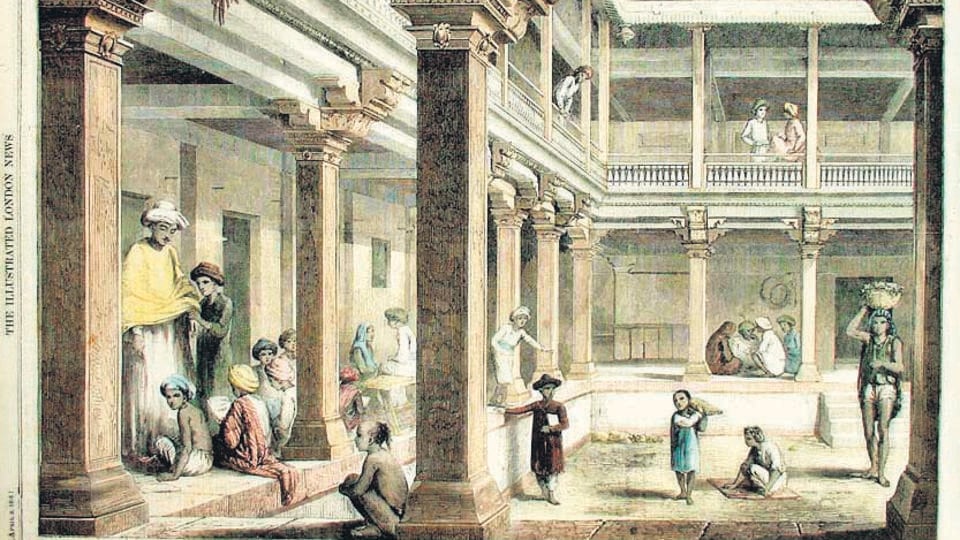
But, did you know that this establishment has a connection to a much older tradition of “Shravan Dakshina”, known from the Peshwa period?
It is difficult to determine the exact date when the tradition of granting “Dakshina” during Shravan month to learned Brahmins folks began. Some scholars attribute it to Shivaji Maharaj, but safer attribution would be to Sambhaji Maharaj or the Rajaram Chhatrapati period. Shravan month is considered to be most auspicious amongst the four-month “chaturmas” period observed by Hindus during the monsoons. Shahu Chhatrapati-I would commission abhishekh rituals at Shiva temple at Kashi-Banaras and distributed gifts worth ₹2lakh to ₹4lakh every year.
Back then, Shravan was also the period when soldiers and battalions retreated to home lands during the rainy season. The residential camp of various military commanders including the Peshwas, would be in Pune. It was a season of meeting families and relatives and also meant the celebration of various rituals and festivities.
The month of Shravan, thus, proved to be the perfect time to carry out personal religious charity deeds. The learned and noble Brahmins, Shastri, Pandits and Veda scholars would earn their livelihoods by knowledge dissemination, teaching and priesthood. This was apparently not enough for their sustenance. Thus, Dakshina during Shravan month served as yearly scholarships for the knowledge fraternity.
As per records, it was sardar Khanderao Dabhade who started the tradition of donating religious gifts to Brahmins during Shravan in Pune in 1718, inspired by the Bhosale kings. It continued till the death of Trimbakrao Dabhade in the battle of Dabhoi in 1730. After his death, Chhatrapati Shahu Maharaj requested the Peshwas to continue the tradition of Dakshina and accordingly, Bajirao I commenced it at Shaniwarwada from 1732 onwards.
In the initial years, 3,000-odd Brahmins benefitted from the Dakshina. The ceremony of Dakshina donation used to take place either at Kabutarkhana near Omkareshwar temple or at Hujurpaga, the horse stables near the present day Laxmi road.
Re1 to Rs12 was distributed on an average, amounting to a total of anything between Rs16,000 and Rs50,000.
Behind Shaniwarwada in Shaniwar peth, a leisure garden was created for personal entertainment. The ceremony of Dakshina donation, in the initial years, conducted at the spot of the Ramna garden gave it the name “Raman” baug. Even today, the school constructed at the same spot in later years, is known as New English School, Ramanbaug. Ramna is an enclosed open space or a leisure garden for entertainment, a place for distributing religious gifts.
As Nanasaheb Peshwa’s tenure started in 1940, the revenue generation and personal property of the Peshwas grew manifold which brought eminent prosperity. Various developmental works undertaken by diplomatic strategist Nanasaheb also bore fruit, thus, increasing the urban cosmopolitan population of the medieval city.
The total donation amount during his reign increased from a mere Rs30,000 to Rs18 lakh. Every year, the crowds of Brahmins congregating in Pune would increase.
This led to the formation of a systematic organisation which would filter and segregate the Brahmins according to their genuine needs and the merit scholarship.
In order to accommodate growing numbers, Nanasaheb Peshwa chose an open space on the foothills of Parvati hill to build a fortified walled open space called the new “Ramna” in 1751-52.
The dimensions of this huge pavilion were 200 feet by 200 feet and it had four gateways in four directions. It was equipped with a full-fledged kitchen, water tanks, storage spaces and ritual spaces for sacrificial yajna, sandhya, and pooja. It could accommodate 50,000 to 60,000 Brahmins on a particular occasion. The Ganesha at the base of Parvati came to be known as Ramna Ganpati.
The Brahmins were placed in the walled pavilion and on their way out were personally granted religious gifts by Peshwas and other eminent officers. Due to the massive numbers, sometimes it would take two whole days for a Brahmin to get out of the Ramna walls. Meanwhile, every donation seeker would be provided with food provisions and an allowance to cook their own food.
Rains during month of Shravan necessitated residential arrangements for visiting Brahmins. Thus, residential arrangements were made for 40,000 Brahmins by building dharamshala or sarai. Temporary arrangements in the form of tents were made for additional crowds. Kabutarkhana or the old Ramna near Ramanbaug was utilised to distribute Dakshina to the non-Brahmins, particularly, beggars and mendicants. In some years, the records show numbers reaching 80,000 people!
As a popular bard (shahir) describes the Dakshina ceremony, there is no count of the number of Brahmins who received charitable gifts in Pune during Shravan. Brahmins from far flung places such as Bundelkhand, Malwa, Kashi, Karnataka, Telangana, Gujarat and Konkan would participate in the Dakshina ceremony. He also quips, how Brahmins from south Konkan demand more money and in spite of getting generous grants complain and bicker about amounts received from the Peshwas.
The Hyderabad Nizam’s attack on Pune region in 1763 caused substantial damage to various establishments including the Ramna which was totally destroyed by troops. The Dakshina was then briefly discontinued, but later was reinstated in Madhavrao Peshwa’s period. The loss of revenue in the Panipat battle was swiftly recovered by pious Madhavrao and within few years, the Ramna ceremony was performed as per its former glory.
Yet another Sanskrit verse describes only two places that are known to turn muddy due to excess discharge of water in the absence of the monsoon; one is at chief justice Ramshashtri Prabhune’s front yard, where people failing the examination for Dakshina eligibility would cry desolately; and the other when Madhavrao pours udak or water during the charity gifting at Ramna.
The Ramna further continued during Sawai Madhavrao’s and Bajirao II’s period. It was required for every Brahmin to pass an examination to be eligible for the Dakshina. Bajirao II‘s period records show that learned women, too, received Dakshina. Dakshina for deserving old and helpless Brahmins was sent to their homes during the month of Shravan. A force of 1,500 soldiers was kept on guard to manage the Brahmin crowds. The descriptions of “satvik” feast distributed during his time include various sweetmeats, dry fruits, sukeli (dried bananas), fanaspoli (dried jackfruit), yogurt, buttermilk and poha.
This pious act conducted for 100 years by subsequent Peshwas was instrumental in spreading tales of generosity and religious character of the Maratha state under the Peshwas. After the end of Maratha rule in 1818, the British government started the Poona Sanskrit School at Vishrambaug wada, as per the orders of Mr Chaplin.
1836 onwards, it was supervised by Major Candy who brought in modern education reforms and named it Hindoo College, currently known as Deccan College and postgraduate research institute.
Today, the Ramna pavilion and Ramanbaug are erased from Pune’s map, but Deccan College continues to herald the Peshwa legacy of Shravan Dakshina - a medieval underpinning of the education capital that is Pune.


