
 E-Paper



Taste of Life: The person behind first dietary reforms for Indian prisons
The first dietary reforms for Indian prisons came to be implemented in the Bombay Presidency in 1862

 Prefer HTon Google


On May 12, 1940, VD Kulkarni, who was sentenced to two-year imprisonment in the Yerawada Jail for not obeying the police during an anti-raid precaution drill, decided to fast onto death, as authorities had been ignoring his demands. Marathi newspapers in Pune did not know what he was fasting for. “Jnanaprakash”, the Marathi newspaper, sent one of their reporters to the jail to meet Kulkarni. Fearing backlash, the jail superintendent granted permission.
According to Kulkarni, his demands were quite reasonable. All he wanted was “Puran Poli” (a popular Maharashtrian sweet flatbread made with wheat flour and sweetened chana dal stuffing) to be served twice a month and “potato papad”, “sabudana khichadi”, and “danyachi amti” (simple groundnut curry) to be served every “Ekadashi” (eleventh lunar day of each of the two lunar phases).
Kulkarni gave up his fast after three days. No newspaper reported why. It is unlikely that his demands were met.
After Mahatma Gandhi announced the Non-Cooperation Movement, Indian jails often proved to be insufficient to accommodate the “satyagrahis”. The arrested satyagrahis were usually kept in tents erected on jail premises. Female inmates were assigned the duty to cook. While most of the satyagrahis were ready to cook and eat whatever was provided to them, more often than not, the quality and quantity of food served in jails became a topic of discussion in vernacular newspapers.
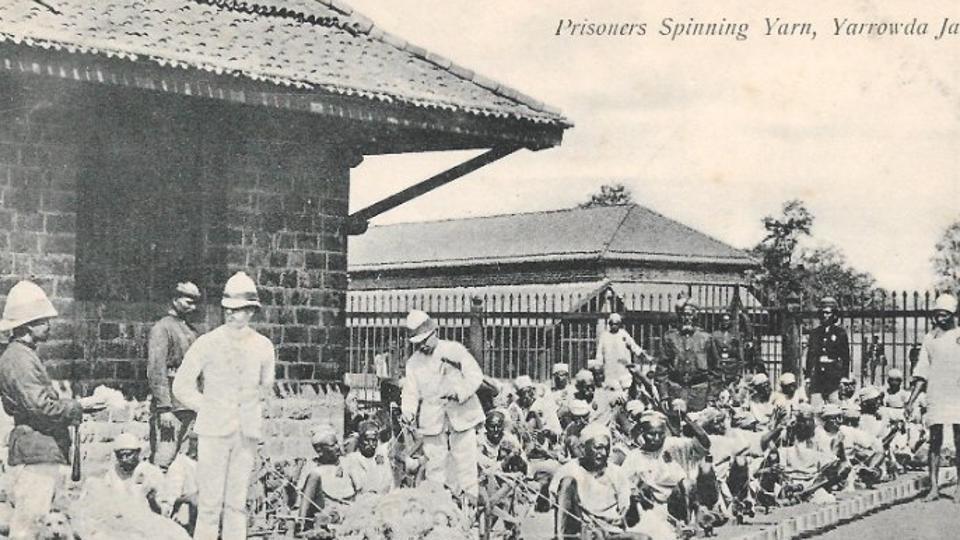
The first dietary reforms for Indian prisons came to be implemented in the Bombay Presidency in 1862. The man chiefly responsible for drawing the diet charts was CG Wiehe, Inspector General of Prisons. Based in Poona, he worked hard for three years before coming up with an elaborate scheme to change how prisoners ate. Wiehe’s recommendations were humane and treated convicts with respect.
Some disciplinarians then believed that the food of a prisoner should be converted into a deterring agent by restricting the dietaries to the “coarsest, plainest, and least agreeable description of alimentary substances compatible with health”. They agreed however that the quantity should be the minimum consistent with health and the amount of physical strength required to perform prison labour. It emphasised that the food should be devoid of articles that might be termed “indulgences”, and of which the class from which the prison populations were gleaned had never had the means nor opportunity of partaking.
Before 1862, it was the practice to allow prisoner to purchase own food, for which purpose a small monetary allowance was made daily; this was considered an “indulgence” by many British officers, leading to irregularities, which was abolished.
The law would never have contemplated that loss of health and strength should be induced by the use of unsuitable and inadequate food to enhance the severity of a judicial sentence and convert the prison diet into a dread instrument of punishment. To reduce the health of a criminal and restore him to society less physically able to earn a livelihood than when he entered the prison formed no part of his original sentence, and was therefore in excess of the requirements of the law. Wiehe argued in his report that food should not be used as a weapon to further punish convicts.
In the mid–1850s, certain dietary experiments had been carried out in Britain which had led prison authorities there to conclude that the convict, confined within prison walls, and subject to the depressing influence of imprisonment, would not maintain the same amount of health upon the same quantity and quality of food as was sufficient for these purposes for a free labourer. The cardinal points kept in view in the formation of a sound prison diet in Britain were variety, quality, correct proportionate arrangement of the “carbonaceous”, and “nitrogenous” principle, fats and “vegetable acids”, coupled with a balanced economy. While Wiehe did keep in mind the advances made in nutritional sciences in Europe, he also consulted physicians working in India, and in Indian jails.
The dietary reforms of 1862 for Bombay Presidency prisons were implemented for two years. It was decided that inspection would be done in 1864 to understand the effect of the new schemes and corrections would be made, if necessary.
In his final report, a revolutionary thought was put forward by Wiehe. He mentioned that the authorities should not lose sight of the depressing and morbific influences of deficient cubic spaces in prisons and imperfect ventilation, which, as a rule, existed in most of the old jails. While it was known that certain diseases of defective nutrition might be generated by the absence or deficiency of “acids, oil, vegetables, dhal, and by the habitual and unvaried use of rice”, Wiehe observed that as long as convicts were confined in space charged with “offensive exhalations”, and pestiferous drains were permitted to carry disease, the reformed dietary charts would be of little use.
Wiehe suggested that small prisons be constructed according to the approved principles of large central prisons, and a mode of conservancy should be adopted which had then gained the favourable verdict of time and experience in Punjab. He urged the government to build bigger and better prisons, because, according to him, the death rate in Indian prisons could not be lowered by dietary reforms alone. He wanted convicts to be allowed to roam inside jail premises after each meal, frail convicts to be allowed to take a short nap an hour after lunch, and petty convicts to grow fruits and vegetables so that they would be able to make a better connection with the food they ate.
The new dietary reforms had tried to take into consideration the racial distribution in the Presidency along with varied peculiarities of climate, habits, and mode of life. While initially the new dietary charts were designed for larger regions, Wiehe hoped that eventually dietary charts would be designed for each district. The medical officers and session judges had been given the discretionary power, subject to approval, to make changes in the dietary allowances.
The new dietary charts were also designed according to religion and ethnicity. The Hindus were subdivided into castes which were under a religious obligation to abstain from flesh – asarcophagous, or flesh non-eating castes – and those which were under no such religious obligation, and which did habitually partake of meat – sarcophagous, or meat-eating castes. The former included Brahmins, Jains, Lingayats, and Bhatias; the latter Marathas, who formed a large proportion of the population, the artisan castes, and the so-called “Hindu out-castes”. Indo-Europeans lived in all respects as Europeans, and the Jews and Native Christians were considered to live partly as Europeans and partly as flesh-eating Hindus.
The greatest takeaway of the dietary reforms was the thorough survey of the food habits Wiehe and his colleagues undertook across the Bombay Presidency. This was perhaps the first large-scale survey undertaken of such kind.
More about this next week.
Chinmay Damle is a research scientist and food enthusiast. He writes here on Pune’s food culture. He can be contacted at chinmay.damle@gmail.com


