E-Paper



Balancing development and heritage core mission of Modi govt: Rai
Union Minister Nityanand Rai highlighted PM Modi's focus on infrastructure and heritage, citing a decline in terrorism and the vision for a developed India by 2047.

 Prefer HTon Google


Union minister of state (MoS) for home affairs Nityanand Rai on Sunday asserted that balancing rapid infrastructure development with cultural heritage formed the core mission of Prime Minister Narendra Modi’s administration, citing the construction of the Ram Mandir as a key milestone of this vision.
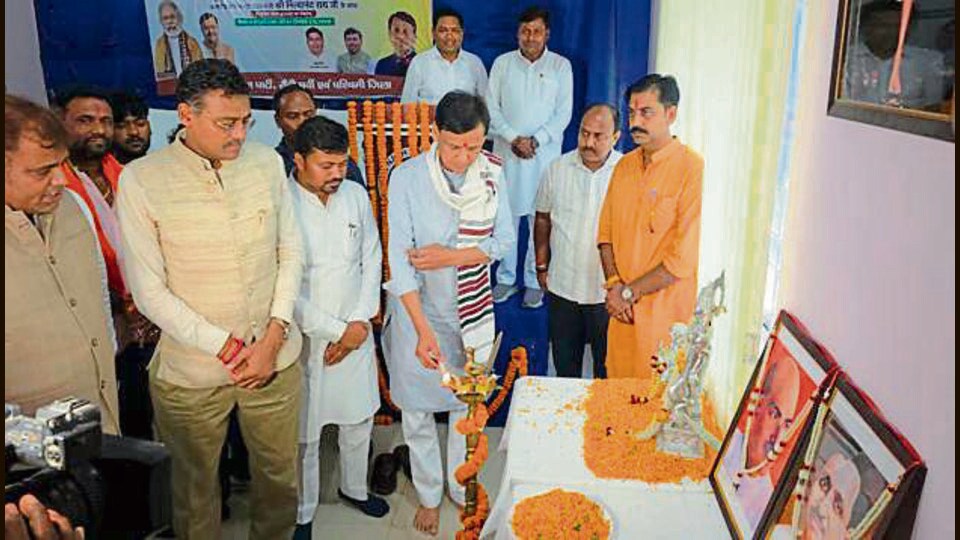
Addressing a national outreach programme at Sai Nath University here, organised to mark the completion of 12 years of the Central government, Rai said India was moving decisively toward its ‘Viksit Bharat’ (Developed India) target for 2047.
Drawing a historical parallel, the MoS noted, “Swami Vivekananda’s childhood name was Narendra, and the country’s PM is also named Narendra. One Narendra is fulfilling the prophecy made by the other. Together, we can realise the dream of a developed India.”
Highlighting the government’s performance on internal security, Rai presented data illustrating a sharp decline in domestic terror and insurgent networks in last 12 years.
“Today, we are seeing a 98% reduction in terror incidents in Jammu and Kashmir. Insurgency in the Northeast has declined by 82%, and the country is firmly on track to be entirely free from Naxalism by 2026,” Rai said.
He pointed to the transforming security landscape in states like Jharkhand as a direct outcome of the Centre’s zero-tolerance policy, urging the public to “assess the situation in Jharkhand today and observe the changes brought about by the eradication of Naxalism. All of this is the result of the strong willpower of the Narendra Modi government.”
Terming the tenure a landmark period of governance, the minister emphasised that a combination of digital innovation and direct benefit transfers had eliminated corruption from public welfare.
“The Modi government’s 12-year tenure has been a golden chapter in the making of a ‘New India’, one built on the foundations of service, good governance, development, transparency, and public welfare,” the minister stated.
He credited flagship schemes like Jan Dhan, Ujjwala, PM Kisan Samman Nidhi, Pradhan Mantri Awas Yojana, and Ayushman Bharat with bringing positive changes to the lives of crores of people.
On the socio-economic front, Rai said India’s global stature had risen in tandem with its domestic capacity building.
“Over the past 12 years, the nation has moved beyond instability and mistrust to achieve new heights of development, stability, and public welfare, guided by the mantra of ‘Sabka Saath, Sabka Vikas, Sabka Vishwas, and Sabka Prayas’,” Rai added, highlighting the massive expansion of premier national institutions like IITs, AIIMS, and medical colleges.
Prior to the dialogue, Rai participated in a public cleanliness drive at the Tetar Toli complex, where he felicitated local sanitation workers as part of the government’s ongoing civic campaigns. Rai also visited the CRPF Group Centre to pay tribute to fallen soldiers and reviewed progress on major infrastructure projects, including the Ratu Road Elevated Corridor, which forms a vital part of the region’s connectivity upgrade.
The high-profile event was attended by prominent administrative, academic, and sports figures, including Sai Nath University V-C SP Agrawal and international footballer Divyani Linda, alongside senior organisational leaders.