Live Score
 Cricket Teams
 Cricket Players
Negative mindsets don’t work here: Samson and the competition with Sooryavanshi
The India opener feels the key is not pretending the outside chatter affected him, but learning how to deal with it

 Prefer HTon Google


New Delhi: When the noise gets too much, Sanju Samson just switches off the Wi-Fi. Sometimes, though, it switches itself back on. He knows there is no escaping the noise that comes with playing for India, particularly when runs are hard to come by and every place in the XI is contested.
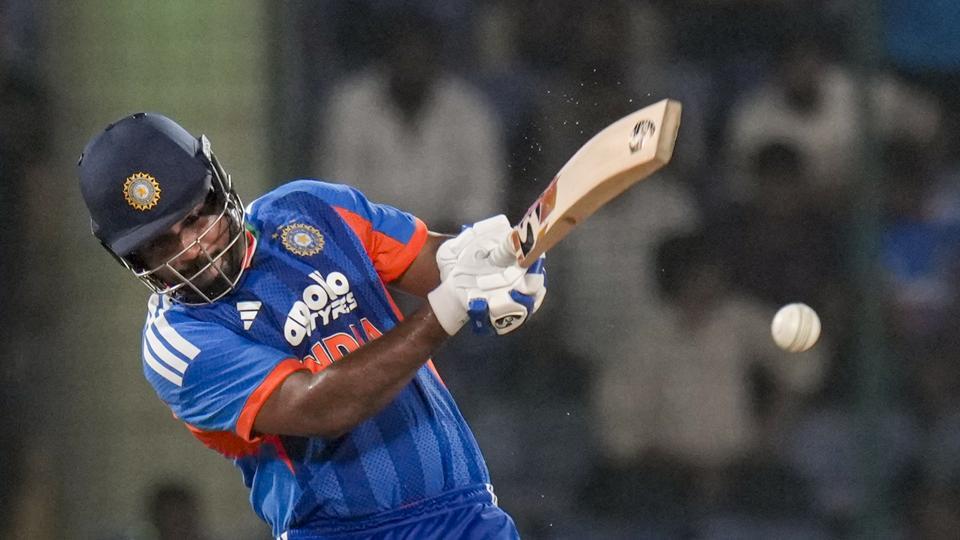
However, after smashing 57 off 22 balls against Afghanistan in the second T20I on Monday, Samson said the key was not pretending the outside chatter affected him, but learning how to deal with it.
“I try to switch the Wi-Fi off. But sometimes the Wi-Fi gets switched on and comments become visible,” Samson told reporters after his knock. “I’m not a machine, actually. We are not robots that we can say, ‘No, it doesn’t affect me.’ Definitely, it affects you.”
Deep Dive

Samson reveals this at a time when the pressure is more about the competition India has at the top-order. With 15-year-old Vaibhav Sooryavanshi breathing down everyone’s neck and Abhishek Sharma being the T20 asset that he is, Samson knows he is one lean patch away from finding his way back to the periphery.
In that case, his mindset has been to remind himself of who he is and what he wants to do when he walks out to bat. “If I paid attention to those things, I couldn’t bat like this. Before hitting a shot, I would think ten times, ‘Yaar, out ho gaya toh phir Wi-Fi problem ho jayega.’ So instead, I tell myself, ‘Koi baat nahi’.”
Samson, batting at a strike-rate of 259, struck seven sixes and three fours, with 52 of his 57 runs coming in boundaries, and tore into Afghanistan’s attack during India’s powerplay. The approach, he said, was not a sudden decision but an extension of the method India have adopted over the last two-three years.
“We are actually the world champions now, and we have a format and approach which has been very successful,” he said. “It’s about just watching the ball and trying to get maximum out in the Powerplay. Sometimes it works out well, sometimes it doesn’t.”
Of the competition, Samson said the competition had to remain exactly that – competition for the outside world, not within the dressing room.
“It’s a very tough choice actually. All of them are really good, all of them are performing, and all of them have to be given the right opportunity to keep performing at the international level,” he said.
Samson has been on the receiving end of some tough selection calls throughout his career, to the point that the question, ‘What else must Samson do?’ was being asked everywhere. One would think that winning the Player of the Tournament at the T20 World Cup would secure his place in the team, but that wasn’t to be the case.
He was dropped from the Playing XI three games after becoming Player of the Tournament in Ireland and then England. However, having captained Rajasthan Royals in the IPL himself, Samson said he understood why difficult selection calls had to be made.
“That’s where communication comes in,” he said, crediting the leadership group for keeping him informed. “Taking hard decisions is not easy. Taking a very popular decision is the easiest thing. But I think, as a leadership group, we have been taking some really tough calls, keeping the team in front.”
“They are competitors for the outside world, but we are a team and we are playing for a country,” he said. “We want to win the game first, and then it comes down to the other individuals.”
That means celebrating another player’s opportunity rather than sulking over his own omission.
“We can’t sulk or be in a negative frame of mind, thinking, ‘Yaar, mujhe nahi mila, usko kyun diya.’ Those kinds of mindsets don’t work here.”
The world may be talking about Sooryavanshi and whilst acknowledging the competition, Samson understands the hype around her former RR team-mate.
“You are seeing a 15-year-old boy who has come after scoring 700-800 runs (in the IPL).”
“He had such a good performance and he had to come in in some other manner. I didn’t perform in two-three games, and he was in form. We wanted to win games in that series, and it was very understandable from a leadership point of view.”
It’s easy to mistake Samson’s words as a solemn resignation, a kind of acceptance of fate. Yet, if one looks closely and remembers years of his trying to justify his talent on every level, there is also a sense of maturity. Now, Samson appears to have arrived at a simpler way of dealing with what comes with being one of India’s most important white-ball players: prepare well, accept the competition, keep the team ahead of himself and, whenever possible, switch the Wi-Fi off.