


 Live Score
 Cricket Teams
 Cricket Players
What is Bazball? 5 things to know about the Brendon McCullum-inspired concept that has taken England cricket by storm
Bazball is not just a set strategy that England follows. It is an approach which comes with a mindset which Bairstow best described it as "freedom".

 Prefer HTon Google


On Friday evening, almost into the final hour of Day 1 of the first Ashes Test, Joe Root smashed Nathan Lyon for two huges sixes - one over mid-wicket and other launched over long-on. The former England batter had just reached his 30th Test century which played a pivotal role in the team's recovery against newly-crowned World Test Championship winners Australia in Birmingham to 393 for eight. There was a sense of freedom in his batting. And despite having a tail end batter in Ollie Robinson at the other end, Root's continued dominance was a certainty implying that on that flat Edgbaston wicket England could add more runs to add pressure on Australia. But England captain Ben Stokes had other plans. Leaving world cricket in sheer disbelief, he decided to declare the innings with 10 more overs scheduled for the day. While the plan was to have a crack at Australia, the tactic drew mixed reactions from veteran cricketers.
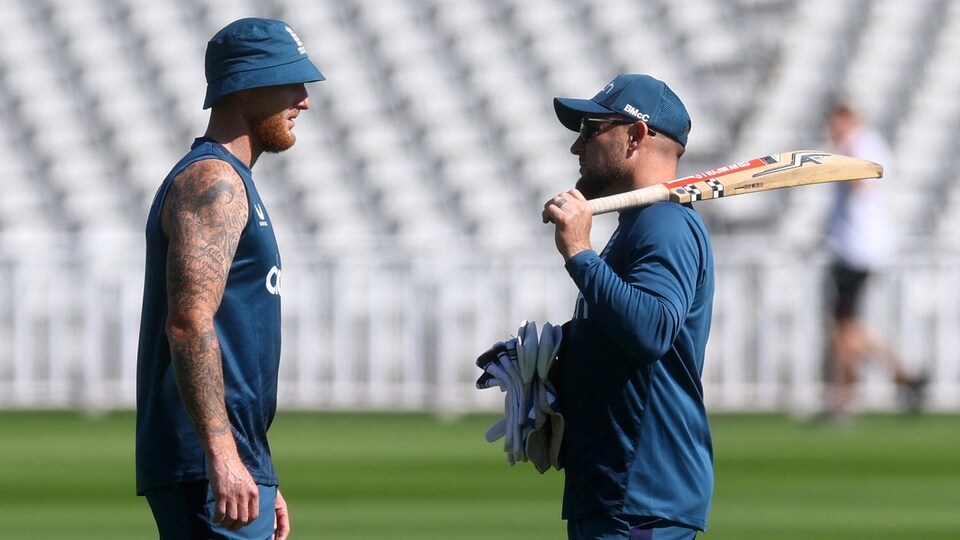
But if you did ask any of them what it really was, the simple answer would be - that's Bazball - the word that has taken England cricket by storm. But what is Bazball?
Origin: The name was first coined by ESPNCricinfo journalist Andrew Miller after former New Zealand cricketer Brendon McCullum's appointment as the head coach in may last year. 'Baz' hence comes from the long-standing nickname for McCullum during his playing days, who himself was known for his aggressive brand of cricket.
ALSO READ: Michael Atherton shuts baffled Ponting with savage 'Bazball' response after Harry Brook bowls in 1st Ashes Test
But Bazball is not just about aggression or is a set strategy that England follows. It is an approach which comes with a mindset which probably Jonny Bairstow best described it as "freedom".
Faster scoring rates: One of the most defining scorecard to highlight this aspect is the Rawalpindi Test against Pakistan last December when England scored 506 runs for four wickets on Day 1 of the match with three batters - Zak Crawley, Ben Duckett and Harry Brook - notching up their centuries. It was the most runs scored by any team on the first day of a match in the history of Test cricket. And the scoring rate of 6.75 was the best ever as well. In fact, since the appointment of McCullum, England's strike rate of 77.06 is the highest during the period. And this fast-paced batting has resulted into batters going for unorthodox shots as well like Root executing the reverse ramp almost in each of his innings.
Aggressive fields and bowling changes: Former England captain Michael Atherton highlighted this aspect on Day 2 of the 1st Ashes Test when he was comparing Stokes with his Aussie counterpart in Pat Cummins. He said: "Every field change, every bowling change from Stokes is about how to get a wicket. Every change from Cummins yesterday was about how to stop runs. It’s a fundamental shift."
On Saturday, when Stokes's dismissal of Steve Smith was the decisive moment in the match, yet it was Travis Head's dismissal that caught more attention. Not for the manner of the dismissal, but for the aggressive captaincy of Stokes, who was willing to leak runs to get that wicket. And he used Moeen Ali, who was smashed for seven boundaries by the batter, to get that wicket. Most skippers would not have gone for the offie who had conceded 45 runs in his first six overs. But Stokes brought the mid-on and mid-off up to lure Head into attacking Moeen again, but this time he fell into the trap. The lofted drive was miscued and the fielder at mid-wicket grabbed the catch.
Taking draw out of equation: The Birmingham Test is not the first instance of Stokes' brave declaration call. At the Oval earlier in February this year, in what was a Day/Night Test, England declared their first innings in the final hour of Day 1 given that the conditions for bowling are better in that hour. New Zealand eventually went three down at stumps. Atherton had later described it as an proof of Stokes “reputation as a captain unwilling to let the game stagnate or drift”.
This aggressive approach has also made England among the best chasing sides, a glimpse of which was seen in Nottingham last year when the team scripted a record run chase against New Zealand. Stokes was later quoted as saying "The message just was run into the fear of what the game was rather than stand still or back away from it…I'll say it quite simply: we were either winning this game or losing it. That was the mentality that we wanted all the batsmen coming in to have…It's obviously paid off. When you have the backing of the coach and captain, it rubs off on the players in a very positive way. So you're not fearing failure. You're just going out and doing what you want to do."
Critics: Earlier this year, veteran Indian bowler Ravichandran Ashwin had made an hinest criticism of Bazball citing that it might be not suit all conditions. He explained: "Certain types of wickets, when you try and attack every ball, you will falter. There are both advantages and disadvantages to this approach. Sometimes, on the wicket, conditions need to be respected.”
Australia's Steve Smith too questioned the longetivity of the approach and wether it is sustainable of green-top tracks with the likes of "Josh Hazlewood, Cummins and Starc are rolling in at you."


