


 Live Score
 Cricket Teams
 Cricket Players
When the Don met the Wizard: Bradman welcomed Dhyan Chand and then watched his home team get thrashed 10-1
On Dhyan Chand's 121st birth anniversary, revisit the 1935 Adelaide meeting where Don Bradman watched hockey's Wizard play and helped create a sporting legend.

 Prefer HTon Google


Dhyan Chand was born on August 29, 1905, and 121 years later, the stories surrounding Indian hockey’s greatest icon still stretch far beyond the goals he scored and the Olympic gold medals he won. Some have grown into legend, others into folklore. But one extraordinary episode from his life stands on firmer historical ground — the day the greatest hockey player of his age met the greatest cricketer of his age.
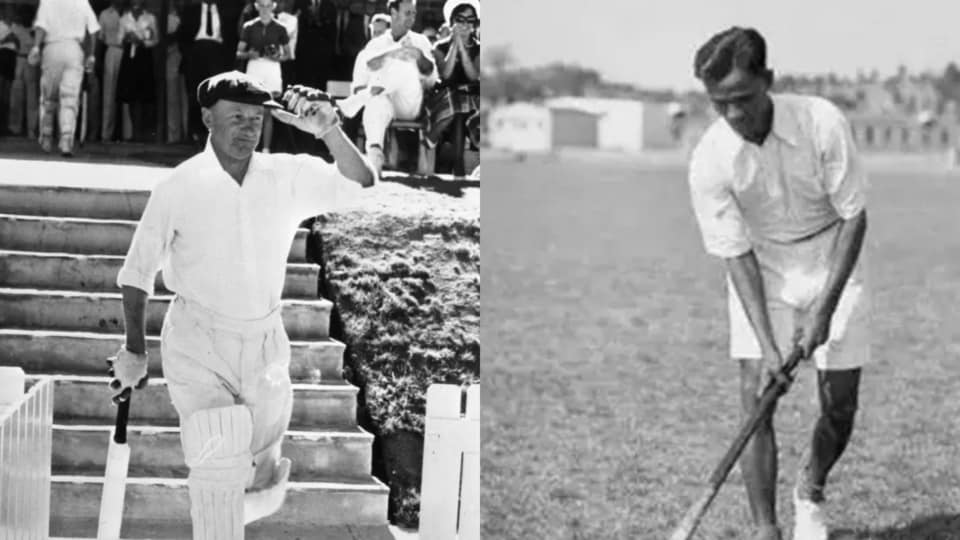
On May 2, 1935, Dhyan Chand and Don Bradman came face to face in Adelaide. It was a meeting between two men who had already reached a level of sporting dominance that few before them had known. Chand, then 29, had won Olympic hockey gold medals with India in 1928 and 1932 and was captain of the Indian side touring Australia and New Zealand. Bradman, only 26, had already established himself as the defining batsman of his generation.
What made the encounter even more remarkable was that Chand himself had wanted it to happen. During India's stop in Adelaide, Chand expressed a desire to meet Bradman. Pankaj Gupta, the team's assistant manager, helped facilitate the meeting through the local authorities, and Bradman was invited to a formal reception for the Indian hockey team at Adelaide Town Hall.
When Bradman arrived, the Indian players immediately recognised him. Contemporary accounts of the reception describe Bradman and Chand rising and shaking hands amid applause. It was an extraordinary image even by the standards of sporting history: cricket's most famous batsman standing alongside a man whose control of a hockey stick had already made him an international phenomenon.
Bradman welcomed the Indian visitors and openly acknowledged their superiority in hockey. “I am particularly glad to welcome the Indian players as they are better exponents of the game of hockey than we are,” Bradman was quoted as saying. He added that Australians could learn from watching the visitors and also expressed another wish: “I hope that this visit will be the forerunner of a visit from an Indian cricket team.”
India had only entered Test cricket three years earlier, in 1932, and had yet to tour Australia. Twelve years after Bradman's remark, India finally travelled there for the 1947-48 Test series. Bradman, by then nearing the end of his incomparable career, captained Australia.
When Bradman watched Dhyan Chand play
The Town Hall reception was only the first part of the story. Later that day, the Indian hockey team played South Australia at Adelaide Oval. Dhyan Chand later recalled that it was the first hockey match Bradman had ever watched.
Bradman's introduction to the sport could scarcely have been more emphatic. India won 10-1.
The tourists were already 7-0 ahead at half-time. Roop Singh, Dhyan Chand's younger brother and another outstanding forward, scored four goals. Lourie Davidson struck three, Peter Fernandes scored once and Chand himself added two.
Bradman had spent his cricket career making enormous numbers appear routine. Now he was watching another athlete dominate his sport in much the same manner. Out of that encounter came one of the most famous sporting comparisons involving Dhyan Chand. Bradman has long been recorded as remarking that the Indian hockey great scored goals the way runs were scored in cricket, with the popular version of the line becoming: “You score goals like runs in cricket.”
The exact wording differs between later accounts, and the phrase does not carry quite the same contemporary documentary trail as Bradman's remarks at the Town Hall. But the comparison itself became inseparable from the story of their meeting. And the numbers Chand produced on that tour help explain why.
India played 48 matches across the wider 1935 expedition and won all 48, scoring 584 goals while conceding just 40. Chand played 43 matches and scored an astonishing 201 goals.
This was not dominance built entirely on favourable conditions either. Chand later wrote about the difficult surfaces encountered in Australia and New Zealand, where wet and uneven grounds often forced the Indians to alter the quick, ground-based hockey that had made them so devastating. Yet the goals continued to come.
The fascination between the two sporting giants was also not something invented decades later. During the tour, comparisons between Chand and Bradman were already being made in Australia.
Pankaj Gupta responded to one such comparison with perhaps the finest line of all. “Some people call Dhyan Chand the Don Bradman of hockey,” he was quoted as saying, “but I prefer to call Don Bradman the Dhyan Chand of cricket.”
The point was obvious. Bradman represented the highest possible standard against which a cricketer could be measured. To those travelling with the Indian team, Chand occupied precisely the same position in hockey. For Chand, however, meeting Bradman carried a significance that remained with him long after the tour ended.
In his autobiography, Goal!, Chand recalled the Adelaide encounter as one of the most exciting moments of his life. He remembered Bradman posing for a photograph with him, Roop Singh and Pankaj Gupta, and described the photograph as something he treasured. That recollection says plenty about the scale of the occasion.
Dhyan Chand would captain India to another Olympic gold medal at Berlin in 1936. His performances would generate stories that survived generations. His international career would turn him into one of India's first truly global sporting figures. Bradman, meanwhile, would retire with a Test batting average of 99.94, a number that remains perhaps the most instantly recognisable statistic in cricket. Yet before either man's story was complete, there was Adelaide in 1935.
One wanted to meet the other. A reception was arranged. They shook hands before an applauding audience. Bradman then went to Adelaide Oval and watched Chand play hockey for the first time. More than nine decades after that afternoon, on the anniversary of Dhyan Chand's birth, it remains one of sport's great meetings: two men from different games, both so far ahead of their contemporaries that the easiest way to explain the greatness of one was simply to invoke the greatness of the other.


