E-Paper



Priests can’t refuse to perform pujas for low-caste worshippers: U’khand HC
The court also ruled that any properly trained and qualified person can be appointed as ‘poojari’ (priests) in temples, irrespective of their caste


Stressing that the system’s failure to “accord and protect the dignity, honour and human rights of the persons belonging to lower castes, has led to large scale conversions”, the Uttarakhand high court on Thursday ruled that high caste priests throughout the state shall not refuse to perform religious ceremonies, pujas or rituals if requested by people belonging to lower castes in all religious places/temples.
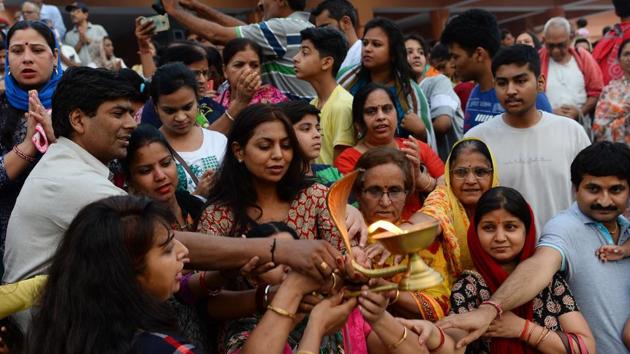
The court also ordered that all persons, irrespective of their caste, be permitted to enter or visit any temple throughout Uttarakhand without any discrimination. The court also ruled that any properly trained and qualified person can be appointed as ‘poojari’ (priests) in temples, irrespective of their caste.
The division bench of justices Rajiv Sharma and Lok Pal Singh gave these directions in response to a public interest litigation filed by Pukhraj & others — followers of Sant Ravidass — in 2016. The order was given last month, but its copy was released on Thursday.
Sandeep Tiwari, counsel for the petitioners, said these followers were not happy with the proposal to construct a new staircase near their Sant Ravidass temple at Har Ki Pauri in Haridwar, arguing that a staircase already existed and the proposed new staircase would cause big inconvenience at their temple.
According to the affidavit, filed by the managers of the dharmshala, it was a private property and the authorities were trying to shift the footbridge to another location without obtaining their prior consent.
The PIL had also sought that high caste priests be instructed to perform the religious ceremonies and pujas on behalf of members belonging to lower caste, and argued that the “time has come to consider appointing any person as pujari in the temple”.
The scope of the PIL was expanded by the high court.
Citing various Supreme Court orders and references from books, the high court bench noted in its order that “high caste priests cannot refuse to perform religious ceremonies on behalf of persons belonging to lower castes”.
The bench said the apex court had held that “there is no justification for permitting only Brahmins to carry out rites and rituals as priests. “The custom of restricting functions of priests or poojaris to Brahmins only, is violative of human rights, human dignity, concept of social equality and the specific mandate of the Constitution and cannot be considered an integral part of the Hindu region”, the bench observed.
“The exclusion of persons from temples open to worship to the Hindu public at large, only on the pretext that they belong to the excluded community, is violative of Article 17 of the Constitution of India. Every person to whatsoever caste he/she belongs has a right to visit/enter the temple and worship and perform religious ceremonies/rituals,” the order said.
The PIL also alleged that previously, untouchability was followed rigidly even in Haridwar, with high caste priests were not accepting the alms offered by the pilgrims belonging to the lower caste. “They used to refuse to perform the ceremonies on their behalf. This community still goes to maha-brahmins for performing their religious chores. This is against the spirit of Articles 14, 15 and 17 of the Constitution of India”, the order said.