
 E-Paper





Shishir Gupta is Executive Editor at Hindustan Times and one of India's top journalists covering national security, strategic affairs, foreign policy and geopolitics. Over the past three decades, he has extensively reported on India's military, diplomatic and security landscape, covering every major conflict and national security challenge, from the 1999 Kargil War and the 2020 East Ladakh standoff to Operation Sindoor in 2025. He has also covered major terror attacks, including the IC-814 hijacking, the 26/11 Mumbai attacks and the 2025 Pahalgam terror strike, along with numerous Pakistan-backed terrorist incidents in the Kashmir Valley and across India. He has reported on national and state elections for more than three decades. A recognised authority on strategic affairs, Gupta has covered India's nuclear programme since the Pokhran-II (Shakti series) tests in May 1998 and has written extensively on global nuclear issues, Indian diplomacy and the country's expanding global outreach. He has also reported widely on international conflicts and terrorism, with a special focus on the Indian subcontinent. Gupta has interviewed Prime Minister Narendra Modi more than four times, including Modi's first interview with the print media after becoming Prime Minister in May 2014. His other interviews include three with the Dalai Lama, as well as conversations with Benjamin Netanyahu, Amit Shah, Yogi Adityanath, S. Jaishankar, Nirmala Sitharaman and Piyush Goyal. He is the author of Indian Mujahideen: The Enemy Within (Hachette, 2011) and Himalayan Face-off: Chinese Assertion and Indian Riposte (Hachette, 2014). He was awarded the Chevening-Wolfson Joint Scholarship at Wolfson College, University of Cambridge, UK, in 1998 and participated in the International Visitor Leadership Program (IVLP) of the US State Department in 2006. He received the Ben Gurion Prize from Israel in 2011 and the K. Subrahmanyam Prize for Strategic Studies in 2015 from the Manohar Parrikar Institute for Defence Studies and Analyses (MP-IDSA). Since 2024, he has hosted Point Blank, Hindustan Times' weekly YouTube show on global geopolitics.
Centre dithers over entry of China card in India
While the UPA govt is supportive of promoting trade in local currencies within the BRICS group, bilaterally it is having second thoughts about introduction of the Chinese bank card for financial transactions in India. Shishir Gupta reports. Areas of apprehension


While the United Progressive Alliance (UPA) government is supportive of promoting trade in local currencies within the BRICS group, bilaterally it is having second thoughts about introduction of the Chinese bank card — UnionPay — for financial transactions in India. The reason for this, sources say, is the huge bilateral trade imbalance between the two countries as well as emerging security issues.

Leaders from Brazil, Russia, India, China and South Africa will meet in Delhi for a two-day summit on March 28-29 for discussing issues related to global security, stability and economic cooperation.
Government sources said the BRICS leadership is expected to move forward on an agreement that allows trade in local currencies, as was agreed in principle during the last summit at Sanya, China, on April 14, 2011. As all the BRICS partners trade in hard currency, it was mooted that participating nations should consider signing bilateral agreements to trade in local currencies.
This move could particularly help businessmen from India and China because trade between the two countries has already touched $74 billion. While the leaders are also expected to discuss the proposed creation of the BRICS development bank, the idea is still in a preliminary stage, and work is in progress.
However, New Delhi is not sure about allowing the entry of the UnionPay credit card, which China says would allow more tourists from the country to visit India. For the last six months, Beijing has been urging India through diplomatic channels to allow the entry of UnionPay, which is a state-owned financial services company unlike the privately held Master or Visa card.
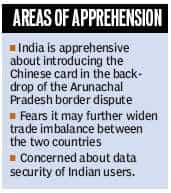
While the proposal is still being examined by various stakeholders on Raisina Hill, including the home ministry, the government is apprehensive regarding security of the data generated by Indian users, considering that UnionPay is backed by the People’s Bank of China.
It also fears that the move could lead to further widening of the trade imbalance between the two countries, which now stands at $27 billion.
With the boundary dispute still not being addressed seriously by Beijing, New Delhi is unsure how the card would play out in Arunachal Pradesh — which China considers South Tibet — even though North Block understands that mere card usage would not lead to assertion of sovereignty.


