
 E-Paper



Delhi at high seismic risk with unplanned growth, flouting of norms
About half of Delhi would have flattened out had the epicentre of Saturday's morning earthquake been in or near the national capital.


About half of Delhi would have flattened out had the epicentre of Saturday's morning earthquake been in or near the national capital.

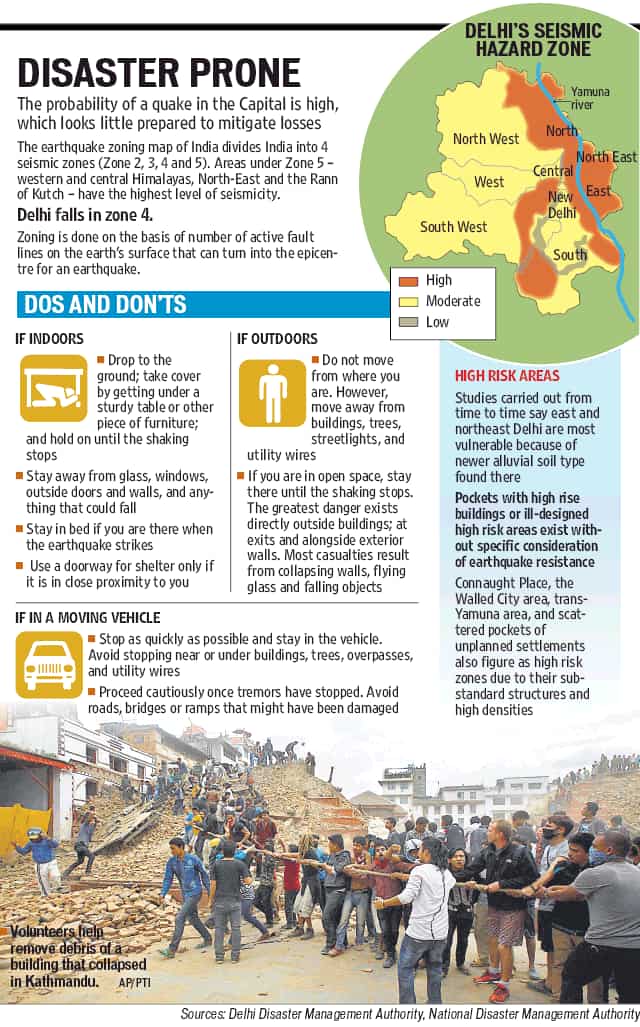
DK Paul, professor emeritus at IIT Roorkee's earthquake engineering department and part of the team that carried out a microzonation study of the capital in 2007, told HT that devastation in Delhi would be many times more not only on account of its high seismicity (it falls in seismic zone IV) but also because of the unplanned growth that flouts structural safety norms in buildings.
The microzonation study had revealed that private buildings in the Capital, especially those in Trans Yamuna and Walled City areas, would suffer the maximum damage if an earthquake of 7 or higher magnitude strikes the Capital.
"An earthquake of 7 and above magnitude with its epicentre in and around Delhi would cause havoc in the Capital mainly because buildings here lack seismic resistant measures. Not only is Delhi densely populated but there is complete lack of enforcement by authorities concerned to ensure that building codes and structural safety norms are followed," said professor Paul.
As per norms, municipalities are supposed to give the go-ahead for construction only if buildings comply with the Indian Design Code, which was revised in 2002 and lays down criteria for earthquake resistant design. "But the problem is we do not have a regulatory framework to ensure compliance of building code resulting in people getting clearance even if their building does not have retrofitting or other seismic resistant measures," Paul added.
The intensity of Saturday's quake in Delhi was about 5 on the Richter scale, which was not very potentially damaging. "It is not earthquakes that kill, it is the buildings. It depends on how resilient a building is... on structural design. If a building is structurally sound, nothing would happen," said Indian Meteorological department director general Laxman Singh Rathore.
Experts say devastation in will would be many times more as the city faces different kind of risks as compared to other cities that have high seismicity.
"The devastation will differ in different locations. For instance, east Delhi areas along the Yamuna that is in the liquefaction zone would suffer the maximum damage on account of the dense, unplanned growth. Rampant unauthorised construction has meant that building bylaws have not been adhered too, even basic soil testing was not carried out before starting construction," said professor Santosh Kumar, director, SAARC Disaster Management Centre.

Stay updated with all top Cities including, Bengaluru, Delhi, Mumbai and more across India. Stay informed on the latest happenings in World News along with Delhi Election 2025 and Delhi Election Result 2025 Live, New Delhi Election Result Live, Kalkaji Election Result Live at Hindustan Times.


