
 E-Paper



CLAT and AILET 2026: How two AIR 4 rankers prepared, handled pressure and adapted when the paper changed
Arshnoor Singh and Siddhant Rohit successfully navigated CLAT and AILET by prioritising adaptability and mock testing in preparation.

 Prefer HTon Google


For law aspirants, entrance exams such as CLAT and AILET are as much a test of temperament as of preparation. That lesson comes through clearly in the journeys of Arshnoor Singh, who secured All India Rank 4 in CLAT 2026 and AIR 202 in AILET, and Siddhant Rohit, who secured All India Rank 4 in AILET and AIR 138 in CLAT.
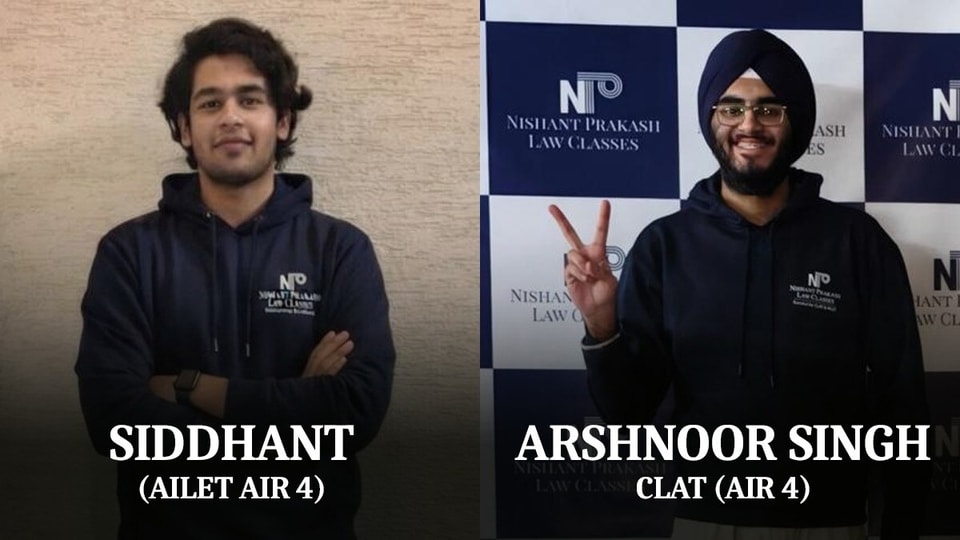
Both students began preparing early, come from non-law backgrounds, and emphasise that what ultimately helped them was not chasing a fixed pattern, but learning how to adapt, stay composed and trust their preparation when the paper did not behave as expected.
Background and early choices
Arshnoor is a Class 12 student at Amity International School, Saket, where he serves as the head boy. Siddhant studies at Delhi Public School, Vasant Kunj, where he also served as the head boy.
Neither has lawyers in the immediate family. Siddhant took Commerce with Maths as a backup option in school, while Arshnoor opted for Humanities, studying subjects such as history, political science, economics and psychology. Both say their interest in law grew from an inclination towards social issues, governance and public engagement rather than any inherited professional path.
Preparation approach: consistency over shortcuts
Both students began structured preparation around Class 11, giving themselves time to understand the language, pace and unpredictability of law entrance exams. A central feature of their preparation was regular mock testing, which helped build decision-making ability and exam temperament.
Arshnoor focused on maintaining high attempts, particularly in the final months. In a rank-based exam, he felt being overly cautious could be counterproductive. Siddhant similarly said repeated exposure to full-length papers helped him learn when to move on from a question instead of losing time.
General Knowledge remained the most challenging section throughout. Both describe GK as open-ended and never truly complete. Daily engagement with current affairs, systematic revision, and consistent newspaper reading formed the backbone of their preparation. Beyond GK, newspaper reading also helped improve comprehension, vocabulary and familiarity with contemporary issues that often appear in passage-based questions.
On Quantitative Techniques, both felt the difficulty was manageable. CLAT maths, they said, is largely based on Class 10 concepts. The real risk lay in neglect. Short, daily practice ensured they stayed comfortable with calculations and avoided panic during the exam.
Handling challenges and exam-day surprises
CLAT 2026 introduced unexpected changes in certain sections, particularly Logical Reasoning. For both students, the key challenge was resisting panic.
Instead of trying to reconcile the paper with expectations, they focused on solving what was presented. Accepting that the structure had changed helped them regain control and move forward. Both relied on elimination-based guessing to manage negative marking, especially in a paper where even small differences translated into significant rank movement.
Role of structured guidance
Both Arshnoor and Siddhant prepared under the guidance of Nishant Prakash, and credit the coaching environment for helping them develop discipline and clarity in approach.
They describe the emphasis as being less on rote learning and more on strategy, time management and post-test analysis. Regular feedback after mocks, personalised discussions around strengths and weaknesses, and repeated emphasis on staying composed during the exam shaped how they approached the paper.
Rather than following a one-size-fits-all formula, the focus, they say, was on understanding individual patterns — how each student performed under pressure and how that could be improved over time.
Social media and balance
Neither student believes success requires complete isolation. Both significantly reduced social media usage in the final months, but did not eliminate it entirely.
Arshnoor said staying connected with friends helped maintain emotional balance during an otherwise intense period. Siddhant described being largely offline closer to the exam, prioritising rest and routine over constant engagement. Both stress that preparation needs to be sustainable, not exhausting.
Support system at home
Family support played a stabilising role. Siddhant’s father is a civil servant and his mother a professor, while Arshnoor’s parents work in finance. Despite having different professional backgrounds, both families trusted their decisions and allowed them the space to prepare without excessive pressure.
That trust, both say, helped them stay focused during low-scoring phases and periods of self-doubt.
What made the difference
For both students, success came down to a combination of belief, discipline and adaptability. Mental readiness mattered as much as academic preparation. Fixating on expected patterns or panicking mid-paper, they say, is where many candidates lose ground.
Mocks, they add, only become useful when followed by honest analysis and course correction.
Message for future aspirants
Their advice to future aspirants is measured and realistic. Law entrance exams are often underestimated, and preparation demands time and consistency.
One year of focused effort can be enough, but longer preparation helps students become comfortable with the exam’s language and volatility. Above all, they caution against walking into the exam with fixed expectations.
Staying calm, attempting smartly and trusting the preparation — especially when the paper surprises — proved decisive in their journeys.


