
 E-Paper



JNU polls 2019: Hostel, library facilities rank high on most candidates’ agenda
While talking about reservations, research scholar Jitendra Suna, 29, the presidential candidate of Birsa Ambedkar Phule Students’ Association (BAPSA), said JNU should ensure proper implementation of reservation.


Ahead of the Jawaharlal Nehru University students’ union (JNUSU) elections on September 6, the five presidential candidates have been campaigning for over 14 hours a day. While students’ organisations are yet to release their manifestos, lack of adequate hostels and libraries, high fee structure for engineering and MBA courses, curbs on free speech, Gender Sensitisation Committee Against Sexual Harassment (GSCASH) and academic inequalities faced by marginalised students are high on the agenda of most candidates.
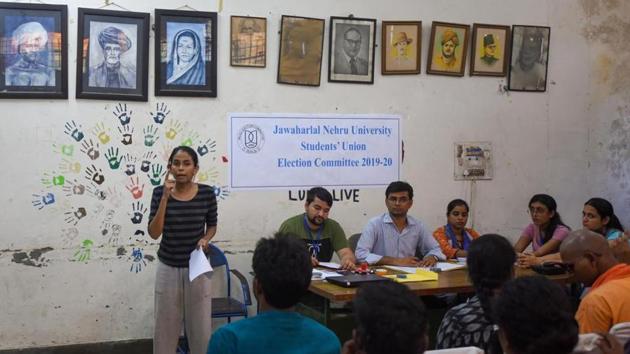
Like last year, the four left-leaning organisations on campus, including Students’ Federation of India (SFI), the All India Students’ Association (AISA), All India Students’ Federation (AISF), and Democratic Students’ Federation (DSF) joined hands to form a united panel – Left Unity.
“There is a huge problem involving hostels and general infrastructure. We will be asking the university to ensure alternative accommodation on rent for those who don’t get hostel berths, along with ensuring transport facilities for them,” said Aishe Ghosh, the presidential candidate of the Left Unity.
“Cuts in the budget of libraries should be revoked and there should be school and centre-specific libraries on campus. Fixed funds should be allocated for books and journals every year. We will also demand that JNU ensures contingency funds for science students so that they don’t have to pay from their own pockets for test-tubes or lab equipment,” said Ghosh, who hails from Durgapur in West Bengal.
“The campus should also be made more inclusive and buses for people with disabilities should be procured,” he added.
Ghosh, a member of the SFI and a two-time convener at the School of International Studies, is pursuing her doctoral research in Inner Asian studies. She said that they would also campaign for getting back GSCASH and ensure students from marginalised backgrounds get the opportunity to access affordable education.
Akhil Bharatiya Vidyarthi Parishad (ABVP) candidate Manish Jangid, 26, is also going to fight on campus issues. “Students are producing research output but often they don’t receive infrastructural support like hostels and libraries. There are no facilities for sports and cultural facilities. Sports quota would be one of our demands since students should be allowed to excel not just in academics but sports as well.”
Jangid, who is from Jaipur and is pursuing his PhD at the School of Environmental Sciences, said if elected, he would focus on ensuring lesser dropouts. “Students should get library material in regional languages as not everybody is fluent in English. We will ensure students get the support they need and there are provisions for supplementary and improvement examinations for such students,” he said. Jangid added that he would also work towards extending e-rickshaw facilities to ensure cheaper connectivity to the nearest Metro station and for running of feeder buses.
While talking about reservations, research scholar Jitendra Suna, 29, the presidential candidate of Birsa Ambedkar Phule Students’ Association (BAPSA), said JNU should ensure proper implementation of reservation.
“We demand a special fund for poor students since they find it difficult to pay increased mess fee or even to live in Delhi. If elected to the union, we will also demand increase in merit-cum-means and non-NET fellowships,” said Suna, a first-generation learner who hails from Kalahandi district in Odisha and is one of the founding members of BAPSA. He added their party would also demand restoration of deprivation points and ensure a more active SC/ST cell and linguistic cell.
The demand for a robust cell has been made by Congress’ students’-wing National Students’ Union of India (NSUI) as well. Its candidate Prashant Kumar, 26, who is pursuing his PhD in Philosophy, said: “There is just one linguistic cell now and that too doesn’t have a robust structure. We want school-wise linguistic cells to ensure students from marginalised backgrounds get the help they need.”
Kumar, who identifies himself as a Nehruvian socialist, said the NSUI would focus on voices which have been ignored. Kumar also said they will demand more mental health counsellors in on campus— an issue raised by Suna and Ghosh as well.
Like Kumar and others, Rashtriya Janata Dal‘s (RJD) students’ wing presidential candidate Priyanka Bharti, 22, also promised to ensure there is no discrimination towards students from northeast.
“Often students from the northeast, belonging to SC/ST categories, score lesser in interviews despite excelling their tests. We will raise our voices against such injustice,” said the postgraduate student of German Studies, who hails from Fatwa village in Bihar.


