
 E-Paper



French minister Philippe Baptiste visits Institute of Liver and Biliary Sciences in Delhi to strengthen research ties
French Minister Philippe Baptiste engaged with the ILBS, promoting enhanced collaboration between India and France in higher education and biomedical research.

 Prefer HTon Google


French Minister for Higher Education, Research and Space Philippe Baptiste visited the Institute of Liver and Biliary Sciences (ILBS) in New Delhi on September 28 for discussions on strengthening collaboration between India and France in higher education, research and innovation.
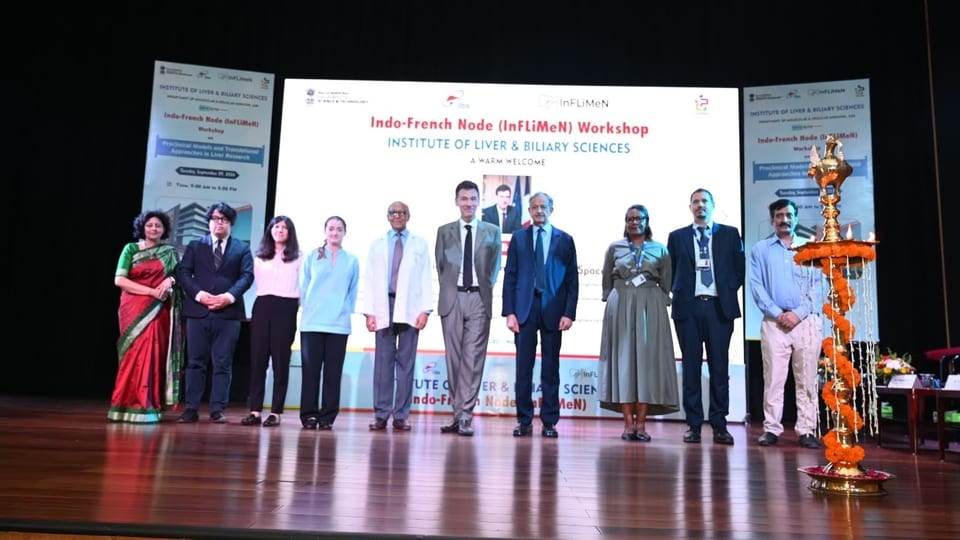
The interaction focused on the Indo-French Liver & Metabolic Disease Network (InFLiMeN), its progress and plans for its next phase. The programme included a presentation on Indo-French collaboration, discussions on student and faculty exchanges and training opportunities, an interaction with ILBS faculty and a visit to the institute’s laboratories.
ILBS Director Dr S. K. Sarin briefed Baptiste on the development of InFLiMeN as an Indo-French collaborative platform focused on liver and metabolic diseases. Sarin outlined a proposal to take the network beyond its existing virtual framework through the establishment of a physical Indo-French centre.
According to the institute, the proposed centre would provide a platform for scientists, faculty and students from India and France to work together on emerging challenges in biomedical research. The discussions also explored expanding the network’s scope by bringing together expertise in nanotechnology and materials science.
The proposed interdisciplinary approach would focus on fundamental questions linked to areas including cancer and inflammation, while creating opportunities for translational research, the release said.
Baptiste acknowledged the progress made through the Indo-French collaboration and expressed support for further strengthening the partnership. Discussions also covered student and faculty mobility, joint training and research exposure between ILBS and French institutions.
The interaction emphasised opportunities for young researchers and faculty to work across institutions and countries and share scientific expertise, methodologies, technologies and research perspectives.
The institute said the visit reflected a shared interest in developing a sustained Indo-French ecosystem spanning higher education, biomedical research, technology exchange and innovation.
The proposed physical InFLiMeN centre is envisaged as a platform where researchers and students from both countries could collaborate on emerging scientific challenges and work on solutions with potential healthcare applications.
The interaction also highlighted interdisciplinary work at the intersection of liver and metabolic diseases, cancer, inflammation, nanotechnology, materials science and emerging technologies.
The institute described the visit as part of InFLiMeN’s evolution from a virtual collaboration towards a stronger institutional partnership connecting researchers, students and academic institutions in India and France.


