
 E-Paper



Experts sceptical of Gurugram’s high rank in cities with ‘reduced pollution’
Despite being ranked a low 88 (of 111 cities) in the ministry of housing and urban affairs’ Ease of Living Index (ELI) – released earlier this week – Gurugram has ranked 7 in the ‘reduced pollution’ category


Despite being ranked a low 88 (of 111 cities) in the ministry of housing and urban affairs’ Ease of Living Index (ELI) – released earlier this week – Gurugram has ranked 7 in the ‘reduced pollution’ category. While the Haryana State Pollution Control Board said Gurugram’s exemplary performance was expected, experts are sceptical.
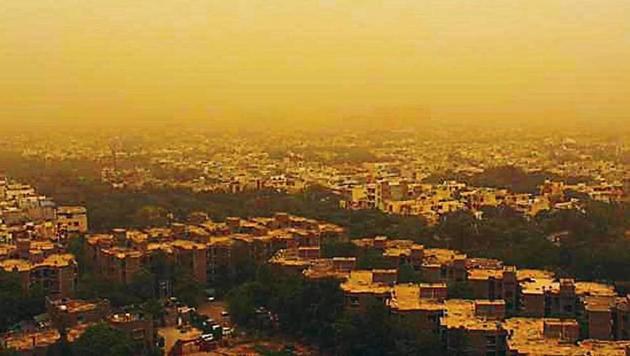
In the same category, New Delhi was ranked 100, Ghaziabad 20 and Faridabad, 86. These numbers indicate that Gurugram has made significant strides in monitoring and controlling pollution — specifically air, water and noise pollution.
The HSPCB’s regional officer for Gurugram, Jai Bhagwan, said Gurugram’s rank was not a surprise. “We have involved various stakeholders in our efforts to clamp down on polluting activities. Last year, the Haryana Urban Development Authority (Huda), the Municipal Corporation of Gurugram (MCG), the police and the department of District Town and Country Planning (DTCP) met with Dr Bhure Lal, the chairman of the Environmental Pollution Control Authority (EPCA) on two occasions to discuss how to tackle the pollution,” Bhagwan said.
Acting on EPCA’s recommendations, the HSPCB officials said they have enforced strict bans on the use of pet coke and furnace oil, which are major sources of NO2 and SO2 pollutants. NO2 and SO2 concentrations are among the five indicators for reduced pollution considered by the Ease of Living Index. The other three are PM10 concentration, noise pollution and quality of water present in surface water bodies.
The dip in NO2 and SO2 emissions, according to Bhagwan, is due to the state government’s clampdown on diesel vehicles. “Commercial diesel vehicles over 10 years old are being phased out,” Bhagwan said, and their licences to operate will not be renewed. The traffic police have also been enforcing Pollution Under Control (PUC) rules, Bhagwan explained.
Both government and private data have shown reductions in NO2 and SO2 emissions in the last six months. On August 16, NO2 and SO2 concentrations in Gurugram stood at 16.26ug/m3 (micrograms per cubic metre of air) and 3.57ug/m3, which are well below their respective safe limits of 50.80ug/m3 and 40.80ug/m3.
Sachin Panwar, an independent air quality expert in Gurugram, who has been tracking air pollution in the city said, “I have noticed a decline in NO2 and SO2 emissions in the last few months. It is plausible that the HSPCB’s measures have worked.”
Panwar also speculated that a reduction in the number of diesel generators operating in Gurugram can reduce NO2 and SO2 emissions. However, that’s a long shot as the city ranked an abysmal 97 (of 111 cities) in power supply.
However, experts, including Panwar, warned that Gurugram’s rank should not be taken at face value. “While the data is optimistic, it is limited. To get a truer sense of the situation on the ground, we need to collect more data and compare it across large time frames,” Panwar said.
At present, there is no clear explanation in the ELI methodology document about the nature, extent and quality of data collected. Moreover, of the three categories of pollution considered for the index, noise pollution is not monitored in Gurugram. Delhi, on the other hand, has 10 noise pollution monitors.
“What statistical tools have been used to equalise these gaps in the data?” asked Mukta Naik, from the Centre for Policy Research in New Delhi.
That would be true for air pollution monitoring as well. Gurugram has only one air quality monitor while Delhi has at least 40. “The data surveyed could be for a day, a year or a month. We have no idea as it is not in the public domain,” she added, calling for more transparency.
The ‘reduced pollution’ category of the index also does not take into account the amount of green cover in the city or the level of atmospheric PM2.5 pollutants, both of which are crucial indicators of pollution. In fact, the national report document of the survey does not specify what the exact indicators in this category aim to capture.
This scope has been defined for most of the other categories, however, leading experts to believe that Gurugram’s high rank of 7 of 111 cities is an anomaly. “Some improvement in the methodology in the future, like adding PM 2.5 measurement and better quality information from dispersed pollution monitoring may bring the index closer to reality,” said Dr Abhijit Datey, assistant professor, department of energy and environment at TERI School of Advanced Studies.

Stay updated with all the Breaking News and Latest News from Mumbai. Click here for comprehensive coverage of top Cities including Bengaluru, Delhi, Hyderabad, and more across India along with Stay informed on the latest happenings in World News.


