
 E-Paper



Gurugram RWAs inch towards self-sufficiency in waste segregation
By adopting in-house waste management, Gurugram societies have reduced the volume of waste going out of their premises

 Prefer HTon Google


The resident welfare associations (RWAs) of Vipul Belmonte in DLF 5 and Silver Oaks in DLF Phase 1 have shown exemplary work in environment protection and resource conservation by following a decentralised model and taking responsibility for their waste.
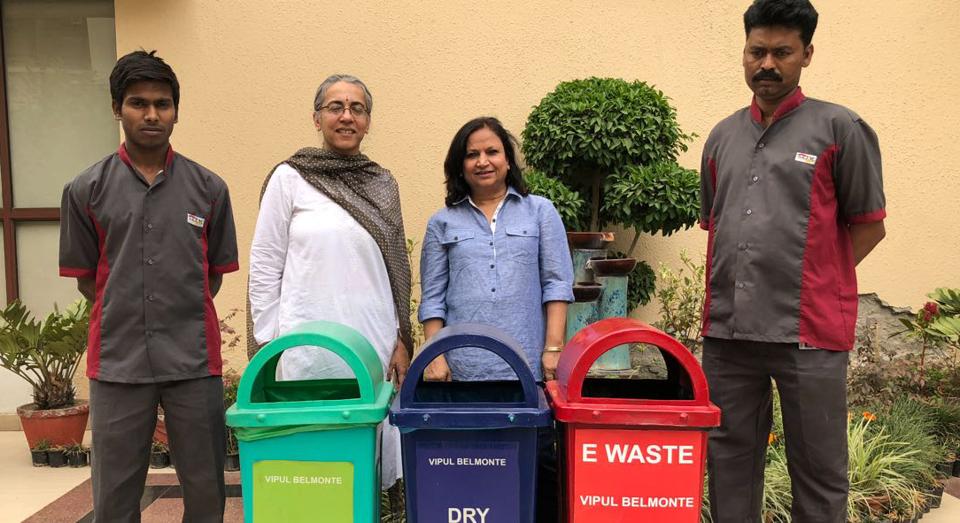
These RWAs continue to do this despite the Municipal Corporation of Gurugram (MCG) halting financial incentives for RWAs in October last year.The civic body had tied up with a private company for waste management then.
By adopting the solid waste management (SWM) project, both societies have reduced the amount of garbage going out of the complexes by approximately 65% to 70%. Out of the total waste generated, up to 50% to 60% of waste is organic and is composted in-house. An additional 10% to 15% of the dry waste is recycled.
Vipul Belmonte, a society with ten towers, includes 312 apartments and is located on Golf Course Road. A team of volunteer residents works closely with its house-keeping staff to segregate waste in the towers.
“Though it was a tough journey that took two years to change mindsets and consider alternatives, we now proudly stand as a group of residents with strong segregation habits who take pride in doing their bit. Regular open houses give insights to the team, as well as an opportunity to the attending residents to voice their thoughts and exchange ideas,” said Bhavna Sharma , a resident and a part of the volunteer team.
Read I Gurgaon: Waste collection service to start in all wards by March 31, says Ecogreen
Collated data from a survey conducted in the society, indicates that 76% of the community recycles, and a majority is willing to waive off personal monetary compensation for the larger community fund.
“While home composters stand at 8%, community composting solutions have become the need of the hour with segregated wet waste forming 60% of the total waste — a huge potential waiting to be tapped,” said Jyotika Bhaskar, another resident.
The residents take help from student volunteers during school holidays to conduct a survey and a door-to-door awareness campaign with demo videos on correct colour-coded disposal.
“Simultaneously, part-time help (all 300 employees that visit daily) is trained by resident volunteers on rotation duties, at the main gate between 5.00 am and 8.00 am,” said Nina Gupta, a resident.
Silver Oaks, a condominium with 700 flats, also launched a four-bin waste segregation campaign and, within 15 days, was able to segregate 90% of its waste.
“We implemented waste segregation through a strict ‘No Segregation- No Collection’ policy. There is a need for the MCG to form bye-laws to make segregation compulsory in the city, as per SWM Rules 2016. To say that people will not segregate is an excuse. The wide support and enthusiasm shown by our residents are proof that segregation is possible,” said Shona Chatterjee, a resident and member of the volunteer team at Silver Oaks.
“Once we started segregating, the waste generator soon understood what was compostable, recyclable, hazardous and rejected. The housekeeping staff, who are key to this project, were given several training sessions and are working very conscientiously,” said Surbhi Iyer, Silver Oaks Condominium Association.
MCG officials want to involve residents in the upcoming initiatives. “We are working on modules where residents will be felicitated for their contribution towards the society and for the city. We have not stopped all incentives, we are working towards much more,” said Yashpal Yadav, MCG commissioner.


