
 E-Paper



72-yr-old gives birth, doctors say she’s too old: What’s the right age?

 Prefer HTon Google


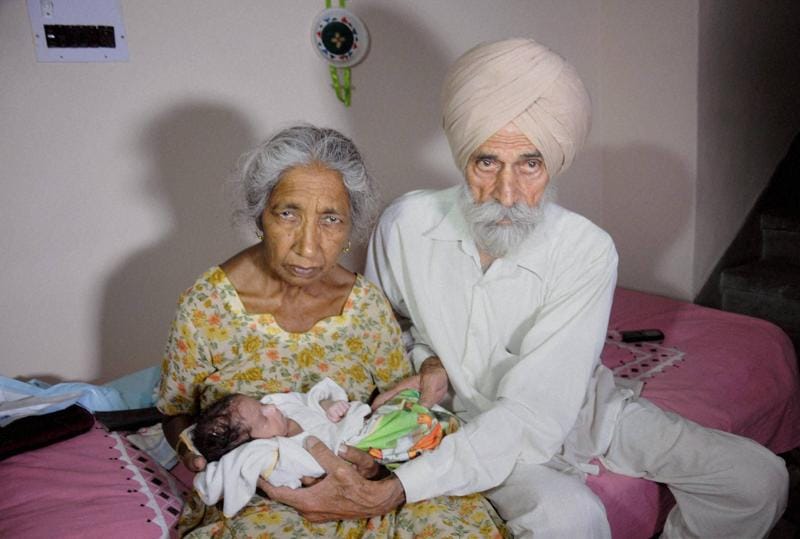
After 46 years of marriage, 72-year-old Daljinder Kaur finally gave birth to a healthy baby boy in April, after two years of fertility treatment in Haryana. She is one of oldest women to give birth in India. But some medical experts say she is ‘too old’.
After 46 years of marriage, 72-year-old Daljinder Kaur finally gave birth to a healthy baby boy in April, after two years of fertility treatment in Haryana. She is one of oldest women to give birth in India. But some medical experts say she is ‘too old’.
In Vitro Fertilisation (IVF), donated eggs and other fertility technologies might have opened up pregnancy to a lot of women, but their decision still attracts suspicion and controversy. For Dr Gunjan Kacker, senior IVF specialist at Aveya Fertility in Delhi, a late-in-life pregnancy is not a question of medical possibility but of unclear consequences. Hence she stresses there should be a cut-off age for women trying to be a mother.
Read: After IVF, in vitro gametogenesis the new way to have babies?
“Women should have children before it is too late,” she says, “Mainly because it could increase the risk of health complications for the child, and it would be unfair on the child to have old parents, who may not live long enough to see them grow up.”
Dr Laxmi Aggarwal, a gynaecologist from Kolkata, believes it was “unnatural” for women to have babies after a certain age. (Read menopause.)
Although, there is no legal age restriction for couples who want to have IVF treatment in India, the state-funded Indian Council of Medical Research (ICMR) advises against implanting embryos in women over 50.
“As a clinician, let’s be clear, I am not scare-mongering. It is a fact that a woman’s fertility potential declines rapidly after the age of 35 and drops even faster after the age of 40,” she says.
Anita Singh, an IVF specialist from Delhi, agrees that 40, or even 38, was ‘too old’ for women to have children, explaining: “From the ovaries standpoint, the number of eggs decline and the egg quality is poor. As a result, it is difficult to conceive and the conception maybe associated with a high rate of chromosome abnormalities and increased chances of miscarriage.”
Read: Mumbai’s first test tube baby, Harsha Shah, has a baby boy
“From the mother’s standpoint, there is a high risk of hypertension, pre-eclampsia (a pregnancy complication characterized by high blood) and caesarean section,” adds Dr Singh.
Dr Kacker said the ‘ideal’ age for women to become pregnant was in their twenties and early thirties. She even advises young women who may want to delay conception for any reason beyond the age of 35 to seriously consider egg freezing as their ‘insurance policy’.
Read: Commercial surrogacy, the half mothers of Anand
“Indeed, successful egg freezing through vitrification has made it possible for women to postpone conception to later in life but as a society, we should be encouraging couples to have children at a younger age, in fact, I recommend that couples should aim to complete their families by the age of 35,” adds Dr Kacker.
The author tweets as @SanyaHoon.


