
 E-Paper



Sexually transmitted infections are surging in Europe
The rates have risen steeply in the past decade, though they dipped during the pandemic


 Prefer HTon Google


TRACKING THE rate of sexually transmitted infections (STIs) is not easy. Many who carry them do not show symptoms. Testing is patchy. And risky behaviour easily goes unnoticed, since sex (thankfully) is usually performed in private. But public-health authorities do their best, and in recent years they have spotted a sharp increase in the incidence of several types of STIs in Europe.

The rates have risen steeply in the past decade, though they dipped during the pandemic, whether because of less diligent surveillance or less casual shagging. After 2021 they leapt upwards. In May the European Union’s Centre for Disease Prevention and Control (ECDC) reported that in 2024, the most recent year for which it has compiled figures, there were some 100,000 cases of gonorrhoea in Europe, more than three times as many as in 2015. Cases of syphilis more than doubled, to around 46,000. Chlamydia, the most common STI, is an exception: after peaking in 2022, prevalence has fallen back to the level of 2015.
The increases are not simply an artifact of more testing, the ECDC concludes. “There is a true increase in transmission happening,” says Dr Stela Bivol, who runs the World Health Organisation’s European office for STIs. The jump just after covid could be partly explained by testing facilities coming back online, says Dr Andrew Winter, an STI specialist in Glasgow, but the continued rise since then cannot.
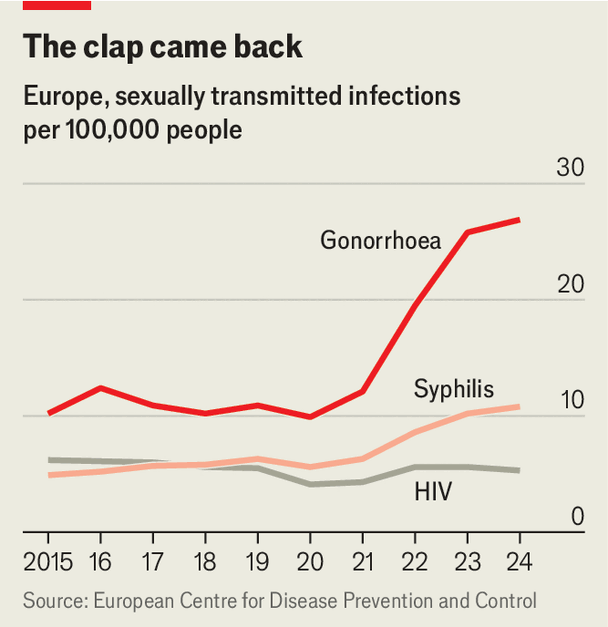
Why the venereal renaissance? Some blame reckless bed-hopping enabled by dating apps, but evidence for that is sparse. Most studies find that users of Tinder and other such apps are more likely to have multiple sexual partners, but that is partly because people seeking multiple sexual partners are more likely to be users. Dr Henry de Vries, a specialist in the Netherlands, notes that dating apps long predate the big rise in STI prevalence. “I would be cautious,” he says.
Another explanation, offered by Dr Bivol, is that people are using condoms less. But here too, the data is only suggestive. A study by the WHO that surveyed nearly 250,000 15-year-olds across Europe from 2014 to 2022 found a significant drop in reported condom use. But that is only one age group, and there is little data regarding changes in population-wide condom usage among those aged 20 and up, who account for the vast bulk of the STI cases.
A more specific hypothesis is that using pre-exposure prophylaxis (PrEP), a pill that fights the spread of HIV, leads more men (especially gay men, who are most at risk) to dispense with condoms. A study of patients at a British sexual-health clinic between 2015 and 2019, by Louis MacGregor of the University of Bristol and colleagues, supported that idea, though it noted that recipients of PrEP were overrepresented since they get mandatory testing for STIs.
What is not disputed is the surge’s danger. Sexual diseases are usually treatable, but they can be devastating if not caught soon enough. Over time, chlamydia and gonorrhoea can cause testicular infections in men and infertility in women. Syphilis can kill. One of the grimmest phenomena noted by the ECDC is a jump in congenital syphilis, passed on by mothers to their babies. This is rare but often fatal. Between 2023 and 2024 the number of cases doubled to 140, with clusters in Bulgaria, Portugal and Hungary.
Fighting STIs starts with working out where the surge is happening. Young men do not seem to be the problem. In the latest data, between 2023 and 2024, gonorrhea rates fell among males aged 15-24, but increased among older ones; overall they rose by 8% among men. Among women, gonorrhoea rates fell, though they remain above pre-covid levels, while rates of syphilis rose by 15%. The biggest increase was among those aged 20 to 34. The rise in STIs is not particularly concentrated among homosexuals: syphilis and gonorrhoea rates have also risen sharply among heterosexual men and women since the pandemic.
Geographically, the increase spans the continent. Some of the steepest rises in gonorrhoea between 2023-24 were in Bulgaria, France and Italy, while Belgium and Hungary saw sharp increases in syphilis. Both diseases spiked in Lithuania and Malta. Some poor countries report misleadingly low rates because of poor surveillance: in Romania, with a population of 19m, just 24 chlamydia cases were recorded in 2024 (far fewer, absurdly, than the number of syphilis cases). In a vicious circle, spotty data makes it harder to justify buying testing equipment and lowers public awareness of the risk.
The ECDC says better monitoring is needed, including information on the proportion of vulnerable groups that receive testing in each country, to put the rates recorded into their proper statistical context. Only a third of European countries provide this data. Knowing whether infections were passed on through homosexual or heterosexual contact could help make better public-health decisions, says Dr Otilia Mardh, an epidemiologist at the ECDC.
Outbreaks of resistance
Countries with widespread testing regimes are grappling with a different problem. Doctors treat STIs with antibiotics, which leads them to become immune to the drugs. Gonorrhoea has already developed strains that are highly resistant. Chlamydia and syphilis have not, but the decision to treat involves weighing the benefits against the risk. The Netherlands recently departed from orthodoxy by cancelling chlamydia screening for people with no symptoms, after studies showed that asymptomatic infections were less likely to damage fertility than had been feared.
Syphilis is another matter. But even there, resources could be used more efficiently. Congenital syphilis, which is easily treated, could be tackled with focused testing during pregnancy. Most EU countries do in fact test women for syphilis in the first trimester, but fewer than half follow recommendations to test those who are most at risk of the disease in the third trimester or at delivery.
One of the greatest barriers to enacting policies that reduce STIs is that many societies care less about the groups most at risk: men who have sex with men; migrants; and sex workers. In parts of central and eastern Europe the number of new HIV infections continues to rise, even as it has fallen elsewhere in the world. Stigma and discrimination, which deter people from seeking testing and treatment, are partly responsible. Dr Bivol fears the same will be true of other STIs.
But higher rates can themselves prompt a response. In Hungary a sharp rise in reports of congenital syphilis, which went from three cases in 2020 to 91 in 2024 (in part due to greater testing), led to much more rigorous screening. Dr Mardh notes that a recent study in which she participated found a drop in reported chlamydia cases in seven countries between 2023-24. A spike in gonorrhoea rates in the years before, the study found, had led to public-health campaigns encouraging safer sex. Sometimes fear is the best medicine.
To stay on top of the biggest European stories, sign up toCafé Europa, our weekly subscriber-only newsletter.
Catch your daily dose of Fashion, Health, Festivals, Travel, Relationship, Recipe and all the other Latest Lifestyle News on Hindustan Times Website and APPs.


