
 E-Paper



Delhi Master Plan 2047 proposes charges for vehicles to enter busy zones: What London, Milan, New York can teach us
MPD-2047 has floated congestion pricing for the Walled City, CP and Metro zones. Cities that tried it cut traffic and air pollution, and funded transit projects

 Prefer HTon Google


The Master Plan for Delhi 2047, notified by the Union housing and urban affairs ministry on August 20, has floated the idea of congestion pricing zones, under which authorities would be able to levy a cost on private vehicles entering areas with high traffic volumes.
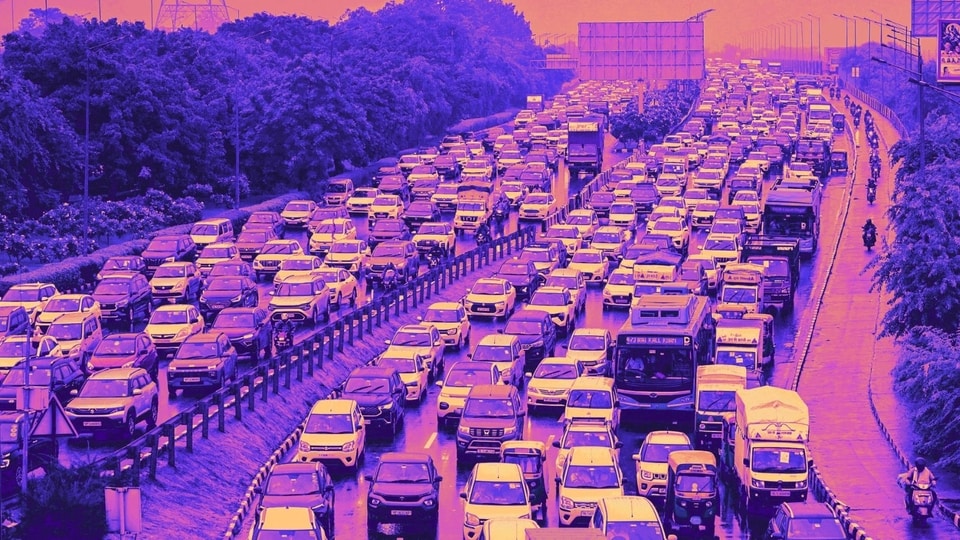
MPD-2047 proposes three possible zones: catchments around transit-oriented development (TOD) nodes, the Walled City Heritage Zone and the Metropolitan City Centre. TOD is high-density mixed-used areas around the Metro or other mass transit stations. The Walled City zone refers to Old Delhi areas such as Chandni Chowk, Sadar Bazar, Jama Masjid and Chawri Bazar. MCC includes Connaught Place, Janpath and Karol Bagh.
Radio frequency identification tags “may” be considered for enforcement, the document says, adding that parking charges could vary by location and time of day.
Housing and urban affairs minister Manohar Lal Khattar has since said there is no immediate plan to introduce the scheme in Delhi.
But if the proposal moves towards implementation, Delhi can learn from cities that did try to price their way out of traffic gridlocks:
The tools
Cities that unclog their core areas reach for a small family of instruments, and cordon-charging is only one of them. Singapore prices road use directly by time and place through its Electronic Road Pricing (ERP) system. London runs a daily flat fee on entry, layered with an Ultra Low Emission Zone (ULEZ) that charges by vehicle type. Stockholm and Milan combine cordon charges with fleet-turnover incentives. Paris has never introduced a congestion charge and has instead closed riverside expressways, dropped the citywide speed limit to 30 km/h, restricted older vehicles through its Crit'Air low-emission zone and reallocated road space to cyclists. Bogotá, Mexico City and Beijing use plate-rotation approaches that resemble Delhi's odd-even scheme.
Singapore, since 1975
The city-state pioneered central-area road pricing. Its Area Licensing Scheme in 1975 required a paper permit to drive into the central business district in peak hours. In 1998, it became the world's first fully electronic road-pricing system, run by the Land Transport Authority. Charges vary by gantry, time, vehicle type and prevailing road speed, and are revised quarterly. Singapore also caps car ownership itself through a Certificate of Entitlement auction.
London, since 2003
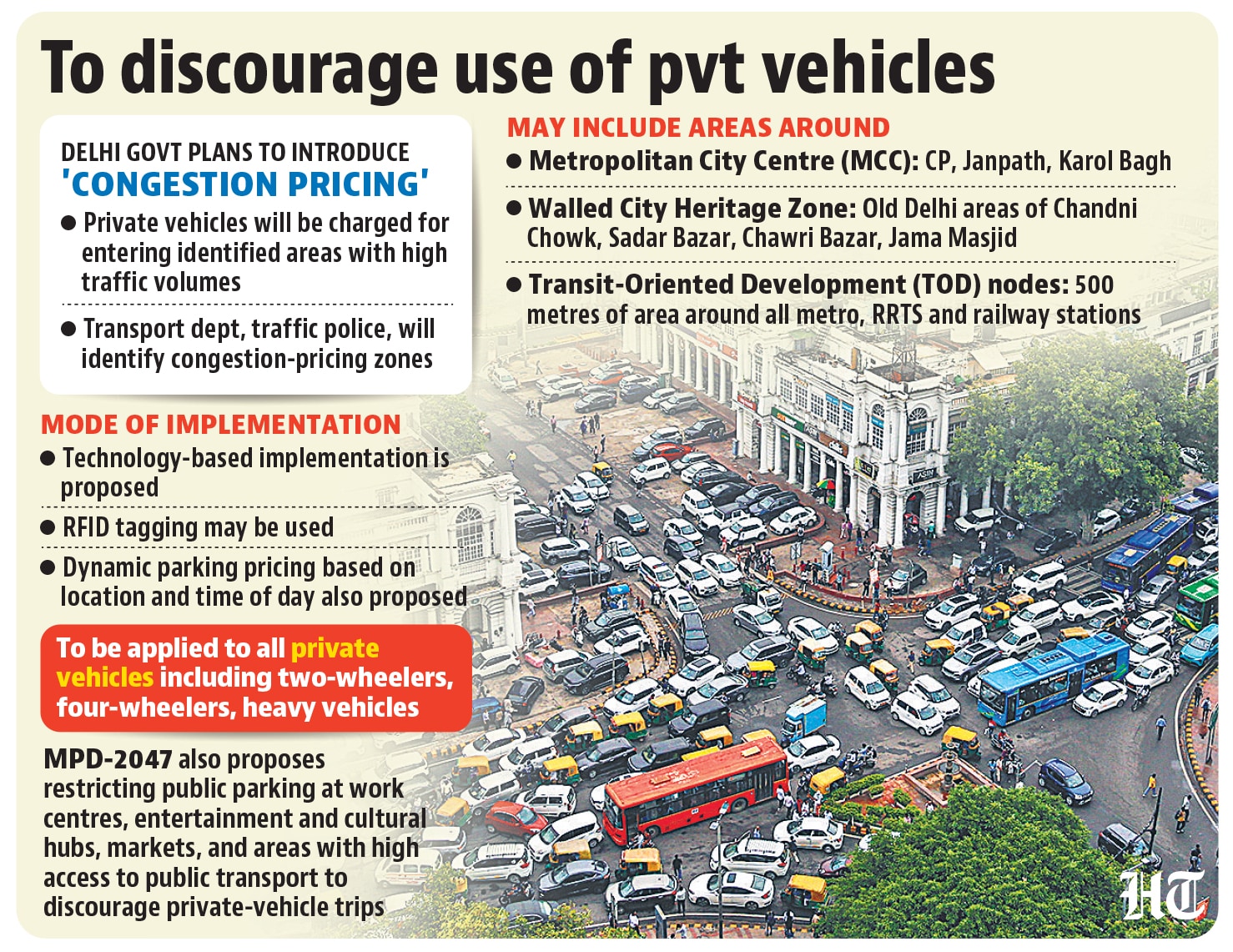
Then London mayor Ken Livingstone's £5 daily congestion charge went live on February 17, 2003. Transport for London's Impacts Monitoring reports over the next five years found that traffic entering the central London zone during charging hours fell about 18%, congestion within it fell 30%, and roughly half of those who stopped driving switched to public transport.
The traffic reductions held, though speeds later eroded as road space was reallocated to buses and cyclists.
In 2019, the British capital added the ULEZ, which charges by vehicle emissions rather than by trip and has since been expanded twice.
A 2020 study in the Journal of Urban Economics found the congestion charge cut several pollutants, but that a growing diesel fleet blunted NO₂ gains — a caution about unintended substitution.
London also runs an adaptive traffic-signal system across around 6,000 junctions that adjusts light timings in real time to smooth flows and reduce stops. The system, known as SCOOT (Split Cycle Offset Optimisation Technique), was developed by the UK's Transport Research Laboratory in 1979 and rolled out progressively across the city from 1985.
Under this system, sensors buried in the road at each junction count passing vehicles and measure the gaps between them second by second. That data is fed to a central computer, which continuously adjusts three things at once: how long the green light stays on for each direction, how long the full red-amber-green cycle takes, and how the timings at neighbouring junctions line up with each other. Because the settings shift with actual traffic instead of running on a fixed schedule, fewer vehicles pile up at red lights and more of them clear intersections in one go. That cuts waiting time and the exhaust fumes that cars release while idling.
The scheme's operators credit it with roughly a 12-15% cut in vehicle delays and a corresponding fall in idling emissions.
Also read: Traffic cops suggest road fixes, flyovers, cameras to ease west Delhi congestion
Stockholm, since 2006
The Swedish capital ran a seven-month trial of the cordon charge in early 2006, and put the question to a referendum in September that year before making it permanent in August 2007.
Jonas Eliasson and co-authors, writing in Transportation Research Part A in 2009, found that traffic across the cordon fell 22% during charging hours and remained stable, and inner-city carbon dioxide emissions dropped roughly 14%.
Public opinion, too, inverted during the trial, with substantial pre-trial opposition turning into a 53% majority in favour of the cordon by the referendum because commuters could feel the time savings on their morning journeys.
A 2021 study in the Journal of Human Resources by Emilia Simeonova, Janet Currie, Peter Nilsson and Reed Walker linked the scheme to a measurable reduction in children's acute asthma attacks.
Milan, since 2008
Milan started with Ecopass in 2008, an emissions-based charge on the most polluting vehicles entering the historic Cerchia dei Bastioni. When a citizen referendum in June 2011 backed a full congestion charge, the Comune di Milano replaced Ecopass in January 2012 with Area C — a €5 daily entry charge (now higher) covering the same 8.2 sqkm central zone, applied to almost all vehicles rather than only the polluting ones.
AMAT, the city's mobility agency, reports that vehicle entries fell about 30% and stayed lower; polluting-vehicle numbers dropped 49% between 2011, the last full year of Ecopass, and 2012, the first year of Area C.
An experiment also lined up when an Italian court briefly suspended the scheme in July-September 2012, with researchers using the interruption period to isolate causal effects of the charge. In a 2015 paper published in the Journal of Urban Economics, they said that the charge had measurably cut pollution and traffic.
Also read: Delhi Master Plan: Unified parking body planned, strategy to shift to managing demand
New York, since 2025
Manhattan's Central Business District Tolling Program went live on January 5, 2025, after years of legal battles and amid the Donald Trump administration's efforts to shut it down. Passenger cars pay $9 with an E-ZPass to enter south of 60th Street in peak hours.
Governor Kathy Hochul's office and the Metropolitan Transportation Authority reported on the programme's first anniversary that 27 million fewer vehicles entered the zone in 2025 than in 2024, an 11% decline.
The MTA said pollution inside the zone fell 22% and crashes fell 7%. The MTA collected more than $550 million in net revenue, which it plans to use as security for $15 billion in new borrowing to fund infrastructure and public transport projects. Importantly, bus speeds inside the zone rose for the first time in years.

Paris, the alternative
Paris has taken a different route. Successive mayors have not priced entry and have instead reshaped supply.
The Voies sur Berges expressways along the Seine were closed to cars in 2016, a citywide 30 kmph speed limit came in 2021, and Crit'Air banned older vehicles from the inner city.
Airparif, the regional air quality monitor, recorded sustained falls in NO₂ in central Paris over the last decade, though disentangling the causes is a contested topic.
The Paris case is particularly interesting because it shows a large capital cutting car dominance without any cordon charge at all.
The odd-even cousins
Bogotá's Pico y Placa (1998) and Mexico City's Hoy No Circula (1989) rotate vehicle registration number plates by day, and Beijing caps new registrations through a plate lottery.
But the efficacy of the programme has been debated. Studies by Lucas Davis in the Journal of Political Economy on Mexico City, and by Jorge A Bonilla in the World Bank Economic Review on Bogotá, found that the traffic gains eroded as households bought second, older vehicles to work around the restrictions.
Delhi's odd-even trials in 2016 were criticised along the same lines.
Also read: 21 Delhi spots emerge as repeat waterlogging trouble zones: Traffic Police
Questions for Delhi
Where the cities priced entry — London, Stockholm, Milan, New York — vehicle volumes inside the charged zones fell between 15% and 30%, and stayed down for the duration of the scheme. Air-quality gains were relatively lower, perhaps because background pollution and diesel exemptions blunted the effect.
Emissions-based charges of the Milan and London ULEZ variety, it appears, outperformed pure congestion charges on pollution.
For Delhi, MPD-2047's proposal raises some key questions.
Do the three candidate zones — TOD nodes, the Walled City and the Metropolitan City Centre — have public transport that can be an alternative to driving personal vehicles? Does the city have an enforcement architecture that can be effective? And will any revenue be ring-fenced for public transport and last-mile connectivity?


