E-Paper



Trump backs IMEC: What the India-Gulf-Europe corridor is, and why it is back in focus
The US President has tied the trade corridor to moving energy routes away from Iran. Funding, construction timelines and regional deals remain unsettled.

 Prefer HTon Google


US President Donald Trump on Tuesday endorsed the India-Middle East-Europe Economic Corridor (IMEC), a proposed network of sea routes, railways and other infrastructure linking India to Europe through the Gulf. He tied the project to efforts to move West Asia's energy infrastructure away from routes exposed to disruption during the ongoing conflict with Iran.
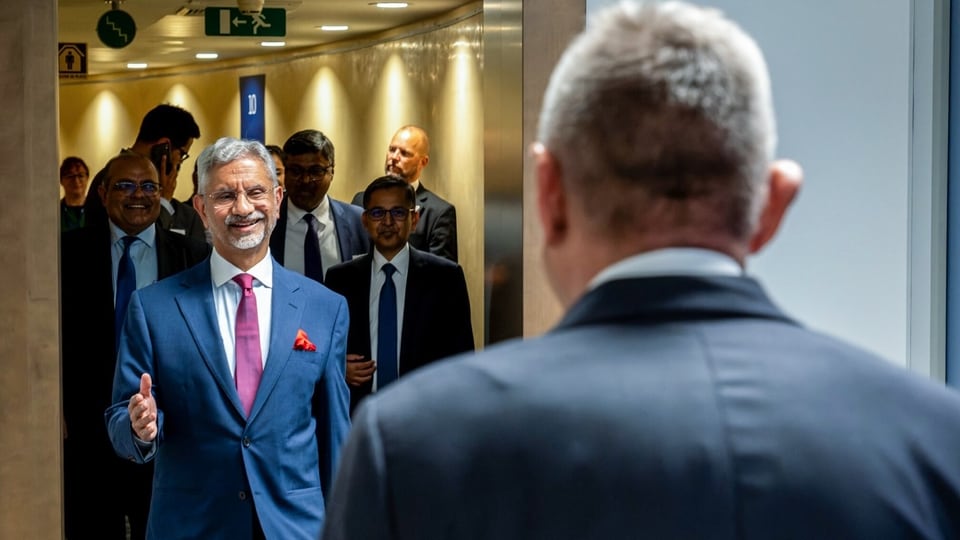
“Iran’s terrorist attacks on commercial shipping in neighbouring countries have shown the need to shift Middle East energy infrastructure away from the Iranian checkpoints,” Trump said on Tuesday, at a multilateral meeting with Gulf Cooperation Council (GCC) leaders on the sidelines of the UN General Assembly. “That's why my administration strongly supports the India-Middle East-Europe Economic Corridor and other places... the form of getting oil out, whether it’s pipelines or anything else,” he added.
The endorsement comes as disruption on key sea routes has brought the vulnerability of West Asia’s trade and energy networks into focus.
What is IMEC?
The corridor was formally unveiled at the G20 summit in New Delhi on September 9, 2023. India, the US, Saudi Arabia, the UAE, the European Union, Italy, France and Germany signed a memorandum of understanding (MoU) on it.
The plan has two key parts. An eastern section would connect India with the Gulf, and a northern section would link the Gulf to Europe through West Asia and the Mediterranean.
The Ministry of External Affairs (MEA) lists its objectives as better connectivity and efficiency, lower transport costs, stronger regional supply chains and greater trade accessibility. The project also envisages cooperation on energy and digital links.
At the announcement, Prime Minister Narendra Modi stressed physical, digital and financial connectivity and said IMEC could help strengthen economic integration between India and Europe.
Also read: Houthi escalation, Mecca Pact: Why India is watching West Asia closely | Point Blank
How would the corridor work?
Cargo from India would travel by sea to a Gulf port such as Fujairah in the UAE. It would then move by rail across Saudi Arabia and Jordan to Israel's Mediterranean coast, with Haifa as a key connection point. From there it would ship to Europe, where ports in France, Italy and Greece have been identified as possible destinations.
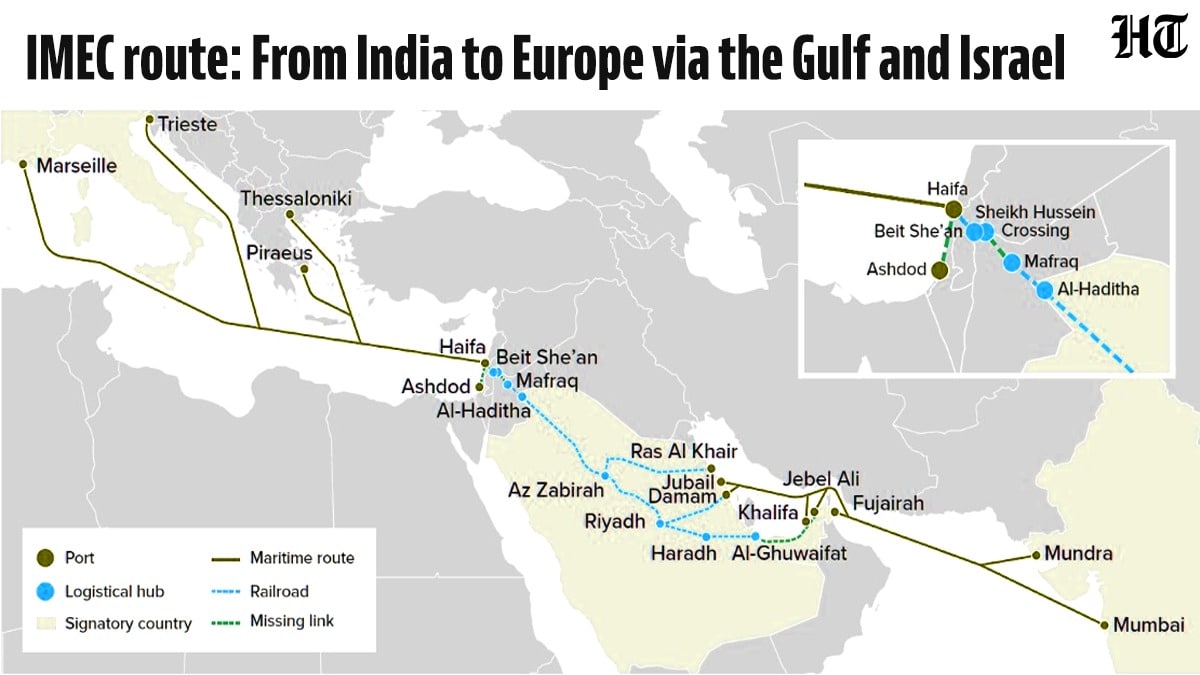
Each leg hands cargo from one mode of transport to the next. The corridor therefore works as a linked chain of ports and rail lines forming an alternative trade route between India and Europe, unlike a conventional single railway or pipeline.
Srikanth Kondapalli, a professor at Jawaharlal Nehru University (JNU), told news agency ANI on Wednesday (September 23) that IMEC is a “multi-billion-dollar initiative” combining sea and land transport, including road and rail networks.
IMEC has also been viewed as a potential counterweight to China's Belt and Road Initiative (BRI). The Council on Foreign Relations wrote in September 2023 that the corridor sought to counter China's infrastructure footprint through the BRI, while the Middle East Institute said in a June 2026 backgrounder that IMEC is “envisioned partially” as a counterweight to the BRI.
Why is IMEC back in focus?
The corridor was conceived at a time when regional economic integration was being pursued alongside diplomatic efforts in West Asia. The Hamas attack on Israel on October 7, 2023, and the Gaza war that followed changed that environment, and efforts to normalise ties between Saudi Arabia and Israel stalled. Conflicts involving Israel, Iran and other parts of West Asia have since complicated the political and logistical conditions the project needs.
The current disruption to shipping routes has renewed attention on maritime chokepoints. The Strait of Hormuz is a critical route for global energy supplies, and attacks and instability around other waterways have also hit commercial shipping.
IMEC was not designed as a simple replacement for Hormuz, and it cannot immediately replace the strait or existing sea routes for energy. The Institute for National Security Studies (INSS), in a September 2026 analysis, said the goal should not be to replace Hormuz but to create an architecture of redundancy through pipelines, ports and corridors. It also noted that existing alternatives have limitations, with Fujairah providing only a partial solution and no current alternative route for Qatari LNG exports.
IMEC's rail links, ports, pipelines and other infrastructure could, however, offer more ways to move goods and potentially reduce dependence on individual chokepoints. An Atlantic Council report published in June 2026 said an expanded IMEC network could hedge against disruptions at Middle East maritime chokepoints, although its proposal goes beyond the corridor's original route.
Also read: Bab el-Mandeb crisis: New geopolitical flashpoint in West Asia
What does India stand to gain?
For India, the corridor is mainly about connectivity, trade and access to markets. The MEA's stated goals include lower logistics costs, easier trade and more secure regional supply chains. The link through the Gulf would also give Indian exporters another physical route to European markets.
Kondapalli said IMEC could benefit from India’s expanding network of trade agreements. “The IMEC project is being talked about because: Number one, they want to resurrect trade and stabilise the West Asian situation. Number two, how to properly utilise the investments that Saudi Arabia and UAE have committed to. Thirdly, there is also the European interest,” he said.
“So as a broader project to combine all of these — the FTAs, the trade agreements, the transportation projects — the IMEC could benefit by initiating some construction work and going ahead with it,” he added.
India also keeps economic and diplomatic ties with countries on opposing sides in West Asia, including Iran, the Gulf states, Israel and the US.
IMEC also makes sense for New Delhi because India remains heavily exposed to disruption in Hormuz. Bloomberg reported in March that the strait carried nearly half of India's oil imports, while S&P Global said about 52% of India's roughly 5 million barrels per day of crude imports passed through Hormuz in early 2026, compared with 41% in 2025.
Why does the US back it?
IMEC was announced in 2023, during the Biden administration’s push for greater regional integration in West Asia. Under Trump, its rationale has also been linked to supply-chain security and to reducing vulnerabilities in energy and trade routes.
Trump also spoke in favour of the corridor during his meeting with Modi in February 2025, calling it “one of the greatest trade routes in all of history” and saying it would connect India to Israel, Italy and onward to the US. His latest remarks give it explicit backing at a time when the security of the region's shipping lanes has become a major concern.
“The American President’s suggestion and support to the IMEC is crucial because investments, markets, trade — the United States has huge leverage,” Kondapalli said.
The Middle East Institute (MEI), a Washington-based think tank, said in its June 3, 2026 backgrounder on IMEC that the project is aimed at upgrading connectivity through integrated trade, energy and digital networks, and described it as partly a counterweight to China's BRI. The institute also noted the corridor's potential to improve supply-chain resilience and regional connectivity.
What has held it back?
The regional political and security environment has been the main obstacle. “Because of the Gaza conflict and the Iranian conflict, the project has taken a back seat,” Kondapalli said.
In its June 3, 2026 backgrounder, MEI said implementation of the proposal remained uncertain, with no firm funding commitments or construction timelines in place as of May this year. It also said the regional relationships underpinning the corridor had come under strain since the announcement.
Trump's endorsement has put IMEC back in the international spotlight, but the corridor remains a long-term infrastructure proposal and not yet an operational alternative to existing energy routes.