
 E-Paper



The aftermath of the AUKUS deal at the Shangri-la Dialogue
The article has been authored by Harsh Mahaseth, an assistant professor, Jindal Global Law School, and the assistant director, Nehginpao Kipgen Centre for Southeast Asian Studies, O.P. Jindal Global University and Sanjana Chib, law student, Guru Gobind Singh Indraprastha University.

 Prefer HTon Google


The heads of government of Australia, the United Kingdom and the United States (UK and US) consists of a trilateral security pact, known by the acronym, AUKUS, the nuclear coalition has ignited unprecedented French rage. Without naming China, US President Joe Biden cleverly announced that “in order to deal with rapidly evolving threats,” the US and Britain would share with Australia, intelligence and advanced technologies in areas like Artificial Intelligence, cyber-warfare, nuclear submarine construction etc. The reason behind the formation of the AUKUS is seen as a historic security pact in the Asia-Pacific region, as an effort to counter China and its desire to reclaim territories which do not even belong to it.
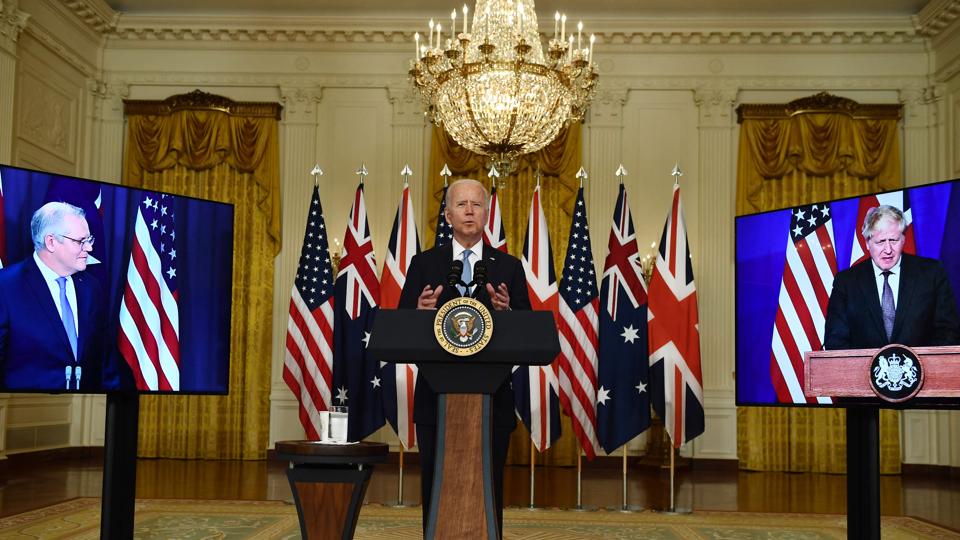
During the dialogue, US defence secretary Lloyd Austin addressed and reaffirmed the importance of ‘integrated deterrence’ and the ‘strategic power of partnerships’ with ones allies and trusted partners, while his like-minded counterparts from Japan, Australia and the UK appreciated the significance of Indo-Pacific coalitions such as the AUKUS arrangement itself as the arrangement gives away the message to the International community that they all oppose China’s aggression in the South China Sea as a threat to freedom of navigation in the critical waterway. On the other end, the arrangement proves to be a matter of worrisome confrontation between France and Australia, and clearly against the Chinese interests as it is nothing but attempt to control it by building a strategy of groupism or small circles to target the big country.
As far as China is concerned, it is articulated by its defence minister Wei Fenghe, that it’s a US strategy to act like the hegemon and create “exclusive blocs” to bully and confront others". China is extremely suspicious of the Quadrilateral Dialogues consisting of the US, India, Australia, and Japan, and their AUKUS (Australia-UK-US) technology-sharing agreement, which allows the US and the UK to help Australia get nuclear-powered submarines. Wei addressed the delegates at the Shangri-la and highlighted that Australia’s relations with China are complex and to ease that complexity, it is extremely important to mark ones presence at the dialogues such as the Shangri-la. He spoke about the AUKUS deal and said that it is nothing but an exercise to ensure the Indo-Pacific countries were “not put in a position of increased militarisation at the hands of the Chinese".
At the end, Australian defence minister Richard Marles, when asked about its government’s take on going forward with this proposal to consider purchasing nuclear propelled submarines answered that, “Australia is working on a long-range capable submarine, which can be the successor to Collins, and having nuclear propulsion is fundamental to that” Marles put a kibosh on the rumors regarding its strained military relations with the French and stated that it is currently having negotiations with Lockheed Martin, who were to provide the combat system, as a better alternative for the canceled French conventional submarine programme.
The article has been authored by Harsh Mahaseth, an assistant professor, Jindal Global Law School, and the assistant director, Nehginpao Kipgen Centre for Southeast Asian Studies, O.P. Jindal Global University and Sanjana Chib, law student, Guru Gobind Singh Indraprastha University.


