
 E-Paper



900k people, 241 zones: Mumbai’s mega plan to fight Covid-19
Each team comprises two or three Brihanmumbai Municipal Corporation (BMC) staffers, and is mandated to identify a containment zone, conduct door-to-door surveys, and get a questionnaire answered by all residents in that zone.

 Prefer HTon Google


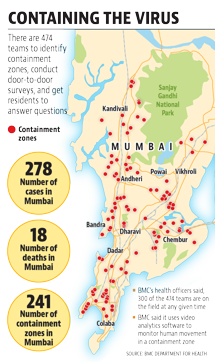
Mumbai: The worst Covid-19-affected city in India has activated 474 teams across 241 containment zones and checked at least 900,000 people as part of its plan to stop the spread of the Sars-Cov-2 virus through human-to-human contact. As of 9 pm on April 3, Mumbai had 278 positive cases and 19 deaths – the highest for any Indian city – according to data released by Maharashtra’s nodal state health department.
Click here for the complete coverage of the Covid-19 pandemic
Each team comprises two or three Brihanmumbai Municipal Corporation (BMC) staffers, and is mandated to identify a containment zone, conduct door-to-door surveys, and get a questionnaire answered by all residents in that zone. In Mumbai, a containment zone means at least one person from the area tested positive for Covid-19. The patient’s family and the building are identified as a cluster zone and at least four to five adjoining buildings on all sides are mapped in the containment zone, depending on the area’s population density. The greater the population density, the wider the radius of containment zone, a BMC health official explained on Friday.
Also Read: BMC has a containment plan for Dharavi
According to BMC protocol, the family and immediate neighbours of positive patients are tested, as they are considered high risk. Other residents of the building are considered low risk and are simply asked to be in home quarantine. They are also asked to keep a tab on emerging symptoms. Residents of adjoining buildings in the containment zone are also surveyed. Entry and exit from a containment zone is restricted and severe lockdown protocols are put in place.
“Each of these teams identifies at least 50 high risk cases per day,” a senior BMC health officer said. “These high risk persons are direct contacts and who have fever, cold, cough, breathlessness, etc. Depending on severity of the symptoms, we advise testing and visiting the closest Covid-19 hospital.”
Also Read: City’s Covid-19 fight goes into high gear
City health officials said this protocol differs from the guidelines issued by the Centre for identifying clusters and containment zones on account of Mumbai’s high population density (32,303 persons per square km). A senior civic officer said: “BMC has been given permission to draw up its own guidelines.” Across all other districts in Maharashtra, however, clusters are identified only if at least three persons are found to be Covid-19 positive in the area. Following that, an area of 3 sq km is screened.
Also Read: Check ‘no-go’ zones near your area on Mumbai civic body’s website
At present, BMC’s health officers said, 300 of the 474 teams are on the field at any given time.
BMC said it is uses video analytics software on top of the live footage it receives from 5,000 installed closed circuit television (CCTV) cameras across the city to monitor human movement in a containment zone. “No one is allowed to roam around in a containment zone,” said an officer involved in executing the containment zone strategy. “If the software spots any movement in the feed, the disaster control room is alerted. We are also updated on the instances of human movement and crowding. We activate the disaster management team and they ensure that people don’t move out. If people move out regularly, we are mandated to take action against them. Food and essential items are being delivered to persons in the containment zone.”
In addition to regulating movement, BMC said on Friday that it will start medical camps at the perimeter of containment zones. As no resident living in the containment zone is allowed to exit, any person showing symptoms of Covid-19 can approach the medical camp. “Patients with other illnesses can also approach the medical camp for a quick diagnosis, and referral to a hospital,” a health officer said. “This comes just days after reports of the death of a senior citizen in Kurla (in central Mumbai) due to a stroke. The senior citizen was a resident of a building sealed by BMC after a positive case of Covid-19 was reported. Residents alleged that policemen standing guard at the building did not allow the man to leave the premises for medical attention.


