
 E-Paper



'AAP's Aroras' face ED fire in Punjab: Minister arrested, state chief under lens as Mann alleges BJP vendetta
Industries minister Sanjeev Arora, himself a major businessman, arrested; Punjab AAP chief Aman Arora named in land scam probe

 Prefer HTon Google


Just over two weeks after seven of its Rajya Sabha MPs switched to the BJP, the Aam Aadmi Party (AAP) faced a fresh crisis on Saturday when a central probe agency, the Enforcement Directorate (ED), arrested Punjab industries and power minister Sanjeev Arora from his official residence in Chandigarh, making him the first sitting minister of the Bhagwant Mann government to be taken into such custody.
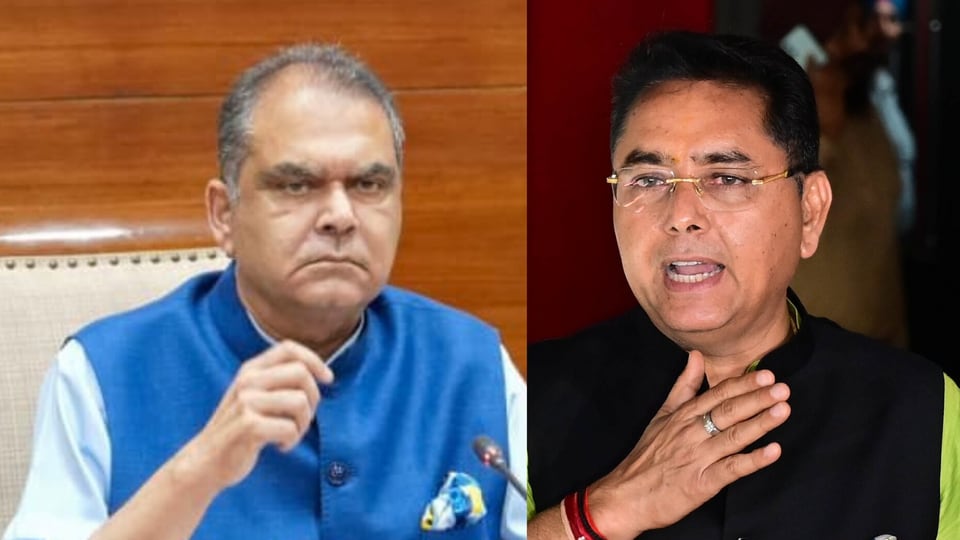
The arrest came at the end of a day of searches across over a dozen locations in Punjab, Chandigarh and Haryana, targeting Sanjeev Arora's residence, the corporate offices of Hampton Sky Realty Limited, and the premises of several associates. It is the third ED raid on Sanjeev Arora in under a year — the second in a single month.
What's the case against Sanjeev Arora?
The agency has been investigating an alleged ₹157-crore GST and export fraud involving fake invoices generated by non-existent firms in Delhi-NCR to claim input tax credit and export refunds on purported mobile phone purchases. Investigators have alleged that ₹102.5 crore was routed through two UAE-based shell entities.
Prior to Saturday's arrest, the ED had provisionally attached bank accounts, demat holdings and immovable assets linked to Sanjeev Arora and Hampton Sky Realty under foreign exchange- and tax-related laws.
Why lens on Aman Arora?
The arrest came less than 48 hours after the ED named Punjab AAP president and cabinet minister Aman Arora in a separate money-laundering and land scam investigation centred on two Mohali real estate groups, Suntec City and Altus Space Builders.
The ED has reportedly described builder Gaurav Dhir of Dhir Constructions as "a close associate of one of the high-ranking AAP leaders" and alleged that two middlemen had helped in securing “political patronage and protection”.
During the searches, bundles of ₹500 notes were allegedly thrown from the ninth floor of a Mohali high-rise — videos of which circulated on social media.
Aman Arora has denied any wrongdoing: "If any wrong is proved against me in any probe, I will leave politics." At a press conference in Chandigarh on Friday, he challenged the ED to conduct a “forensic examination” of his phone and questioned why his name was absent from the agency's first statement on the raids, only to be inserted in a second statement issued half an hour later.
Also read | ‘6.6% votes, 86% seats’ after Raghav Chadha shift: BJP sees Punjab RS spike, but assembly polls a challenge
What AAP has said
Chief Minister Bhagwant Mann, speaking at a press conference in Sangrur on Saturday, framed ED actions as part of a coordinated BJP strategy to destabilise his government.
“The BJP's motive is not to recover black money but to send a message that joining their party ensures immunity,” Mann said, pointing to the case of Rajya Sabha MP Ashok Mittal.
Mittal had faced ED action before defecting to the BJP along with six other AAP MPs on April 24 — and Mann alleged that the raids against him ceased immediately after he switched sides.
The seven defectors, including former AAP national general secretary Sandeep Pathak, former cricketer Harbhajan Singh, Raghav Chadha, Swati Maliwal and Vikramjit Sahney, reduced AAP's Rajya Sabha strength from ten to three. Six of the seven — barring Maliwal — are from Punjab.
Mann has accused the BJP of attempting to replicate in Punjab what he called a "politics of fear" similar to that deployed in West Bengal, where the party had recently come to power. He has since passed a confidence motion in the Punjab assembly, which the Congress and other opposition parties boycotted, and launched a statewide 'Shukrana Yatra' (gratitude tour) built around the state's new anti-sacrilege legislation.
When Majithia said ‘Arorey vi challe’
Shiromani Akali Dal leader Bikram Singh Majithia, who was jailed by state agencies for months on corruption charges, has used this as a chance to attack the AAP for its alleged hypocrisy over the alleged misuse of probes.
In a post on April 25 — one day after the Rajya Sabha defections — Majithia had written cryptically in Punjabi: "AAP de arore vi challe" ("AAP's Aroras will also go").
On Saturday, after Sanjeev Arora's arrest, Majithia detailed the ED's findings in a post on X, and claimed that Sanjeev Arora functioned as a financier for AAP.
Who are the Aroras, and what's their political heft
Punjab's assembly elections are due in early 2027. With its Rajya Sabha bench decimated, two of its most powerful cabinet ministers now under the ED scanner, and the BJP hoping to make a mark on its own in Punjab after a massive Bengal boost, the AAP is facing a severe test in the only state it still governs.
Sanjeev Arora, 60, a Ludhiana-based textile and real estate entrepreneur who entered politics in 2022 as a Rajya Sabha nominee of AAP, had resigned from the Upper House in July 2025 after winning the Ludhiana West assembly bypoll. He was replaced by another Ludhiana industrialist, Rajinder Gupta, who went to the BJP in the Chadha-led rebellion.
In the Mann cabinet, he now holds three of the most economically consequential portfolios — industries and commerce, power, and local bodies — an accumulation that made him arguably the most powerful minister after the CM himself.
He has said repeatedly that he had no interest in politics until the AAP led by Arvind Kejriwal approached him with a Rajya Sabha offer in 2022.
On the more recent question of possibly defecting to BJP, Sanjeev Arora has been unequivocal, publicly, and ruled out any defection. He asserted last month that he had not been in contact with Chadha for the past six months.
Also read | Chadha's anti-defection bill could've stopped his AAP-BJP switch
On the ED action, during the April 17 raids, when he was on an official visit to Amsterdam, Sanjeev Arora posted on X that he would fully cooperate with the investigation and expressed confidence that the truth would prevail.
Demographic matters
Sanjeev Arora's political significance lies partly in what he represents demographically.
He is a Hindu Khatri, a trading and business community with a strong presence in urban Punjab, particularly in Ludhiana, Jalandhar and Amritsar, and pockets across Punjab, such as Abohar-Fazilka.
Based on the last census, Sikhs are the majority in Punjab at approximately 58%, while Hindus constitute the second-largest group at roughly 39%. Other minorities, including Christians and Muslims, make up the remaining.
After AAP's 2022 landslide, credited by analysts to its dominance among Sikh rural and semi-urban voters, the party's induction of Arora was a signal to the urban Hindu merchant class, which had historically leaned BJP or Congress.
Aman Arora is, on that count, similar. But his political journey is whollly different. A second-generation politician from Sunam in Sangrur district, he carries forward the legacy of his late father Hardev Singh Arora, a Congress-era leader with deep roots in the Malwa belt.
He joined the AAP early, contested and won from Sunam in 2017, and has since risen steadily through the party structure to become both a cabinet minister and the state unit president. He holds the governance reforms and renewable energy portfolios.
This demographic is key to the BJP's hopes to make a mark in Punjab, where it currently has just two MLAs but has recently managed to get six of the state's seven Rajya Sabha MPs on its side.
It has declared it won't ally with the SAD, whose junior partner it remained until Sukhbir Singh Badal broke the pact over the later-withdrawn trio of agriculture-related laws during the 2020-21 farmers' protest.
The BJP got less than 7% of the vote in the last assembly election, when too it was not with the SAD; which it improved to 18% in the 2024 Lok Sabha polls but did not win a seat.


