
 E-Paper



Opposition unity unlikely to hamper 2024 election prospects: BJP
BJP is confident that the “development agenda” of PM Modi, along with his “popularity”, will outmaneuver the Oppn’s efforts to stop it from returning to power

 Prefer HTon Google


The Bharatiya Janata Party (BJP) on Thursday dismissed the opposition’s bid to stall the party’s electoral juggernaut as futile and unavailing, as several different parties are attempting to build a coalition against it ahead of the 2024 Lok Sabha elections.
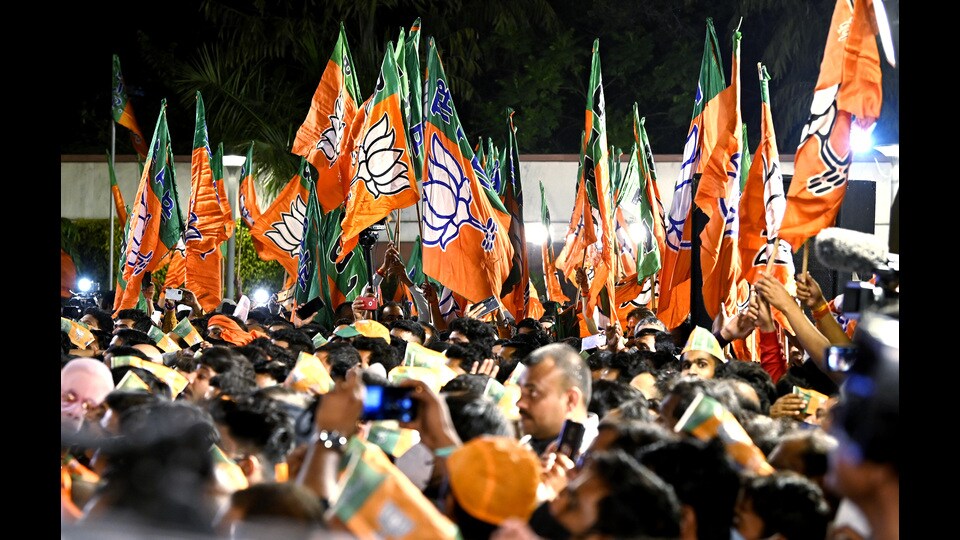
BJP leaders who spoke on conditions of anonymity said the party, which was voted to power at the Centre in the last two general elections with a decisive majority, does not anticipate an opposition bloc surviving the challenges of coalition politics and sees no threat to its narrative that combines development with ideology.
A meeting of the Congress, Janata Dal (United) and Rashtriya Janata Dal (RJD) leaders in the national capital on Wednesday set off speculations that the BJP will have to face a coalition of parties that have also been political adversaries.
A senior opposition leader privy to the meeting, attended by Congress’ Rahul Gandhi, Bihar chief minister and JD(U) leader Nitish Kumar and his deputy and RJD leader Tejashwi Yadav, said though attempts to foster a coalition have not yielded results in the recent past, the parties have identified uniting as a single entity as a worthwhile move to stop the BJP in its tracks.
“The BJP benefits from a multi-polar contest. If opposition parties join forces and contest as a single unit, then there is little chance of the anti-BJP vote being divided, which will be the only way to take on the party, particularly in the Hindi heartland states,” the opposition leader explained, wishing not to be named.
The opposition’s attempts to coalesce may have set off concerns in the BJP but its leaders asserted that such a grouping is unlikely to withstand internal pressures and conflicts.
“Coalitions and alliances have been part of India’s electoral politics. Even the BJP in the past has had alliances with unlikely partners, including the Left, but the success of an opposition bloc dethroning a government depends on the public mood more than the composition of parties,” a senior BJP leader said, seeking anonymity.
Citing examples, the leader said the Congress, which was considered a behemoth before the Emergency in 1975, was defeated after there was public outcry and people chose to accept a coalition of parties that were otherwise ideologically divergent.
“It is not enough for these parties to just come together to oppose the BJP. They must have a strong narrative, and leadership to pull it off. The Congress today that is aiming to be the nucleus of an anti-BJP coalition does not have a Harkishan Singh Surjeet or Pramod Mahajan or even Ahmed Patel to pull off an impossible alliance,” the BJP leader said.
While Mahajan and Patel played key roles in shaping the BJP-led National Democratic Alliance (NDA) and United Progressive Alliance led by the Congress, Surjeet was credited with bringing together the Congress, the Left front and a clutch of regional parties against the BJP in 1996 and 2003.
The BJP is confident that the “development agenda” of Prime Minister Narendra Modi, coupled with his “popularity”, will outmaneuver the opposition’s efforts to prevent the party from coming to power in 2024.
“What has been the biggest achievement of the BJP government – delivery of schemes, implementation of pro-people policies and inclusion of the most backward and deprived people in the list of beneficiaries. Will these people who witnessed change be swayed by the narrative of a handful of parties that have a record of corruption, casteism and dynastic politics,” a second BJP leader said, also seeking anonymity.
Opposition leaders, meanwhile, were optimistic after Wednesday’s meeting, with Gandhi calling it a "historic step" and a process that will “develop the Opposition's vision for the country".
“The BJP has already reached its saturation point in the North... In 2024, it may not be able to repeat its performance in states such as Madhya Pradesh, Rajasthan and Uttar Pradesh. It has set its sights on the southern region to increase its overall tally from 303 Lok Sabha seats in 2019. In the event if the opposition putting up a united front, the BJP’s southern expansion too will get a jolt and its score in the heartland states will also dip, because regional satraps will come together,” said the opposition leader quoted above.
The BJP is unfazed by the observation and asserts that vote banks are not captive and any alliance that is not bound by a powerful narrative and a common minimum programme will come with a limited shelf life. It is also banking on inherent ideological differences of the parties to bring down the attempts to unify against it.
“There is a difference between allying on paper and being able to set aside contradictions and aspirations. Will the Congress that takes on the AAP in Delhi want to give them a bigger role? Will the TMC that fights against the Communists bury the hatchet? In UP, who will want to cede space to the opposition? The BSP and SP have traditionally been rivals,” said a third BJP leader.
The third BJP leader, however, admitted that the party would need to revisit its own alliance in the wake of the opposition bloc and the regional parties gaining heft.
Over the past nine years, the BJP has lost some of its oldest allies including the Shiv Sena (Uddhav Balasaheb Thackeray), the Shiromani Akali Dal and the Telugu Desam Party.
Should the opposition coalition worry the BJP? Political commentator Sanjay Kumar said, “If the opposition parties are divided into two or more blocs, the BJP has nothing to worry about, but should they put up a common candidate, then the party faces a challenge.”


