
 E-Paper



BJP’s new Uttar Pradesh Rajya Sabha team: Who are the eight new faces?
The list brings together OBC, Dalit and upper-caste leaders, two women and several organisational functionaries

 Prefer HTon Google


The Bharatiya Janata Party’s decision to field eight candidates from Uttar Pradesh for the upcoming Rajya Sabha elections is being viewed less as a routine exercise in filling Upper House vacancies and more as an early indication of how the party is preparing for the 2027 assembly election.

The list brings together OBC, Dalit and upper-caste leaders, two women and several organisational functionaries. It also creates a careful regional spread—from western UP and Rohilkhand to Braj, Awadh and Purvanchal.
At one level, the arithmetic is straightforward: three OBC faces, two Dalits, two Brahmins and one Rajput. At another, the choices reveal a more nuanced attempt to expand the BJP’s social coalition without unsettling its traditional support base.
Deep Dive

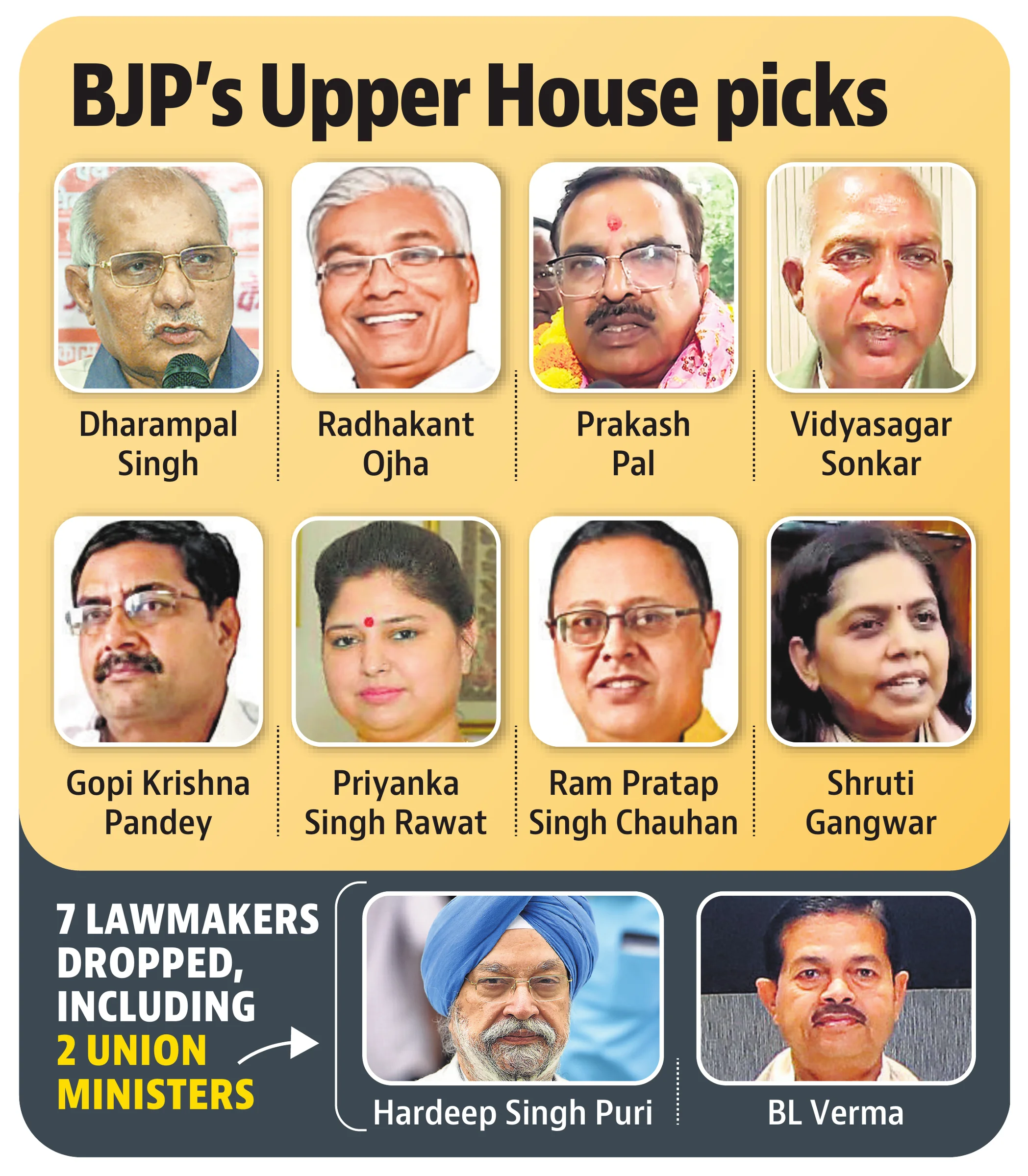
Dharampal Singh: The Lodh OBC anchor
Dharampal Singh is among the most consequential choices in the list. A cabinet minister in the Uttar Pradesh government holding the livestock and dairy development portfolios and MLA from Aonla in Bareilly, Singh is one of the BJP’s prominent Lodh Rajput/OBC leaders in western Uttar Pradesh.
His importance goes beyond his caste identity. He has been active in both the BJP organisation and government for a long period, making him a politician who combines electoral experience with organisational familiarity.
His Rajya Sabha nomination could therefore serve a dual purpose. The BJP gets a seasoned OBC voice in Parliament while reinforcing its hold over the Lodh community, particularly in western UP and adjoining regions. It also fits the party’s broader effort to retain the non-Yadav OBC constituency, which has been an important component of its electoral success in the state.
Radhakant Ojha: Brahmin outreach through the legal fraternity
Senior Prayagraj advocate Radhakant Ojha, a former president of the Allahabad high court Bar Association, brings the legal and professional establishment into the BJP’s new Rajya Sabha group.
His selection carries significance for the party’s Brahmin outreach. Ojha is regarded as a prominent face among the educated and professional sections of the community and has a substantial connection with the legal fraternity.
His presence could also prove useful in Parliament, where constitutional interpretation, legislation and judicial matters frequently dominate Upper House debates.
The political message is equally clear: while the BJP is expanding its OBC and Dalit representation, it is not allowing its traditional upper-caste constituency to become politically secondary.
Prakash Pal: The BJP’s OBC organisational face
Prakash Pal, president of the BJP’s Uttar Pradesh OBC Morcha, is perhaps the clearest expression of the party’s backwards-class strategy.
Pal, who belongs to the Gadaria/Pal OBC community, has previously headed the BJP's Kanpur-Bundelkhand region. His organisational background makes his nomination particularly relevant.
The BJP is effectively putting one of its principal OBC mobilisation faces into Parliament. This assumes greater importance as the Samajwadi Party continues to push its PDA narrative.
Pal can become part of the BJP’s counter-narrative: that backwards-class representation is not the preserve of one party or one dominant OBC community.
Vidyasagar Sonkar: A Dalit bridge to Purvanchal
Vidyasagar Sonkar, a member of the Uttar Pradesh Legislative Council and former BJP state general secretary, represents the party’s Dalit outreach in eastern Uttar Pradesh.
Sonkar, from the Sonkar/Khatik community, has a long association with the BJP organisation and is regarded as a significant Dalit leader in the Jaunpur-Purvanchal belt.
His nomination gives the party both social representation and organisational experience. It also fits the BJP’s continuing attempt to consolidate Dalit communities beyond the traditional Jatav political base.
Gopi Krishna Pandey: Retaining the Brahmin pillar
Senior BJP organisational leader Gopi Krishna Pandey is the second Brahmin nominee from UP.
His political utility lies less in electoral prominence and more in his organisational work, particularly in strengthening the BJP’s connect with the Brahmin and wider prabuddh varg in the Purvanchal and Awadh regions.
His inclusion alongside Ojha indicates that the BJP is trying to achieve a delicate balance: expand among OBCs and Dalits while keeping its traditional upper-caste social foundation firmly intact.
Priyanka Singh Rawat: Dalit women’s representation
Former Barabanki MP and BJP state general secretary Priyanka Singh Rawat adds both a Dalit and a woman’s face to the list.
A leader from the Pasi community, Rawat has remained active on public-interest and women-related issues in her political career. Her nomination gives the BJP a woman leader with previous parliamentary experience rather than a purely symbolic representation.
For the party, the calculation extends beyond caste. Dalit women constitute a politically important constituency, and Rawat provides the BJP with a recognisable face for that outreach in central Uttar Pradesh.
Ram Pratap Singh Chauhan: The Braj-Rajput component
Former Etmadpur MLA Ram Pratap Singh Chauhan brings the Braj region and Rajput community into the equation.
A senior BJP leader and long-time organisational worker, Chauhan represents the party’s traditional Kshatriya support base in the Agra-Braj belt.
His inclusion is significant because the BJP’s social engineering in UP is not designed to replace its upper-caste coalition. Instead, the party appears to be adding OBC and Dalit layers to it. Chauhan’s presence, therefore, provides a counterweight to the OBC-heavy component of the list.
Shruti Gangwar: Women, youth and the Kurmi factor
Shruti Gangwar adds another dimension to the BJP’s calculations in Rohilkhand and the Bareilly region.
A young and active woman leader, Gangwar, comes from the Kurmi OBC community. Her nomination consequently serves two purposes—expanding OBC representation and increasing the visibility of women in the party’s parliamentary team.
The Rohilkhand connection is equally important. Along with Dharampal Singh, her presence gives the region substantial representation and allows the BJP to reinforce its connection with the Kurmi/OBC constituency.
Eight names, one larger political design
The BJP’s UP list, therefore, goes beyond a simple caste count. It combines Lodh, Gadaria/Pal and Kurmi OBC representation; Sonkar/Khatik and Pasi Dalit representation; Brahmin and Rajput faces; women; youth; and organisational experience.
Geographically too, the spread is deliberate—Rohilkhand, western UP, Braj, Awadh and Purvanchal all find representation.
The broader political objective appears to be to build a coalition capable of withstanding the SP’s PDA mobilisation. The BJP’s response is not to abandon its upper-caste base but to broaden it: non-Yadav OBCs and non-Jatav Dalits alongside Brahmins and Rajputs.
What makes the exercise particularly significant is that several nominees are not merely caste representatives. They are organisation-oriented leaders who can carry the party’s message into their respective communities.
The Rajya Sabha, in this calculation, becomes more than the Upper House. It becomes a platform for constructing the BJP’s next generation of social connectors and political messengers in Uttar Pradesh.
And with 2027 approaching, the message from the list is unmistakable: the BJP wants to fight the next UP election not only on its governance record but also on who represents which community, region, and generation within its political coalition.


