
 E-Paper





Rezaul Hasan Laskar is Foreign Editor with the Hindustan Times, which he joined in 2015. He began as a journalist in his hometown of Shillong in northeast India and has worked in newspapers and wire services over the years. He moved to New Delhi in 1997 and initially focused on defence, national security, Jammu and Kashmir and the northeast, while also working of foreign policy and international relations. He has been part of the media delegation accompanying PMs on foreign visits and has reported from destinations ranging from Tibet to Ukraine. Between 2007 and 2013, he was the Press Trust of India correspondent in Pakistan, one of only two Indian journalists allowed to report from the country. He extensively covered Pakistan’s domestic politics and the life of the common people, as well as the fallout of the 2008 Mumbai attacks on India-Pakistan relations and the subsequent trial in Pakistan of the suspects involved in the attack. As part of his reportage in Pakistan, he travelled the breadth of the country, from the Swat Valley to Balochistan. Reza’s first gig in journalism was writing a weekly music column, and music – especially classic rock – remains a keen interest. He is also a movie buff and a keen photographer.
Colombo Security Conclave adopts 2026-27 roadmap to boost maritime security, counter terror
Ajit Doval attended the CSC meeting in the Maldives, where member states adopted a 2026-27 roadmap covering maritime security and counterterrorism.

The members of the Colombo Security Conclave (CSC) have adopted a roadmap of cooperation for 2026-2027, with deliverables and activities in areas such as maritime security and countering terrorism and radicalisation.
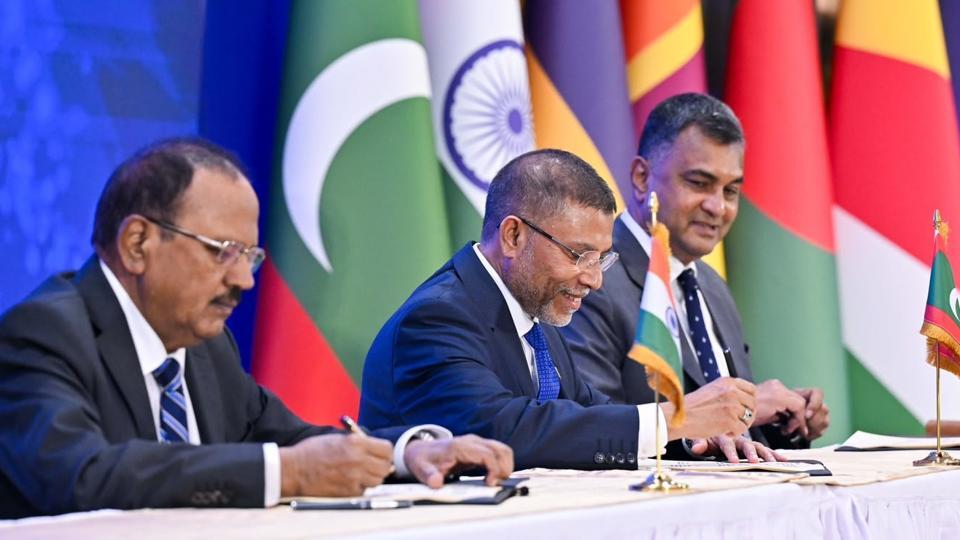
A meeting of national security advisers of the CSC was hosted by the Maldives at Villa Nautica Paradise Island on Wednesday. India was represented at the meeting by a delegation led by National Security Adviser Ajit Doval.
The CSC includes India, the Maldives, Mauritius and Sri Lanka and has emerged in recent years as a key platform for countering terrorism and ensuring maritime security in the Indian Ocean.
The external affairs ministry said on Thursday that the CSC member states adopted the roadmap of cooperation, which sets out key deliverables and planned activities under the five pillars of cooperation – maritime security, countering terrorism and radicalisation, combating trafficking and transnational crime, cybersecurity, protection of critical infrastructure and technology, and humanitarian assistance and disaster relief.
In addition to delegations from the Maldives, Sri Lanka and Bangladesh, Australia and Malaysia participated in the meeting as guests. Australia was represented by Sarah Storey, head of the office of Southeast Asia in the Department of Foreign Affairs and Trade, and Malaysia by Khairul Azhar bin Abu Bakar, director of the maritime security division at the National Security Council.
During the meeting, the CSC’s first secretary general, Vice Admiral SN Ghormade (retired), presented a review of the actions taken to implement the decisions of the last meeting of the national security advisers in New Delhi in November 2025.
The member states also reaffirmed their collective commitment to promoting regional peace and security through sustained cooperation. They emphasised the need to strengthen collaboration across the five pillars of cooperation, especially through training and capacity-building initiatives, and underlined the importance of collective efforts to advance the objectives of the CSC.


