The festival of Diwali is just a couple of weeks away. Cultural and religious considerations aside, the biggest festival of the Hindu calendar is also a critical period for the economy as consumption demand peaks. Given the background of the pandemic’s impact, festive demand will be even more important for the economy. How does this year’s festive season look when compared to last year’s? Here are five charts that answer this question.
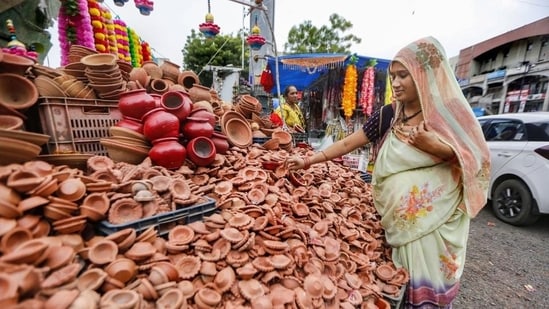
A vendor arranges earthen lamps at her shop ahead of Diwali in Ahmedabad on Monday. (PTI Photo)
The pandemic has ebbed ...,
This holds no matter which indicator one looks at. India’s first wave of Covid-19 peaked in September 2020, if one takes seven-day average of daily new cases as the metric. The second wave of the pandemic peaked on May 9, and was far more severe. Since then, the situation has improved radically. Current levels of daily new cases and positivity rates (cases found per hundred tests conducted) are a third those between Dusshera and Diwali last year. The situation looks even better if Kerala is excluded from the comparison, as it accounts for more than 50% of daily new cases at the moment, but accounted for less than 20% of cases between Dussehra and Diwali last year.
... mobility levels, especially for retail and recreation, are much higher...,
What is especially encouraging about the pandemic’s situation is that cases have not gone up despite a significant rise in mobility levels. Data from Google Mobility Indices shows that mobility levels are significantly higher than what they were during the festive season last year. This holds for retail and recreation, transit stations as well as workplace mobility. That India has managed to partially vaccinate at least 75% of its adult population and has fully vaccinated around 33% has definitely played a role in this virtuous combination of high mobility levels and low daily new cases.
... and concerns about inequality aside, the economy is looking good...,
Whether one takes ultra-high frequency indicators such as the Nomura India Business Resumption Index (NIBRI) or RBI projections for GDP in the quarter ending December 2021, the economy’s prospects are definitely looking better compared to last year. NIBRI was at 105.3 in the week ending October 24 compared to 83.3 a year ago (week ending October 25, 2020).
As per the latest projections of the Monetary Policy Committee (MPC), GDP growth in the quarter ending December 2021 is expected to be 6.8%. These numbers however do not mean that a broad-based jump in consumption demand is guaranteed. RBI’s Current Situation Index (CSI) has not had much of a recovery compared to last year. It was at 57.7 in the September 2021 round and 49.9 a year ago. Some of the divergence between indicators such as CSI and NIBRI is also on account of the fact that the latter mostly track the formal and well-off sectors of the economy.
... but commodity prices are a much bigger problem at the moment ...,
Headline numbers on retail inflation, as measured by the Consumer Price Index (CPI) might not show this. Annual growth in CPI was 7.3% in September 2020. This number was just 4.4% in September 2021. A lot of the relief in headline CPI numbers is because of a moderation in food prices. The situation changes when one looks at other measures of prices. For example, India’s crude oil basket was priced at $ 40.7 per barrel in October 2020. It reached $83.2 on October 22, latest data from the ministry of petroleum showed. The Bloomberg Commodity Price Index was at 72.01 on October 25, 2020. It has risen to 105.03 on October 25. If commodity prices continue to increase or even stay at their current levels, they will add to headwinds facing the Indian economy.
...,even as a short-term supply crunch adds to worries about long-term demand.
The current commodity price spike is unlike what the world has seen in the past. This because it has been accompanied by a clogging of global value chains thanks to a shortage of critical inputs such as microchips, even shipping containers. This means that many businesses, such as those making cars and high-end personal gadgets, might not be able to meet demand for the festive season. A lot of the demand might dissipate if there are no supplies in the crucial window. This, when read with the fact there are long-term concerns about India’s growth potential – the IMF has slashed India’s potential growth from 6.25% to 6% -- is not exactly good news. While this is definitely a concern for the economy going forward, and needs concerted policy intervention, it does not take away from the fact that this year’s festive season is definitely better for the economy compared to last year.
Follow India news real-time updates and the latest news covered on Hindustan Times, featuring today's critical updates on Sonam Wangchuk LIVE and more across India.
Home/India News/Comparing The 2021 Festival Season With The One In 2020

 E-Paper