
 E-Paper



Confusion prevails as Assam receives final list of exclusions
HT found widespread confusion about the road ahead and ignorance about documentation defects .

 Prefer HTon Google


It is 9.30 am and a sprawling single-storey building in Sutargaon village in central Assam’s Hojai district is decked with red and violet balloons. Outside, armed guards with machine guns keep a watch on a steady stream of people pouring into the building.
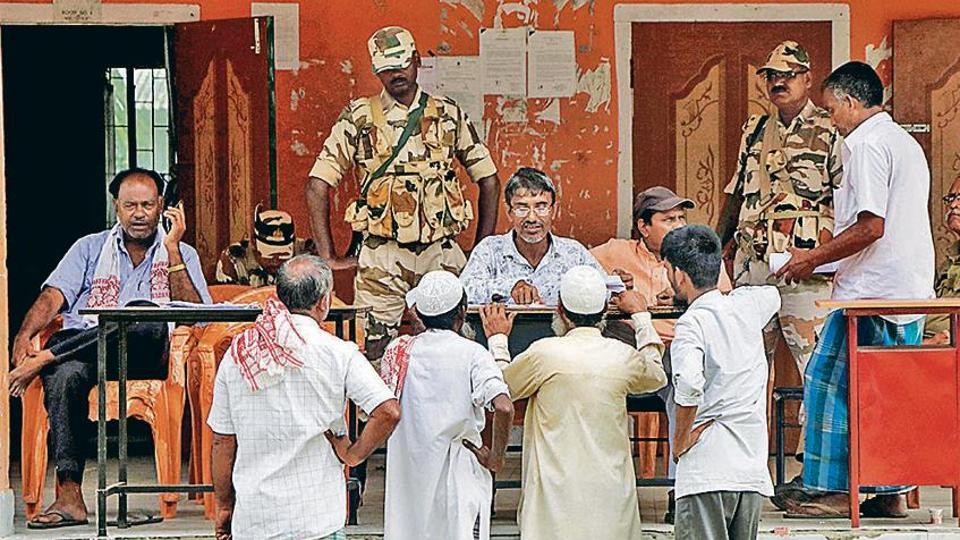
As the clock strikes 10, people run to catch a glimpse of deputy commissioner TP Borgohain, who has arrived to release the final list of the National Register of Citizen (NRC). He is presented with a pair of scissors to cut the ceremonial ribbon and handed over a yellow envelope with the list of names, neatly encased in glittering wrapping paper. “It is a historic day for all of us,” he said amidst applause.
Salma Khatun’s home is a few metres away, but she has already found that her application had been rejected. Born in Nagaland’s Dimapur, the schoolteacher had submitted her birth certificate, school-leaving certificate and PAN card. “They are bound to give us another chance, right?” she asked. One town away in Doboka, Mohammad Babul Uddin has discovered that neither he nor his six children have made it to the NRC list, because his grandfather, Jalal Uddin, was marked as a ‘D’ or doubtful voter — an exercise carried out by election and border police officials. Though Babul has a passport, he worries that it will be impossible for his family to claim NRC status because Jalal Uddin died in 2017. “I only found out about the D voter status when a hearing notice came on August 10,” he says. “He has high pressure now. Sometimes it feels like we are dying slowly,” added Halima Begum, Babul’s wife.
After four decades of protest and agitation against so-called illegal immigrants in Assam, the final NRC was published on Saturday, in which 33 million people were included and 1.9 million were excluded.
In interviews with 30-odd people cutting across religion, language and ethnicity in Hojai district, which recorded the highest rate of exclusion in an earlier draft, HT found confusion about the road ahead and ignorance about the defects in documents that shunted people out of the list. Additional interactions with people in four other districts revealed that exclusions cut across communities.
Derapathar village in Hojai is a settlement of 12,000 people, comprising Bengali-speaking Hindus and hill-based and plains-based tribal people, most of whom claim to be refugees. On Saturday afternoon, the slow hum of the village life has not been affected. Groups of men sit on bricks on the side of dirt tracks, playing cards. Every few minutes, someone comes back from the local NRC centre, carrying news of their citizenship status.
For Parimal Majumdar, the news is not good. While he is on the list, his wife Khuki and three other women relatives have been excluded. His neighbour Ranjit Das laments that while his two brothers and their families have been included, neither he nor his sons are in the list. “We used the same documents, so I don’t know how this happened,” he added. For Das and Majumdar, who claimed to have settled in Derapathar in 1967, the rejection was a clear sign of hostility towards Bengali-speaking Hindus.
There appeared to be four main reasons for exclusion, according to a senior official familiar with the exercise.
One, people did not possess documents from the so-called list A that comprised 14 mandatory documents, including NRC of 1951 and voter lists of 1961, ’66 and ’71. These documents were necessary to show that an applicant or their ancestor lived in Assam before the cut-off date.
The second was small inconsistencies in name and surnames of the ancestor who was said to have been present in Assam before the cut-off date of March 25, 1971. According to the NRC process, a person has to draw a link to an ancestor who was in Assam before the cut-off date, but a mistake in even a single letter rendered the applicant ineligible.
The third was a mismatch in the so-called family tree verification. Applicants were asked to provide a family tree of relatives, which was matched with a computer-generated version of the same. Any discrepancies were sorted out at a hearing.
The fourth, people declared as foreigners by tribunals, people marked as ‘D’ voters and those with cases pending before tribunals (and the descendants of people in each category) were found to be ineligible for NRC.
To be sure, there is a mechanism in place to ensure that those who have been incorrectly excluded can rectify the error. Over 4 million people were left out after the draft NRC was published last year, and were given a month to file their appeals. Subimal Hajong, a retired SSB personnel, was one of them. After re-submitting his documents, his name is now on the latest NRC list. However, his 75-year-old mother continues to be left out.
“I will appeal once but if it doesn’t happen, then I don’t know. She doesn’t have long to live, and how will we go back to Meghalaya to get all the documents?” he asked. Among those left out, there is widespread confusion. The government has said that these people will be given 120 days to appeal before a foreigners’ tribunal, a quasi-judicial body that adjudicates on whether someone is an illegal immigrant. There are 100 such tribunals across the state and 200 are in the process of being set up.
Binita Dalu, a tribal woman, for example, did not know what to do once left out of the NRC. She had never heard of a foreigners tribunal and reposed her faith in the local village headman to sort out her citizenship status. “I don’t know what will happen. People have been telling me they may grab me in the middle of the night or put me in detention camp, but I am sure it will not happen. I will just refuse to leave,” she laughed. The government has repeatedly clarified that no drastic steps will be taken to curtail political rights or enforce detention.
Promod Bodo, president of the All Bodo Student Union, said the exclusion of some members of the state’s largest tribal community, showed that the NRC exercise would not put an end to the foreigners debate. “I am not satisfied. Barring the Supreme Court, nobody else has worked honestly. Several Bodos have been left out. How can we consider it to be a correct exercise? This is why we earlier said that there should be review,” he said .
Kishore Upadhyay, Bharatiya Janata Party (BJP) leader and general secretary of the Assam Gorkha Sammelan, said tens of thousands of people from the Gorkha community may have been left out. “NRC authorities did not verify documents properly. For example, my three brothers and I are in, while my older sister is out,” he said. The dissatisfaction about the NRC unified these communities with some of the original backers of the demand, who said the numbers of those excluded were too low, and that illegal migrants had forged documents to get into the list.
It is clear that the NRC has, by no means, capped Assam’s festering illegal migration debate.


