E-Paper



GoM led by Harsh Vardhan holds Covid-19 review meeting
In the 14th meeting of the group since February, a presentation on the Covid-19 cases globally and within the country was made, according to a health ministry statement.

 Prefer HTon Google


A group of ministers (GoM) headed by Union health minister Harsh Vardhan held a review meeting on Tuesday, discussing the strategies India has formulated to fight the coronavirus disease (Covid-19) and identifying possible loopholes in implementation.
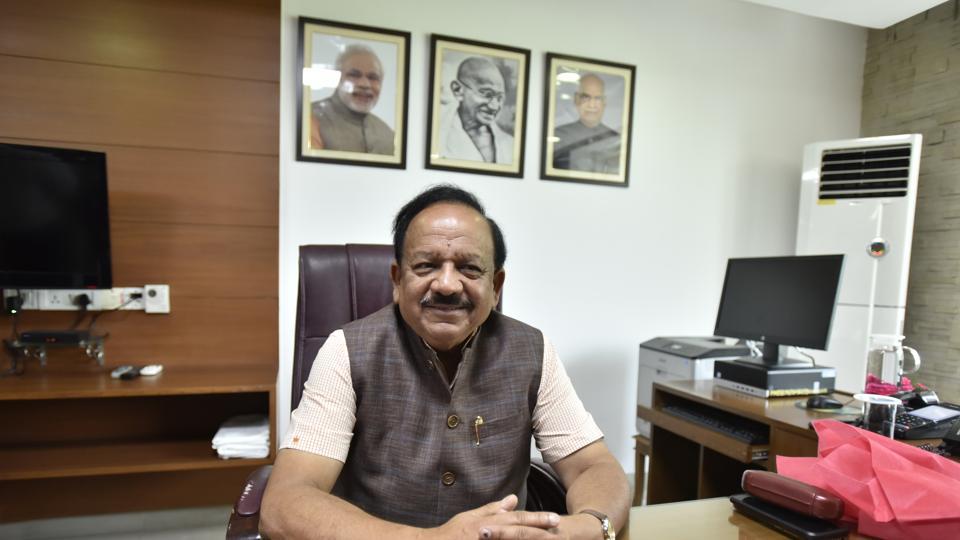
In the 14th meeting of the group since February, a presentation on the Covid-19 cases globally and within the country was made, according to a health ministry statement.
“The Group of Ministers had in-depth deliberation on containment strategy and management aspects of COVID-19, as well as the measures being taken by the Centre and various States,” the statement said.
Civil aviation minister Hardeep S Puri, foreign minister S Jaishankar, MoS home Nityanand Rai, MoS health and family welfare Ashwini Kumar Choubey, chief of defence staff Bipin Rawat, and Union home secretary Ajay Kumar Bhalla were present at the meeting.
Separately, speaking to news agency PTI, Vardhan said India has so far been able to stave off community transmission of Covid-19, expressing hope that “behavioural changes” brought about by the infection could become the “new normal” for a healthy society after the pandemic abates.
Community transmission takes place when a person tests positive for the disease but doctors are not able to trace the source of the infection. It indicates undiagnosed and asymptomatic people are unknowingly spreading the infection, which makes it difficult to break the chain of transmission.
“By now we know that fighting coronavirus is no rocket science. If behavioural changes such as hand, environmental and respiratory hygiene, which are being practised more rigorously during this period, get imbibed in society it will become the new normal,” Vardhan said.
“Once the havoc caused by the virus subsides and the crisis blows over, people may remember it as a blessing in disguise,” Vardhan added.
At the GoM meeting, measures pertaining to strengthening health care capacity of states, including devoting adequate resources for creating dedicated Covid-19 hospitals, and equipping medical facilities with adequate personal protection equipment (PPE) kits, ventilators and other essential equipment were discussed.
A senior official present at the meeting described it as a stocktaking exercise.
“All members discussed steps that were taken by the Centre and how well the states implemented the directives. The gaps were identified, and what improvements are needed and in which areas (were discussed) to check the spread of the infection and bring down the number of deaths,” the senior official said, requesting not to be named.
The health ministry statement said the GoM “highlighted the need for ensuring that stringent measures of quality control were taken for PPE kits, masks, ventilators etc”.
“Random batch sampling for ensuring compliance and adherence to the quality standards laid down were also needed,” it added.
The production of essential medical equipment in India has seen a significant growth with domestic manufacturers reaching the production capacity of nearly 250,000 PPE kits and about 200,000 N-95 masks per day.
In addition, the manufacturing of ventilators by domestic players has also been started and orders placed. Steps have been taken to maintain the quality norms for PPE, masks and ventilators. Oxygen cylinders are also being procured.