
 E-Paper



Govt tells states to ramp up testing amid Omicron fear
Union health secretary Rajesh Bhushan chaired a high-level virtual meeting with states and UTs to review Covid-19 public health response measures and preparedness amid the fear of the highly mutated variant Omicron coming into the country.


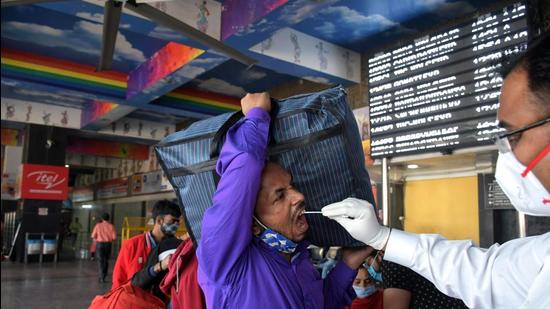
Amid concerns over the new variant of Sars-Cov-2, Omicron, the central government on Tuesday advised states and Union territories to undertake effective surveillance of international passengers and ramp up Covid-19 testing, even as it extended the door-to-door vaccination campaign, Har Ghar Dastak, till December 31, 2021, from the earlier November 30 deadline.
Union health secretary Rajesh Bhushan chaired a high-level virtual meeting with states and UTs to review Covid-19 public health response measures and preparedness amid the fear of the highly mutated variant Omicron — labelled as a variant of concern by the World Health Organisation on Friday — coming into the country.
Also Read | Blanket travel bans will not prevent Omicron spread, says WHO
States have been asked to not let their guard down and keep a strict vigil on international passengers coming to the country through various airports, ports and land border crossings, according to the advisory issued by the Centre.
The states were specially advised to undertake effective surveillance of international passengers, including scrupulous testing of samples of international travellers coming from “at risk” countries on day 1, and of specified category of passengers on day 8. Passengers from “at risk” countries will have to wait at the airport till the report of the RT-PCR test is available, as per the advisory.
Covid-19 testing infrastructure will be enhanced to ensure ample testing takes place in each district while maintaining higher RT-PCR ratio.
Meanwhile, Union health minister Mansukh Mandaviya on Tuesday told Parliament that India has not yet reported any cases of the new variant, Omicron.
“There are 14 countries from where Omicron has been reported. We haven’t detected in India a case of the new variant even though testing is currently on. Advisories have been issued based on the experience and information received from other countries where the new variant has already been detected. Screening has been scaled up in airports and ports; samples of any suspected cases are quickly sent for genomic sequencing. Also, we have learnt a lot from our Covid experience and it is time to make use of that… we can deal with any situation,” the health minister said.
Also Read | Six test Covid positive in Maharashtra after return from high-risk countries
Effective monitoring of hot spots is a must to contain the spread, with the Centre asking states to make sure there is continued monitoring of areas where recent cluster of positive cases has emerged. Positive samples must be sent for genome sequencing as quickly as possible to determine the variant in circulation, the advisory said.
State governments will have to strictly adhere to guidelines drafted for home isolation of positive persons; and also ensuring physical visits to homes of passengers from “at-risk” countries. The status of those who were found to be negative on day 8 will also need to be physically monitored.
Also Read | From December, India imposes new rules for international arrivals over omicron scare
“For infrastructure augmentation, the states have been asked to ensure availability of ICU and oxygen beds, and ventilators etc, and to implement Emergency Response and Health System Preparedness Package, with focus on rural areas and for paediatric cases...” read a health ministry statement.
Experts also say the target population should be vaccinated as quickly as possible.
“Previous infection plus vaccination provides the broadest possible cover. There is no need to panic but usual measures that we know have worked should be strictly followed. High transmissibility may not mean severe disease,” said Gagandeep Kang, senior vaccine expert, and professor, Christian Medical College, Vellore.
“Testing is crucial in identifying the cases early, to be able to quickly isolating them that helps in curtailing transmission,” said Dr GC Khilnani, former pulmonology head, AIIMS, Delhi.
Also Read | Up to 64k beds, better oxygen infra: Delhi ready for Omicron, says CM Kejriwal
Another key aspect is to co-ordinate with airport health organisations, port health officers, land border crossing officers etc., and strengthen support to them for effective surveillance.
“The more effectively we screen, better we will be at tracking cases,” said Dr Khilnani.


