
 E-Paper



How India pulled off BRICS consensus on Delhi declaration amid West Asia crisis
The Brics leaders endorsed New Delhi’s long-standing position that “dialogue and diplomacy” are the only options to settle conflicts

 Prefer HTon Google


India pulled off a diplomatic victory at the Brics Summit on Saturday with the adoption of a consensus joint declaration despite divergences between Iran and the United Arab Emirates (UAE) over the West Asia crisis, though the document was shorn of any references to the war and only spoke of dialogue and diplomacy to resolve conflicts.
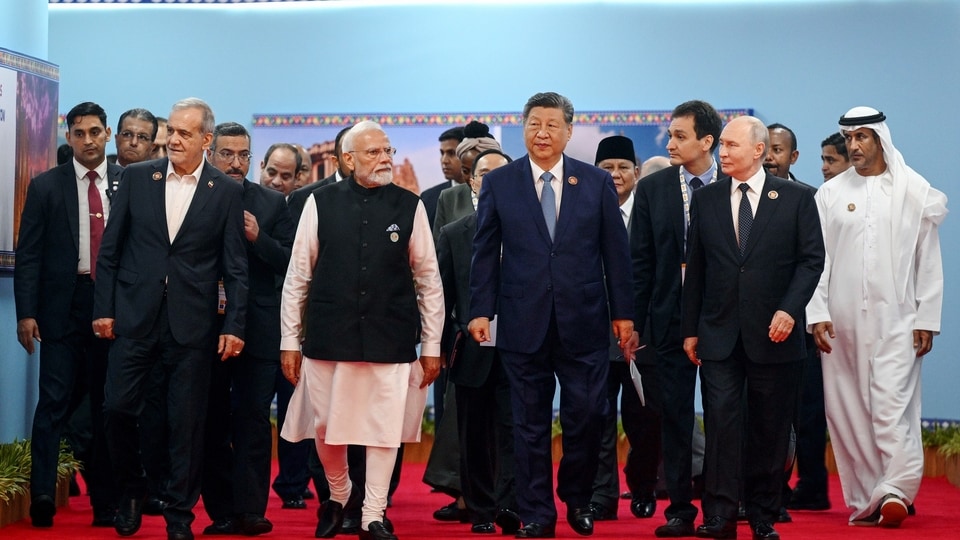
Members of the diverse grouping agreed to the final text of the Brics New Delhi Declaration, especially the paragraph referring to the situation in West Asia, late Saturday afternoon, hours before the document was unveiled around 4:30 pm, people familiar with the matter said.
Also Read | ‘Differences should not become disputes’: PM Modi tells Xi peace on border key to India-China ties
Prime Minister Narendra Modi announced the adoption of the declaration at the end of the opening day’s deliberations in the presence of Chinese President Xi Jinping, Russian President Vladimir Putin and Iranian President Masoud Pezeshkian.
Deep Dive

Also Read: PM Modi, Xi welcome ‘steady progress’ in India-China ties at BRICS meet
The Brics leaders endorsed New Delhi’s long-standing position that “dialogue and diplomacy” are the only options to settle conflicts and stressed the need for joint efforts to ensure the flow of global trade and energy. The declaration was adopted on the opening day of the two-day summit, capping uncertainty created by the sharp divisions between Iran and the UAE that held up joint statements at several preparatory meetings in recent months. Brics operates on consensus, and objections from any member state could have blocked a joint declaration.
The crucial paragraph on West Asia expressed “deep concern over the continued escalation of tensions” in the region and called for maximum restraint and “avoiding actions that could further aggravate the situation”. There was no direct reference to Iran in the context of the conflict, or the US and Israeli attacks on Iran in February that triggered the conflict.
The declaration called for ensuring the protection of civilians and civilian infrastructure in line with the UN Charter, including respect for the sovereignty and territorial integrity of states.
“We encourage increasing efforts, through dialogue and diplomacy, towards a long-term understanding that will contribute to lasting peace, security and stability in the region,” the declaration said. “We stress the need to work together to maintain smooth flow of global trade, supply chains and energy, in accordance with applicable international law.”
Several factors contributed to India’s efforts to forge consensus on the joint declaration, including getting Iran and the UAE to shift from their earlier demands seeking condemnation of attacks on their territories, the Russian side seeking the toning down of language on conflicts that could be perceived as a reference to the situation in Ukraine, and renewed efforts by Iran to mend fences with key players in West Asia, the people said.
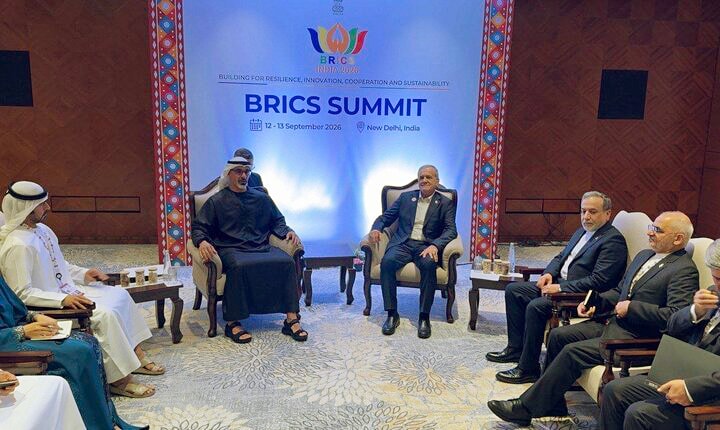
Pezeshkian met Abu Dhabi Crown Prince Khaled bin Mohamed bin Zayed Al Nahyan on the margins of the Brics Summit on Saturday, and Iran plans to meet members of the Gulf Cooperation Council (GCC) and Iraq in Oman on September 14 to discuss an agreement on transit through the Strait of Hormuz. This will be the first such meeting since the start of the West Asia conflict.
Ajay Srivastava of the economic think tank Global Trade Research Initiative (GTRI) said the declaration, without naming the US, Israel or Iran, had sent a “clear and carefully balanced message that the US and Israel should avoid attacking Iran, Iran should refrain from retaliatory strikes against neighbouring Gulf states such as the UAE, and all parties must protect civilians, respect sovereignty and pursue dialogue and diplomacy”.
The call to maintain the smooth flow of global trade and energy is significant as it is a call to the US and its allies to avoid military action that could obstruct the critical global energy corridor of the Strait of Hormuz, Srivastava said. “Given Brics’ conflicting interests and internal constraints, securing consensus on such a clear position represents a diplomatic win for India,” he said.
Also Read | BRICS nations condemn Pahalgam attack, seek action against terror safe havens
Diplomatic observers, however, noted that the New Delhi Declaration was different from the declarations at the Brics Summits in Russia in 2024 and in Brazil in 2025 in that it made no direct references to the conflicts in Iran and Ukraine. The Rio de Janeiro Declaration, for instance, condemned the military strikes against Iran in June 2025, and also recalled national positions on the conflict in Ukraine.
The declaration expressed deep concern at the continued violence in Gaza despite a ceasefire and urged all parties to maintain the truce and ensure unhindered humanitarian access in the region. “We call for halting any policies aimed at forced displacement of Palestinians from Gaza Strip and express concern regarding arrangements that may prejudice the inalienable rights of the Palestinian people and legitimise or prolong occupation,” the declaration said.
It said a just and lasting solution to the Israeli-Palestinian conflict can be achieved only through peaceful means and the fulfilment of the legitimate rights of Palestinians. Expressing unwavering commitment to a two-state solution, the declaration called for the establishment of a sovereign, independent and viable state of Palestine with East Jerusalem as its capital.
Also Read | PM Modi, Putin and Xi hold hands at BRICS summit in a powerful show of unity
Brics also endorsed India’s zero-tolerance policy towards all forms of terrorism and the shunning of double standards in countering terror, with the declaration backing a concerted approach in dealing with the challenge. The declaration condemned in the “strongest terms” the Pahalgam terror attack in Jammu and Kashmir in 2025 that killed 26 people.
The grouping also criticised the proliferation of “trade-restrictive actions that are inconsistent with WTO rules, whether in the form of indiscriminate rising of tariffs and non-tariff measures, or protectionism under the guise of environmental objectives.”
“We voice serious concerns about the rise of unilateral tariff and non-tariff measures which distort trade and are inconsistent with WTO rules,” it said.
In the context of economic cooperation, which has emerged as one of the key pillars of Brics, the declaration noted that the multilateral trading system was at a crossroads and the proliferation of trade-restrictive actions inconsistent with WTO rules, including “indiscriminate rising of tariffs and non-tariff measures, or protectionism under the guise of environmental objectives”, threatens to further reduce global trade, disrupt supply chains and introduce uncertainty into international trade activities.
“We voice serious concerns about the rise of unilateral tariff and non-tariff measures which distort trade and are inconsistent with WTO rules,” the declaration said, adding that Brics states will work to enhance WTO’s responsiveness to trade disruptions and the priorities of emerging markets and developing economies.
Without naming the US, the declaration condemned unilateral coercive measures, including economic sanctions and secondary sanctions, and said such actions negatively impact the rights to development, health, and food security of targeted states, disproportionately affect people in vulnerable situations, and deepen the digital divide.



