E-Paper



India isn’t waiting for world to rescue it: Bhupender Yadav
Bhupender Yadav said developed countries who agreed to mobilise $100-billion funds for developing countries are yet to fulfil their promise


India is not waiting for the world to rescue it from disasters, Union environment minister Bhupender Yadav said on Thursday at the HT G20 Agenda on green development; climate finance and LiFE (lifestyle for environment). He was referring to India’s efforts to domestically finance climate actions and adaptation measures.
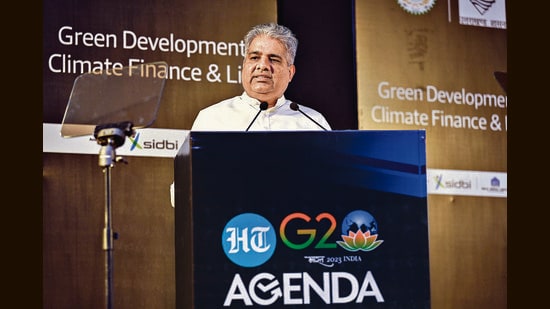
“India, under PM Modi, is a confident nation with a ‘Can Do’ approach. We are not waiting for the world to rescue us. We are, in fact, working to pull ourselves out of this crisis through domestic efforts and also helping the global South by leading alliances such as the Coalition for Disaster Resilient Infrastructure and Infrastructure for Resilient Island States to ensure no one is left behind,” Yadav said in his keynote address.
An investment of at least $4-6 trillion per year will be needed for a global transformation to a low-carbon economy, Yadav said while highlighting that developed countries who agreed (at the 15th Conference of Parties (COP15) of the UNFCCC in Copenhagen in 2009) to mobilise $100 billion funds for mitigation efforts in developing countries are yet to fulfil the promise.
“Climate action will also find it difficult to move ahead without adequate climate finance. For now, the international community is divided over the definition of climate finance. This has created an ambiguity in both the funding of climate projects and determining the amount required for it. The United Nations Framework Convention on Climate Change has operationalised only a working definition so far,” Yadav said. HT has reported in the past that one of India’s main demands on behalf of developing countries at the UN Climate negotiations is to finalise a multilaterally agreed definition of climate finance. Due to a lack of common understanding, several different estimates of what has flown as climate finance are available.
“Climate finance is generally known as a financial flow mobilised by industrialised country governments and private entities that support climate change mitigation and adaptation in developing countries. This means that funds allocated by national governments for energy/climate transition activities would not count as climate finance,” Yadav pointed out, while referring to India’s domestic efforts.
Working on a consensus-driven approach, India wants to ensure the world emerges from the crisis together and stronger, the minister said. “Under India’s Presidency, the G20 member countries have reaffirmed their commitment towards combating the environment and climate crisis, with a renewed sense of urgency. On the domestic front, India’s climate actions have so far been largely financed from domestic resources. However, providing new and additional financial resources as well as transfer of technology to address the global climate challenge are among the commitments and responsibilities of the developed countries under UNFCCC and the Paris Agreement,” Yadav said while emphasising that India will also require its due share from such international financial resources and technological support.
An August, 2022 analysis of India’s adaptation funding found that 94% of it came from domestic public finance, which included Central and State government budgets according to Yadav. But globally, mitigation finance has accounted for a larger share of climate finance as compared to adaptation finance. In 2020, mitigation finance was 1.69 times of adaptation finance, as compared to 2016, when mitigation finance was 4.1 times of adaptation finance. The United Nations Environment Programme’s Adaptation Gap Report 2021 suggests that the annual adaptation costs in developing countries could reach somewhere between $ 155 billion and $ 330 billion by 2030.
“The vagaries of climate change today are impacting the developing world more. This has raised the risk of many nations being pushed into acute poverty and major food and water crises. While the world acknowledges that poverty anywhere is a threat to peace and security everywhere, the required action to prevent this poverty is missing,” Yadav said.
“Apart from the G20, there is also a financing summit that president (Emmanuel) Macron (of France) is hosting next month. India is co-chairing the steering committee and one of the things we are exploring is how we can explore innovative financing mechanisms that can raise a lot more capital particularly to address the vulnerability issue. While mitigation financing gets a lot more investment from the private sector, adaptation and particularly resilience will require a lot more innovative thinking...We also have to design an insurance cushion. Loss and damage suggests that once you are lost or damaged then someone will pay up. You need an insurance cushion that gives you a bulwark to fall back onto, when the compounding climate shocks emerge and that’s what we don’t have right now. We have some catastrophic bonds etc, but those are limited in scale and to geographic scope,” said Arunabha Ghosh, founder and CEO of Council on Energy, Environment and Water during a panel discussion that followed.
India considers the creation of the dedicated fund a remarkably important development, Yadav said. “ India, as the voice of the global south, had been a vocal supporter of the loss and damage fund…but India is also concerned over the future of this fund given its past experience and urges the global community to act on it. At COP27 itself, while the loss and damage funding arrangement was agreed upon, serious concern was expressed that the goal of developed country Parties to mobilize jointly $100 billion by 2020 has not yet been met,” Yadav noted.
For more than a decade the ambiguous language in developed country’s climate finance commitments for adaptation and mitigation has been called out, Yadav said, including debates on what counts as ‘climate finance’, the ‘fair share’ of climate finance from diverse provider countries. “The developed world has fallen short of honouring its commitment to climate finance,” he said.
HT reported on November 20 from the UN Climate Conference (COP27) in Egypt’s Sharm El-Sheikh that the negotiations which saw polarised debates on responsibility and accountability among the global North and South, made history with a decision to create a Loss and Damage fund which will provide support to developing countries in efforts to avert, minimise and address loss and damage associated with the adverse effects of climate change in the light of continued global warming.
One of the main contentions on the Loss and Damage funding issue was that developed countries were pushing to expand the donor base to include high income countries and emerging economies such as China and India and wanted to narrow the beneficiaries to only the most vulnerable (island nations and least developed countries). EU also sought to link the formation of the Loss and Damage facility to mitigation efforts such as peaking global emissions before 2025; reaffirming the call to reduce by 2030 non-carbon dioxide greenhouse gas emissions; pushing all parties to urgently increase their efforts to closing the remaining mitigation gap to pathways consistent with 1.5 degrees; accelerating the phase down of unabated coal power as soon as possible and submit roadmaps towards this aim, HT reported on November 18, 2022.
Loss and Damage refers to compensation for impacts of extreme climate change events and slow onset events like sea level rise or glacial retreat or immediate disasters such as inundation, extreme heat stress, severe floods, loss of infrastructure due severe cyclones etc. Economic loss and damage are negative impacts that we can assign a monetary value to.
“The good news is that we in India have continued to make efforts to combat climate change at our own level. Environment conservation is the front and centre of all policy formulations today in India. PM Modi has outlined that in India, environment conservation and development are not at cross-purposes but work together. If you look at Budget 2023-24, the Saptarishi, or seven priority areas including Green Growth…the aggressive policies of India towards rapid deployment of renewables and robust framework for energy efficiency programs have shown considerable impact. India has been ranked among the top five countries in the world, and the best among the G20 countries, based on its Climate Action performance. I am tempted to say we have come so far without the promised climate finance,” the minister concluded.
 ABOUT THE AUTHORJayashree Nandi
I write on the environment and climate crisis and I believe these are the most important stories of our times.