
 E-Paper



Jaishankar heads to France, aircraft engines, subs and Indo-Pacific on cards
Jaishankar will meet his French counterpart Jean Yves Le Drian, Minister for French Armed Forces Florence Parly and is expected to call on French President Emmanuel Macron. He will address a conference of EU Foreign Ministers on Indo-Pacific and hold a Head of Mission conference for Indian envoys in Europe

 Prefer HTon Google


External Affairs Minister Subrahmanyam Jaishankar arrived in Paris for a
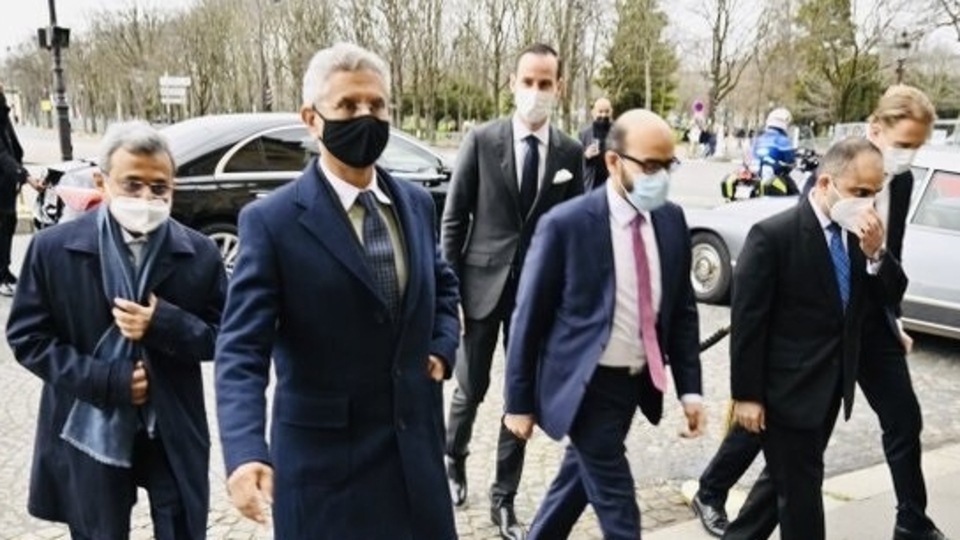
three-day visit to cement bilateral defence cooperation as well as discuss the security environment in Indo-Pacific.
During his packed visit, he will meet his French counterpart Jean Yves Le Drian, Minister for French Armed Forces Florence Parly and is expected to call on French President Emmanuel Macron. He will address a conference of EU Foreign Ministers on Indo-Pacific as well as hold a Head of Mission conference for Indian envoys in Europe.
With France being one of India's closest strategic allies, Jaishankar is expected to hold discussions with his counterparts for France on sharing technology to manufacture 100 kilo newton thrust Safran aircraft engines in India under the Aatmanirbhar Bharat route as well as helping India in expanding its nuclear powered attack submarine capability.
It is understood that France has offered to manufacture in India as well as joint develop nuclear powered conventional attack submarines due to rapidly changing security environment in Asia and Indo-Pacific. The Indian minister will also hold a meeting of Indian envoys in Europe, in which he is likely to spell out Modi government's vision on Europe as well as share the assessment of Indian ambassadors.
Jaishankar's visit comes day after his visit to the Munich Security Conference in Germany, marked by his firm counter to the critics calling the Quad alliance as an Asian version of NATO..
Earlier, Jaishankar during his visit to Munich had spoken on length over India's relations with China, and most importantly the notions surrounding the Quad alliance which also includes Australia, United States and Japan.
Rejecting the notion that Quad was an Asian Nato as a ‘misleading term’, Jaishankar asked the critics not to slip into the lazy analogy of an Asian Nato.
"It isn't because there are three countries who are treaty allies. We are not a treaty ally. It doesn't have a treaty, a structure, a secretariat, it’s a kind of 21st century way of responding to a more diversified, dispersed world," Jaishankar argued.
During the Munich Security Conference, Jaishankar had described that India's ties with China were going through a difficult phase.
"For 45 years, there was peace and there was stable border management. There were no military casualties on the border. That changed. We had agreements with China not to bring the military forces to the Line of Actual Control and the Chinese violated those agreements. Now the state of border will determine the state of the relationship. That's natural," news agency ANI had quoted Jaishankar.
When the event's moderator asked about India's role in European security vis-à-vis Ukrainian crisis, Jaishankar denied that the two events were analogous.
“We have quite distinct challenges, what is happening here or what is happening in the Indo-Pacific. In fact, if there was a connection by that logic, you would have had a lot of European powers already taking very sharp positions in the Indo-Pacific. We didn’t see that. We haven’t seen that since 2009,” Jaishankar said.


