Sign in

Number theory: Can India’s demographic dividend help it overtake the Chinese economy?

By July 1, India’s population will be an estimated 1.429 billion, 2.96 million more than China’s estimated population.

Updated on: Apr 21, 2023, 14:31:22 IST
Share
Share via
  • facebook
  • twitter
  • linkedin
  • whatsapp
Copy link
  • copy link

The United Nations believes that India’s population has overtaken China’s or will do so by July 1. By then, India’s population will be an estimated 1.429 billion, 2.96 million more than China’s estimated population on that day. A high population, especially in a younger age cohort, is generally seen as an asset rather than a liability for the economic fortunes of a country. The simple reason for this is that more people also means more working hands.

China’s population will peak in 2029 at 1.44 billion before beginning a period of “unstoppable” decline, a government report said. (AP File Photo)

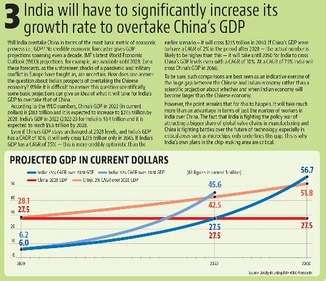
It is this understanding which has generated a widespread consensus that India is now enjoying a unique demographic dividend. To be sure, a demographic dividend is not a guarantee that a country will catapult its economy to a significantly higher income level and this reasoning holds for India’s economic prospects vis à vis China as well. Here are three charts that explain this argument in detail.
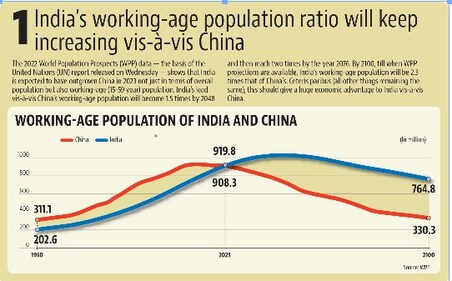
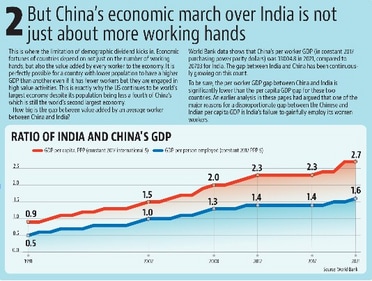
Chart 1
Chart 1
Chart 2
Chart 2
Chart 3
Chart 3
  • Roshan Kishore
    ABOUT THE AUTHOR
    Roshan Kishore

    Roshan Kishore is the Data and Political Economy Editor at Hindustan Times. He heads the newsroom's data journalism team, which produces Number Theory, a daily data-driven feature for the print edition and the HT app. Number Theory uses data analysis and story-telling based on it to add value to the newsroom’s daily coverage by putting stories in a larger context on a range of issues, including politics, macroeconomy, markets, global affairs and climate. Under his leadership HT’s data journalism work has established itself as a niche product in Indian journalism and pushed the boundaries of marrying academic rigour with news sense and speed. Along with writing and editing data stories, he has also been writing a weekly political economy column called Terms of Trade for HT Premium. A trained economist with an MPhil degree from Jawaharlal Nehru University, Kishore has also been a visiting fellow at the Centre for Advanced Studies of India (CASI) at the University of Pennsylvania. Along with his journalistic work, his writings have also appeared in journals such as the Economic and Political Weekly and working papers for CASI and UNESCAP.Read More