E-Paper



Number Theory: Household debt's role in India's growth story
This is the last of a 2-part data journalism series on household finances and Indian economy. The first discussed the latest fall in household savings in India


The first part of this story discussed the net fall in household asset flow in 2022-23 and argued that the data which is available does not provide any objective basis to argue that the number suggests a growing distress in the financial sector or household balance sheets. If the 2022-23 number is just a reflection of ‘revenge spending’ on account of two lost years in the pandemic, then there is nothing of macro-economic importance in this data. But what if these numbers are the beginning of a new trend in household financial behaviour? To be sure, one will have to wait for at least a few years to accept or reject this proposition. However, it is worth engaging with this question given the crucial role of debt in India’s post-reform growth story.

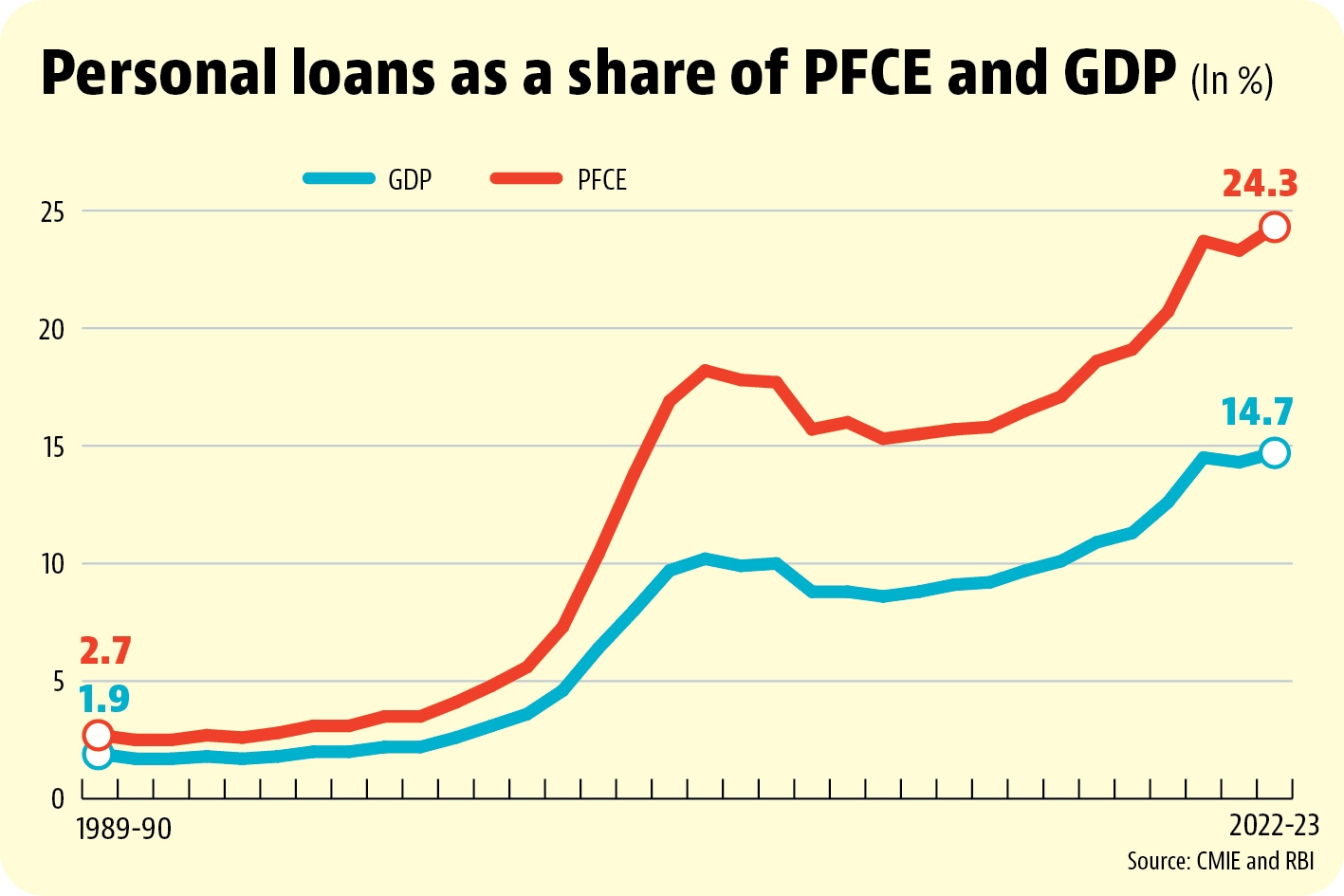
 There has been a constant increase in India’s household debt-GDP ratio since the 2000sCentre for Monitoring Indian Economy’s (CMIE) database gives total outstanding amount of personal loans (from RBI) since 1989-90. If one looks at this number as a share of private final consumption expenditure (PFCE) or GDP, there is a sharp increase around the late 1990s, which stabilised after the global financial crisis of 2008. This number started rising once again, albeit slowly from 2014-15 and the post-pandemic trend seems to be nothing out of the ordinary. It is important to underline that unless the financial system starts giving out sub-prime credit – this was the case in the US before the 2008 crisis – rise in household credit as a share of GDP is not necessarily a bad thing. It could represent either a growing confidence in future stream of incomes, or an increase in propensity to consume. There is good reason to argue that the rise in household credit to GDP ratio in India is a reflection of the latter two factors rather than precarious lending.
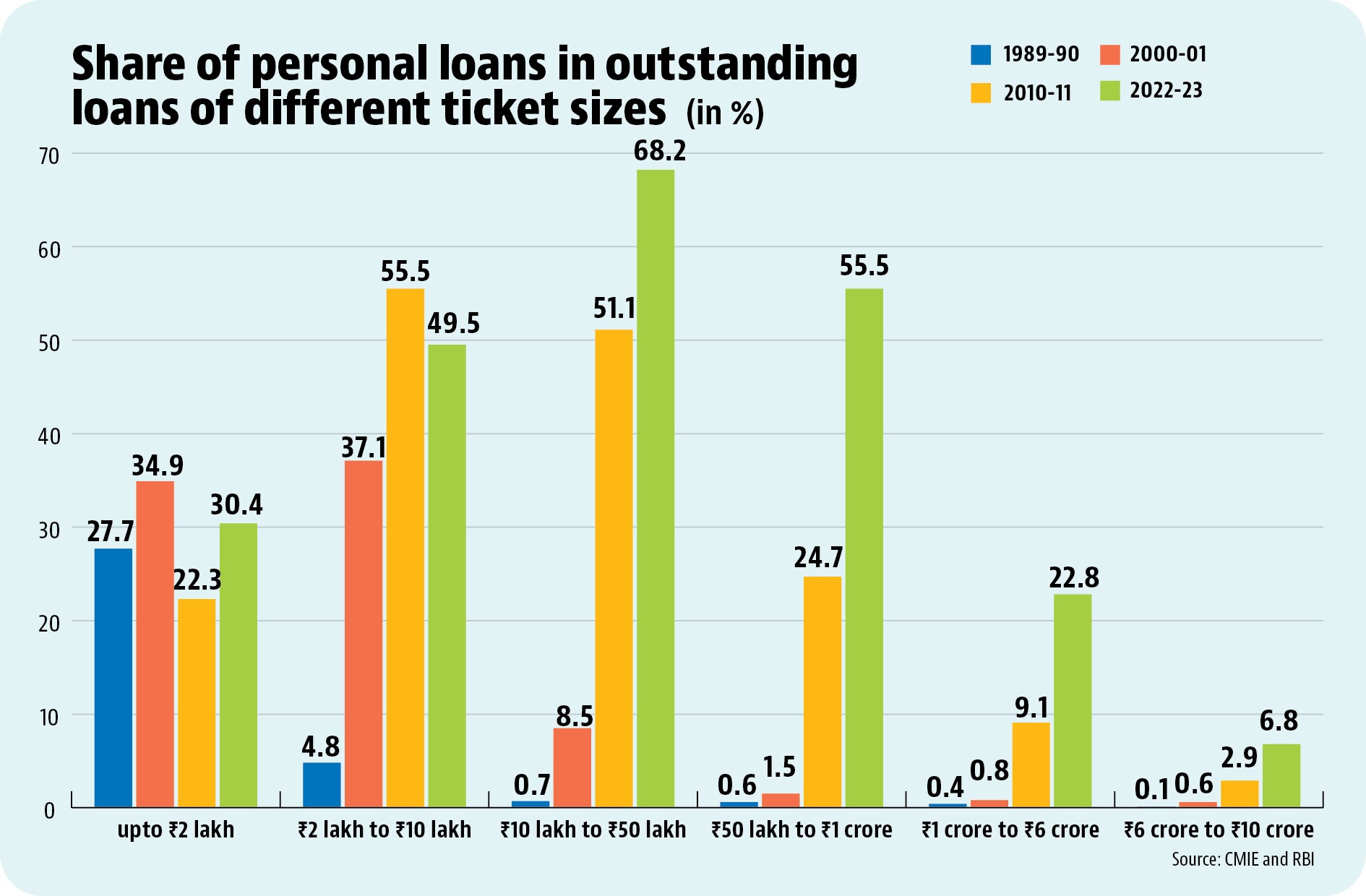
- The ticket size of personal loans has been increasing at a very rapid paceRBI data from the CMIE database on the share of personal loans in total outstanding bank lending of different ticket size shows this clearly. Personal loans now account for more than two-third of total outstanding loans in the ₹10 lakh to ₹50 lakh category and more than half of the total outstanding credit in the ₹50 lakh to ₹1 crore category. Even in total outstanding credit in the ₹1 crore to ₹6 crore and ₹6 crore to ₹10 crore, there has been a sharp increase in the share of personal loans in the last decade. The supply side story of personal loans from the increase in average ticket-size data makes complete sense with the demand side story of boom in premium housing – half of outstanding personal loans in India are housing loans – and passenger car markets after the pandemic. It also aligns well with the story of a growing class of high-income salary earners – this was discussed in detail in a two-part series in these pages – in the last decade. Banks, after all, would not give these loans if they did not deem the borrowers credit worthy.
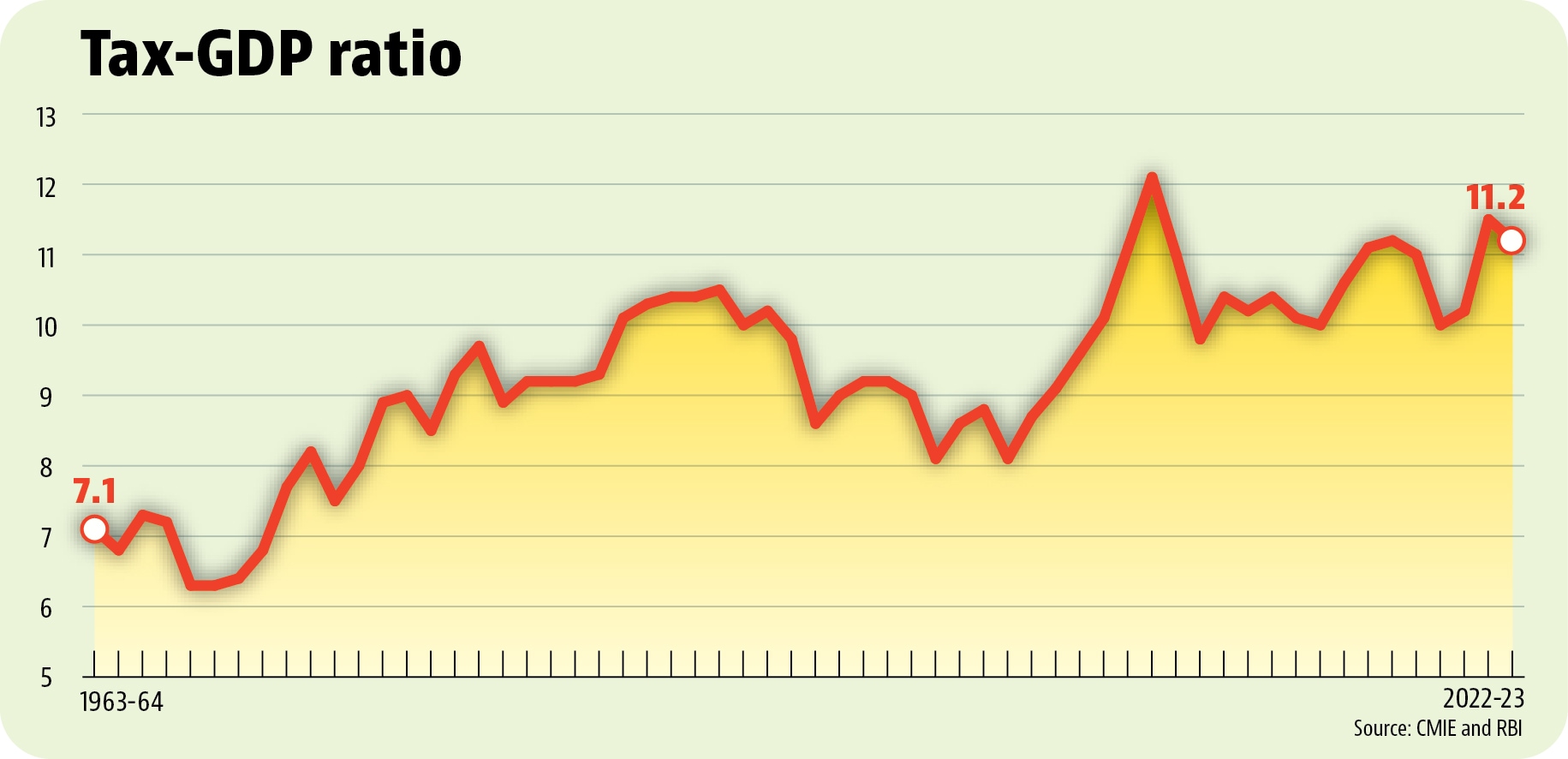
- But this rich-driven growth has not been accompanied by an increase in India’s tax-GDP ratioThe crux of the story which has been discussed here so far is that there is a growing club of rich who are extremely confident about their future incomes and therefore not averse to borrowing to have a better lifestyle today. Their consumption demand is clearly a major tailwind for India’s near-term growth prospects. However, the Indian economy also has an overwhelmingly large section of people who needed something as basic as free food grains during the pandemic to make ends meet. The political economy balance in the country is pretty much using largely rich-driven economic growth’s revenue proceeds to provide some income/asset relief to the ranks of the poor. It is on this front that this economic model will increasingly be tested because it has not seen a sustained improvement in the tax-GDP ratio in the post-2008 era. Unless this happens, the government will find it increasingly difficult to reconcile the aspirations of the poor with their material deprivation.