
 E-Paper



Heritage or hospital: A conservation debate splits Hyderabad
Even as the case continues in the high court that has said that no demolition can take place until the PIL (public interest litigation) is adjudicated fully

 Prefer HTon Google


For more than a hundred years, the grandiose building of the Osmania General Hospital (OGH) has towered over Hyderabad as one of the city’s most iconic landmarks. It has all the trappings of a heritage building; domes that pockmark the sky; intricate grottos; turrets that tell the story of the age it was built in; as well as walls that are now peeling off, moss in the corners from the rain and drain water that seeps in; and the ever-present danger of falling ceilings.
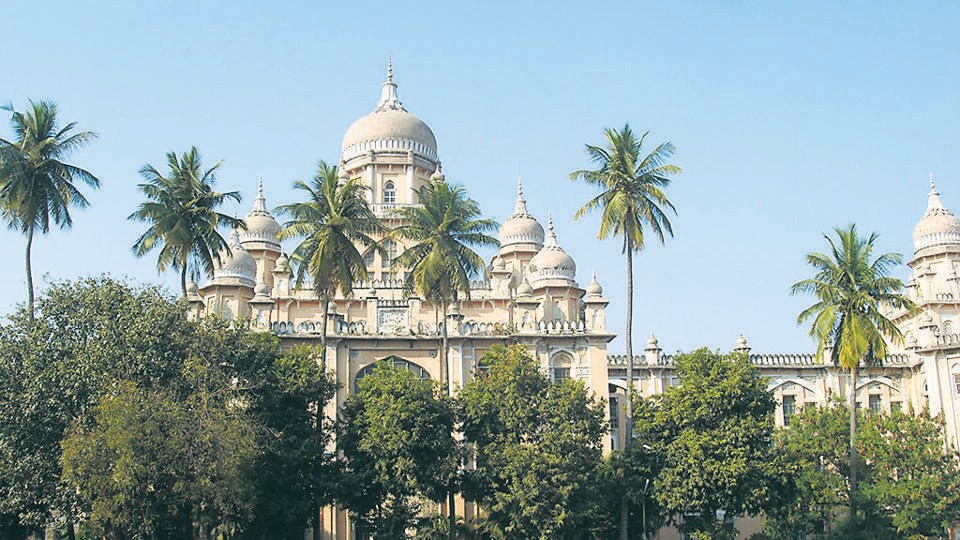
On July 27, citing the second batch of unflattering reasons the Telangana government told the high court that it intends to demolish the heritage structure and its adjoining buildings because it no longer fulfils its original purpose – that of being a hospital.
SAM Rizvi, health secretary of the Telangana government, submitted an affidavit to the Telangana high court, a copy of which has been seen by HT, that said a consultative committee of various public representatives, officials and technical experts, which met under the chairmanship of state health minister T Harish Rao on July 3 unanimously decided to raze the existing building and construct a modern multi-storey 1,812-bed hospital on 22 acres of land in its stead.
Even as the case continues in the high court that has said that no demolition can take place until the PIL (public interest litigation) is adjudicated fully, the government’s intentions have created a storm, with conservationists arguing that there were ways to circumvent the problem and preserve the building; a structure that has come to define Hyderabad’s skyline.
The origins of the hospital
The Osmania General Hospital was founded as the Afzal Ganj Hospital in 1866 by Salar Jung-I, the then prime minister of Hyderabad during the regime of the sixth Nizam, Mahboob Ali Khan. The heritage structure, as it stands today, was constructed on 1.5 acres of land in a sprawling 26.5-acre plot by the seventh Nizam, Mir Osman Ali Khan, in 1919. It was designed by British architect Vincent Jerome Esch and chief engineer Nawab Khan Bahadur Mirza Akbar Baig in the Indo-Sarcenic style, of which Esch was a pioneer. Indeed the British architect was employed by the seventh Nizam to create an architectural legacy in Hyderabad, devastated by the Great Musi floods of 1908. Among Esch’s other buildings are the iconic Kachiguda railway station, the high court and the City College.
By 1926, all the wards of the Afzal Gunj hospital were transferred to the building built by Esch and Baig.
As it stands today, the structure is a Grade II-B heritage building – structures that have regional, local and architectural importance – under the Hyderabad Metropolitan Development Association (HMDA). Over the years, however, administrative neglect and a lack of renovation and maintenance have meant that it has fallen into various stages of disrepair.
From July 2020 for instance, it had to be shut down because it was inundated by rain and sewage and patients had to be shifted to two other buildings of the OGH. The building that flooded has since never opened, and is now merely used as a pathway for doctors to access the parking lot.
Quoting from the minutes of the July 3 meeting, Rizvi said in the government’s affidavit that the old building of the OGH was unfit for “any kind of patient care” and hence had to be demolished along with the adjacent satellite buildings for an entirely new hospital spanning 3.6 million square feet. To be sure, Rizvi said that any demolition would be carried out subject to the orders of the state high court, which is hearing a clutch of PIL petitions filed by heritage conservationists from Hyderabad.
Noted conservationist P Anuradha Reddy, who is also the convener of the Indian National Trust for Art and Cultural Heritage (INTACH), said that on April 8, 2022, the high court had passed an order that had said that no demolition would take place without the approval of the court. “It only directed the state government to take the necessary steps for the upkeep of the building. Now that the government has filed an affidavit seeking permissions for the demolition of the heritage building of the OGH, we await the orders of the court before taking our next steps,” she said.
Reddy said that a middle path, short of demolition, was entirely possible and pointed to a committee of experts, constituted by the state government on March 10, 2022, that studied the structural stability of the OGH building. This committee had external representation too, with the high court directing that two more members, a structural engineer nominated by the director of IIT Hyderabad and head of the Archaeological Survey of India, Telangana, be included in the committee.
A report submitted to the high court on December 13, 2022, said that the building was not safe for use for hospital purposes at all. “However, the structure can be repaired and renovated so as to increase the life of the building,” it said.
The committee said that since it was a listed heritage building under HMDA, conservation could be taken up under the supervision of a conservation architect. “After repairs and renovation, the building can be put to use for non-hospital purpose only, as the hospital requires many modifications to the building to accommodate various services like oxygen pipelines, gas lines, air-condition ducts, water lines, sewerage lines etc, which will affect the heritage character and structural stability of the building,” the committee said.
It was when this report was submitted that the high court passed interim orders, asking the state government to come up with a comprehensive proposal with these recommendations of the expert committee in mind, to which the government responded with its affidavit that it intended to demolish the entire structure.
The hospital versus conservation argument
Reddy said that the recommendations of the expert committee were what they had tried to convince the government to do. “While conserving the old heritage building, the government could construct the new building complex in the adjacent area, which is around 25 acres by removing other buildings like residential quarters, nursing hostels, etc,” Anuradha Reddy said.
Government officials, however, said this was unfeasible.
I Ganapathi Reddy, engineer-in-chief of Roads and Buildings, one of the attendees of the consultative meeting convened by the health minister on July 3, said the new hospital complex will require a built-up area of 2.2 million square feet according to Indian Public Health Standards (IPHS) that stipulate that 100 to 110 sqm per bed is required for a teaching hospital.
In addition to the hospital building, 484,000 square feet built-up area is required for residential quarters for postgraduate students; another 585,000 square feet for multi-level parking and 266,000 square feet of utility space for services such as an electric sub-station, a liquid oxygen tank, mechanised laundry, a mortuary, and other facilities.
“Thus, the total area required for the new hospital complex of 1,812 beds is 3.6 million square feet. For constructing this, a total of 9.30 acres is required as the footprint. Since the footprint has to be less than 40% of the total area as per National Building Code 2016, the total land required is 22.2 acres,” Ganapathi Reddy said.
He added that digital surveys have shown that the actual land area of the OGH is 24.417 acres. If one were to remove the existing religious structures, a graveyard, and a police station located on the premises, the remaining areas is 22.203 acres. “Thus, the available land after the demolition of all buildings including the old building will just be sufficient to construct a new building with 1,812 beds,” the engineer-in-chief said.
The government’s decision, however, has evoked strong reactions from historians that have urged them to reconsider. William Dalrymple, the author, for instance, called it “Barbarous philistinism”. “There is, in every other part of the world, a process called conservation,” he tweeted.
Convener of the Forum for Better Hyderabad M Veda Kumar said the Telangana government, which had taken up the exercise of restoring several historic monuments and structures in Hyderabad such as Sardar Mahal and Moazzam Jahi Market, should also conserve the OGH building.
“It is a majestic riverfront building with architectural splendour. Such buildings have to be conserved as per international norms. My appeal to the government is that it can be restored and used as a health museum.”


