
 E-Paper



Panjab University protest grows, sees clash: Why issue is bigger than just PU, Chandigarh | Explained
Protesters want immediate poll schedule for PU senate, days after Centre retracted move to largely do away with poll system. Here's why history has a big role

 Prefer HTon Google


Tension at Panjab University in Chandigarh brimmed over, leading to a brief clash between protesters and the UT police at one of its main gates, after a wider participation call on Monday, November 10.
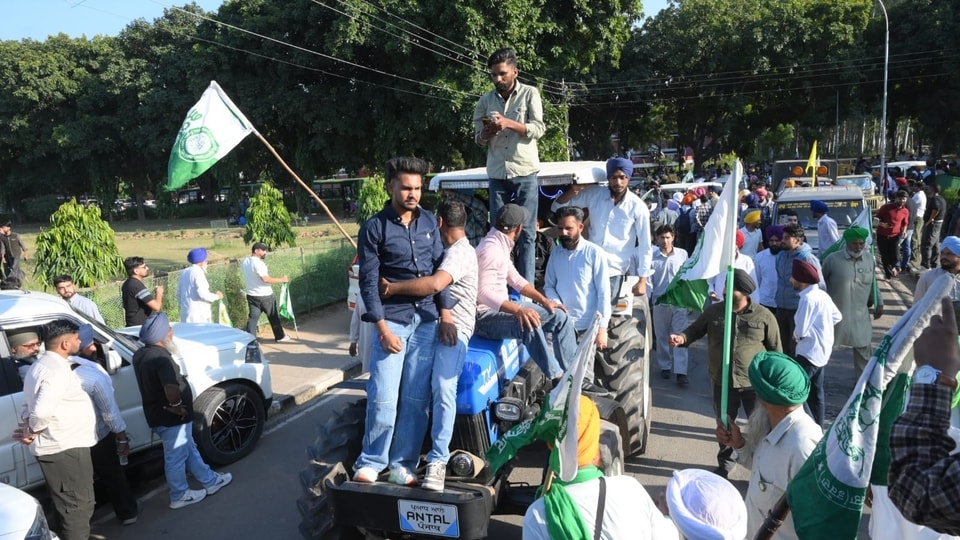
The protesters are now demanding an immediate poll schedule for the PU senate — the previous tenure of which ended last year — days after the Centre had to retract its move to largely do away with elections for the governing bodies of the public university.
Here are key points that explain the current situation, the wider protest, and how it's an issue that goes beyond the university, into Punjab's history.
Why did clash erupt at PU in Chandigarh?
Groups seeking to join the protest forced their way through PU gates on Monday morning, even when the heavy police deployment sought to stop them using canes. The police were overwhelmed by the scores of protesters, including representatives of Sikh organisations and farmer unions, who marched in.
Police said they were trying to prevent outsiders from entering the campus. Chandigarh senior superintendent of police (SSP) Kanwardeep Kaur was seen trying to pacify the protesters at the gate.
Nearly 500 protesters then gathered near the roundabout in front of the vice-chancellor’s office, where a makeshift stage was set up. The protest began with an ardaas (Sikh prayer) before speakers addressed the gathering, demanding that the university’s autonomy be protected.
On stage, among the main speakers were PUCSC vice-president Ashmeet Singh, former senator Ravinder Singh Dhaliwal, student leader Rimaljot Singh, and Students for Society president Sandeep. Other groups had their own mics too, though.
Except for the protesters gathering, the campus was largely deserted as the administration had already declared holiday for November 10 and 11.
Why rest of Chandigarh, state borders remain tense
Around 2,000 police personnel were deployed across Chandigarh, with 12 checkpoints set up, leading to traffic disruptions, particularly on the Zirakpur (Punjab)-Chandigarh highway.
There were long traffic jams some kilometres away on the UT's border with Mohali and Mullanpur areas of Punjab too, as police sought to stop an influx of protesters from the state.
Why protest began, how Centre retreated
The demand for senate elections has been on for almost a year now, as its previous term ended in October 2024. But the current protest essentially began at the end of last month after the union government sought to amend the very structure of PU's governing bodies.
The central government had, through an October 28 notification, effected a major overhaul in the functioning of the 142-year-old Panjab University originally established in Lahore in the undivided Punjab, India.
The notification to amend the Panjab University Act, 1947, would have trimmed the size of its apex governing body, the senate, to 31, and doing away with elections for its executive body, the syndicate. The Centre's move would have abolished the larger poll constituency of PU graduates for the senate.
This was seen as an assault on PU's autonomy, and therefore on federalism and Punjab's claim over the UT of Chandigarh — fueling a complex historical matter.
By November 7, the Centre relented and rescinded the notification, after first seeking to merely defer its implementation. Yet, the Panjab University Bachao Morcha refused to withdraw its protest call, saying the stir would continue until the senate elections are scheduled.
Why PU's matter is not just PU's matter
There is some history to the matter, which is why it has seen an emotive, political reaction across Punjab in particular.
PU was established as University of the Punjab in Lahore in 1882 by the British raj. This makes it one of the oldest universities in India. Upon Partition, since Lahore became part of Pakistan, the eastern side of Punjab took its share and ‘Panjab (spelt an ‘a’) University’ was enacted into being in 1947 by the state. Its HQ came to be in Shimla, Rohtak, Jalandhar, and eventually the newly built city of Chandigarh.
Things changed two decades on, by when the current states of Haryana and Himachal Pradesh were carved out, and PU became an “inter-state body corporate” under the Punjab Reorganisation Act, 1966, passed by Parliament. Chandigarh became a UT, serving as Punjab and Haryana's joint capital.
PU is not a state or central university, though. The funding, for example, is shared between the Centre and Punjab. The university's 200-plus affiliated colleges are in Punjab and Chandigarh. Financially, the Centre provides the bulk of PU’s support — around 85% of total funding, PU officials told HT.

But, as with Chandigarh, so with PU, the Punjab has seen this aspect of the 1966 reorganisation as a historic wrong committed to the Sikh-majority state in a Hindu-majority country. Claims over Chandigarh, and related issues, have been factors in the period of militancy in Punjab in the 1980s and ’90s, and continue to fester in infrequent disputes with Haryana and other states over river water, for instance.
Political parties, including sometimes the Punjab unit of the BJP, argue that Haryana anyway has its own cities and universities, such as the one in Kurukshetra, and PU and Chandigarh belong thus to Punjab.
That backdrop makes this protest over PU's autonomy a politically charged moment.
The ruling BJP, and its ideological parent body RSS, are frequent targets, particularly now that they are in power at the Centre. RSS-affiliated student body ABVP recently won the PU student union president's post after a gap of five decades, but it has largely been absent from the protest organised by organisations such as Sath and Students for Society, among others.
How wide array of leaders joined protest, what CM said
In this wider backdrop of state-Centre relations, and Punjab's historical grouses, chief minister Bhagwant Mann of the AAP alleged that PM Narendra Modi's central government was “desperately trying for a backdoor entry into PU”.
"The state will never surrender its rights,” Mann has said.
Besides former professors and students, members of the All India Sikh Student Federation (AISSF) also joined the protest on November 10.
Punjab activist Lakha Sidhana and actor-dirrector Amitoj Mann were there too, while singer Satinder Sartaaj, an alumnus, also visited the peaceful protest site recently.
Senior leaders from the Congress and Shiromani Akali Dal were expected later in the day. Many of them have visited the site earlier too.
How reforms were triggered, and varied views
The issue of reforming the PU governing structure is not new. The then Vice President of India and thus PU chancellor M Venkaiah Naidu had in 2021 constituted an 11-member committee to suggest changes in view of the National Education Policy (NEP) 2020, which submitted its report the same year calling for a downsizing.
The university has also argued in court that the senate and syndicate needed to be leaner. It said the elections to the graduates' constituencies in particular were “complex and cost-intensive”, and not needed in the present scenario.
VS Chauhan, a former NAAC chairman and member of the 11-member panel, had welcomes the Centre’s decision to restructure the governing bodies, before it was withdrawn. “We had recommended replacing elections for 15 registered graduates with nominations of eminent alumni by the chancellor and giving preference to university and college academicians — both of which the government accepted,” he had told HT.
‘Senate was politicised’ vs ‘anti-democratic view’
PU officials said the restructuring aligns with NEP 2020’s emphasis on efficient and merit-based governance. “The earlier senate was highly politicised. Its election process, involving over three lakh registered graduates, was time-consuming, expensive, and often diverted attention from academic priorities,” an official said.
Protesting activists have said this view is essentially anti-democratic and makes wide presumptions.
The new senate was to have 31 members (24 nominated and 7 ex-officio) instead of 90 (85 elected and 5 ex-officio). The representation of Punjab was not changed, the officials had said — with the Punjab CM, chief justice of Punjab and Haryana high court, and Punjab education minister continuing as ex-officio members. The 15 registered graduates previously elected to the senate were now to be replaced by two alumni nominated by the chancellor.


