
 E-Paper



PM Modi, Parrikar to decide on chief of defence staff role next month
Major military reforms are in the offing with defence minister Manohar Parrikar slated to meet Prime Minister Narendra Modi early next month to discuss the mandate of a proposed chief of defence staff (CDS).

 Prefer HTon Google


Major military reforms are in the offing with defence minister Manohar Parrikar slated to meet Prime Minister Narendra Modi early next month to discuss the mandate of a proposed chief of defence staff (CDS).
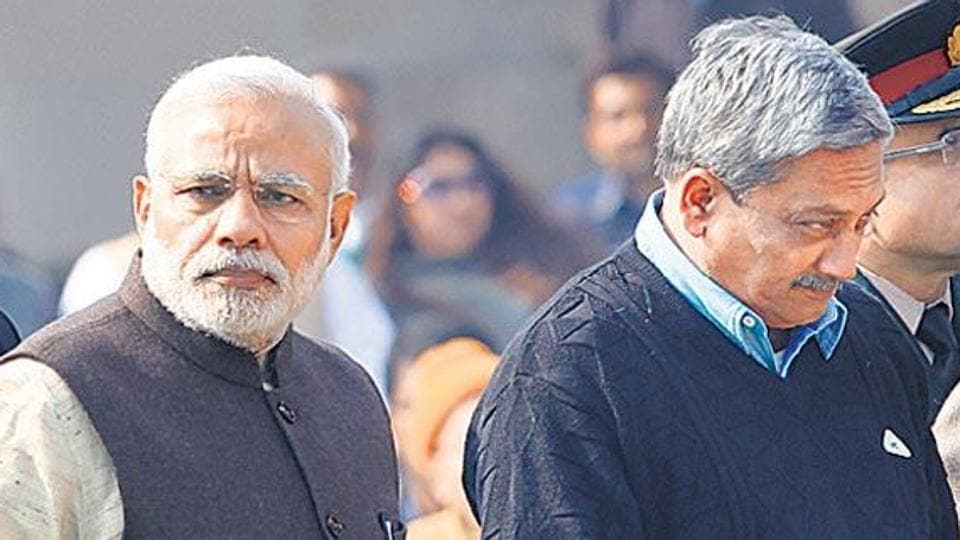
Work has begun on creating joint commands to optimise resource utilisation among the three armed services; the Army, Navy and the Air Force.
South Block sources told Hindustan Times that the Modi government has decided to appoint a CDS, a single point military adviser to the political leadership in matters of acquisition, procurement policy and resource rationalisation.
The mandate for the proposed CDS will be decided by defence minister Parrikar in consultation with the PM and National Security Adviser Ajit Doval. “The new post of CDS will not be used for parking slots for super-ceded generals and a new man will be tasked with the job once work profile is clearly defined,” said a senior official.
Parrikar is currently studying the report of retired General DB Shekatkar on making military more effective with better teeth-to-tail ratio.
The Shekatkar committee has also identified areas where there is redundancy, and downsizing of the military could be undertaken without compromising combat effectiveness.
“For example, a couple of hundred signal troopers had been deployed to listen to radio broadcasts in 1962. This unit is still functional despite it being technologically redundant. Similarly, the National Cadet Corps could be downsized by more than 50% by hiring retired soldiers,” said the official.
After preferring merit to seniority in appointment of Army Chief, the defence ministry is now examining the case for a joint command as a step towards integrated theatre commands.
The army, air force and navy currently operate in silos with each protecting its turf and operations. The ministry now is looking towards creating integrated structures where all three services are synergised towards military operations.
For example, it is proposed that Northern Command could come under one overall commander from any one of the three services, with overall control of all military and air assets. “This does not mean that top level vacancies will be reduced. Only that there would be one overall commander in one theatre and future roles of military chiefs being redefined and refocused. Essentially, the reforms will be close to what has been done in US Armed Forces with tweaking on ground,” said a senior official.
However, top defence analysts are sceptical about the theatre command concept as it not only required dedicated military resources but also command synergy at the cutting-edge levels. According to them, maybe the first step could be formation of tri-services battle groups before the theatre command concept is followed.
“US has global armed presence and hence the theatre command concept works with dedicated land, air and naval assets earmarked for each command. In India, we have flexible air and naval assets that are earmarked as per operational requirement,” said an analyst.


