E-Paper



Send a message Brics isn’t a divisive group, says PM Modi at closed session
PM Modi called for unanimous cooperation to deal with terrorism, and said there can be “no place for double standards” on such serious issues

 Prefer HTon Google


NEW DELHI: The world community is looking to the Brics grouping to play a positive role as it grapples with challenges ranging from wars and conflicts to food and energy security and disinformation in an age of technology, Prime Minister Narendra Modi said on Wednesday.
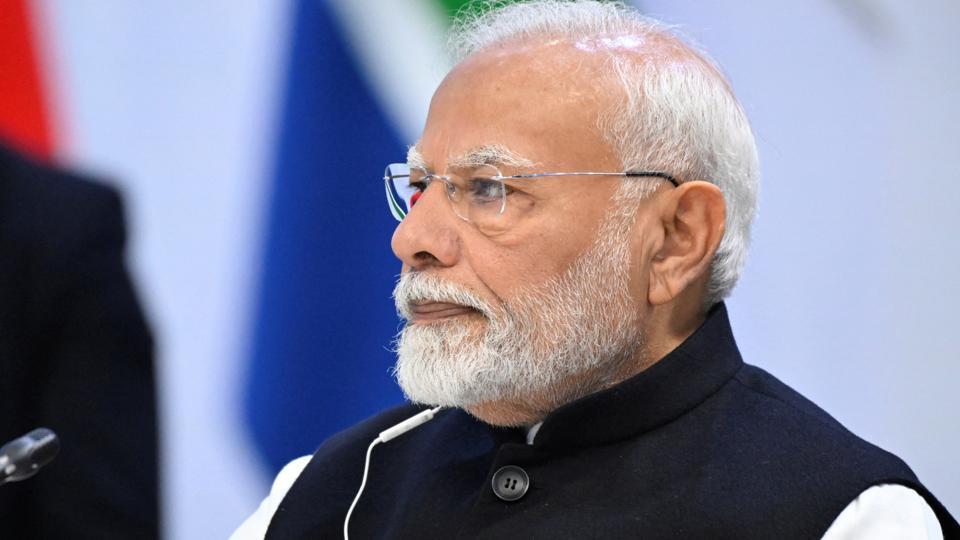
Modi made the remarks while addressing a closed plenary session of the Brics Summit in the Russian city of Kazan, the first gathering of the bloc since its expansion last year. The approach of Brics, he said, should remain people-centric and it should send a message it isn’t a “divisive group but a public interest group”.
“I believe that as a diverse and inclusive platform, Brics can play a positive role on all issues,” he said, speaking in Hindi. “We support dialogue and diplomacy, not war. And just as we together defeated a challenge like Covid, we are fully capable of creating new opportunities for a safe, strong and prosperous future for the future generation.”
Modi listed the various challenges confronting the world community, including wars, economic uncertainty, climate change, terrorism, and a North-South and East-West divide. Tackling inflation and food, energy, health and water security are priority issues for all countries, he said.
“In the age of technology, new challenges like cyber security, deep fake and disinformation have emerged. In such a situation, there are many expectations from Brics,” he said.
Modi called for strong and unanimous cooperation to deal with terrorism and terror financing, and said there can be “no place for double standards” on such serious issues.
“We should take active steps to prevent radicalisation among the youth of our countries. We have to work together on the pending issue of the Comprehensive Convention on International terrorism in the UN. Similarly, we should work for global regulations for cyber security and safe and secure AI,” he said.
While India is ready to welcome the new category of “Brics partner countries”, all decisions in this context should be made “unanimously and the views of the founding members of Brics should be respected”, Modi said.
“The guiding principles, standards, criteria and procedures that we adopted at the Johannesburg Summit should be followed by all member and partner countries,” he said.
Brics has the “will to change itself according to the times” and its members should unanimously raise the need to reform global institutions such as the UN Security Council, multilateral development banks and World Trade Organization (WTO). At the same time Brics should ensure it is seen as an organisation that wants to reform global institutions but not replace them, Modi said.
In this process, the aspirations of the Global South should be kept in mind. “Last year, African countries were added to Brics. This year too, many countries of the Global South have been invited by Russia,” he said.
“The Brics group, formed by the confluence of different types of ideas and ideologies, is today inspiring the world to move in the direction of positive cooperation. Our diversity, respect for each other and the tradition of moving forward with consensus are the basis of our cooperation,” Modi said.
Brics was originally formed by Brazil, Russia, India, China and South Africa, and the bloc was expanded last year with the inclusion of Egypt, Ethiopia, Iran and the United Arab Emirates.
The summit is being held at a time when China and Russia have forged a closer partnership to cope with their differences with the West.