
 E-Paper



At least 7 LeT terrorists behind Poonch attack
Prior intelligence inputs, a second official said, suggested three of the terrorists crossed over from Pakistan and hid inside the dense forest.

 Prefer HTon Google


Prime facie investigation into the Poonch attack in Jammu and Kashmir on Thursday, which led to the deaths of five Rashtriya Rifles jawans, suggests the role of at least seven Lashkar-e-Taiba (LeT) terrorists, officials aware of the matter said, as the Indian Army launched a manhunt for the suspects and National Investigation Agency (NIA) teams reached the site.
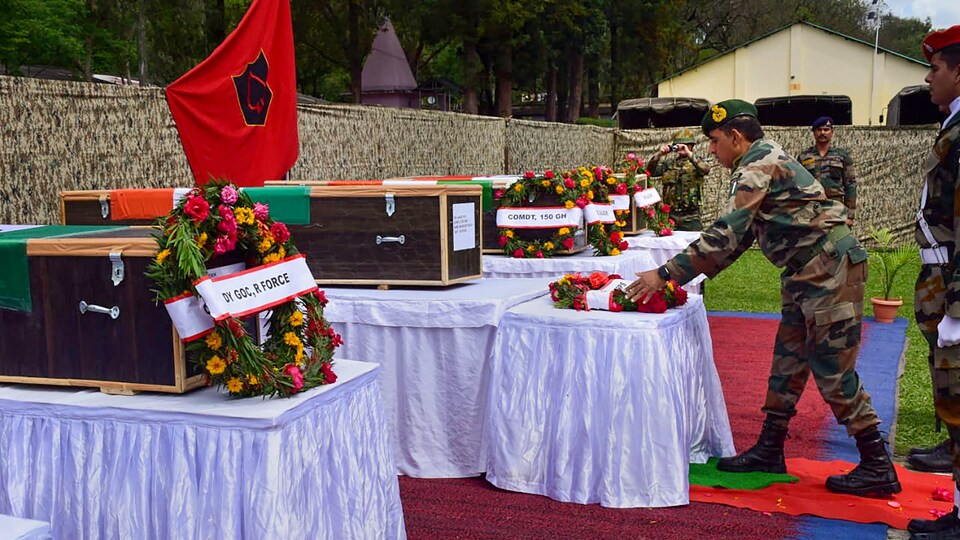
This is the fourth incident in which the Indian Army has suffered casualties in the Poonch-Rajouri area. The spot is 7km from Bhimber Gali at the Line of Control (LoC), with a thickly forested belt on the Indian side of the LoC that the terrorists are believed to have made use of to hide, spot and carry out the “well-planned attack”, people aware of the matter said.
Also read | Army releases names of soldiers killed in Poonch terror attack
The intent, they added, could be to create fear ahead of G20 meetings slated in Jammu and Kashmir.
“This was a very well-planned ambush carried out by multiple terrorists from three sides – from the top of the hill, front and left side of the moving side of Army truck, which had rations apart from security personnel,” said an officer, who didn’t want to be named.
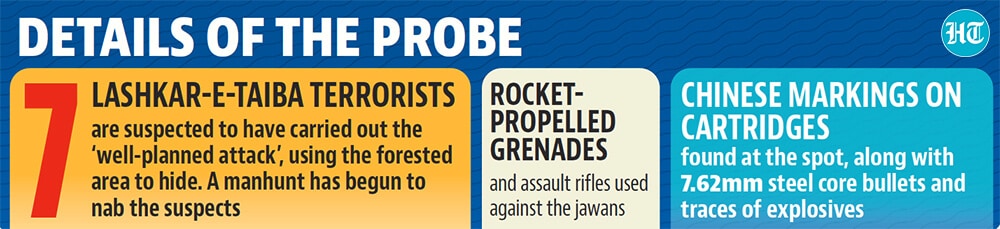
Prior intelligence inputs, a second official said, suggested three of the terrorists crossed over from Pakistan and hid inside the dense forest.
According to inputs from the Jammu & Kashmir Police, the terrorists used rocket-propelled grenades and assault rifles against the RR jawans travelling in the truck. It’s still not clear whether the truck caught fire due to a direct RPG hit or was set on fire by terrorists after the Indian soldiers were gunned down.
“The incident has been deliberately planned by the Pakistani-deep state to instigate violence in Jammu and Kashmir and Uttar Pradesh and deliberately spread fear among the delegate attending the G20 event,” said a senior J&K official, asking not to be named.
Drones, bomb squad, NIA in Poonch after terror attack on Army truck: What we know
The third G20 tourism meet is scheduled to be held in the third week of May in Srinagar. Pakistan has objected to New Delhi’s decision to hold meetings in the Indian Union territories of Jammu & Kashmir and Ladakh.
A Jaish-e-Mohammad proxy , PAFF (People’s Anti-Fascist Front), claimed responsibility for the attack in a tweet, but investigators are not ruling out a joint operation of it and the LeT. PAFF was banned by the ministry of home affairs (MHA) on January 6 this year under the Unlawful Activities Prevention Act (UAPA).
“This area in Poonch, which is very close to the Line of Control (LoC) has always been stronghold of JeM in terms of carrying out terror attacks,” a third official said, asking not to be named.
“Inputs in recent weeks have claimed that terror outfits have been asked by the Pakistani army and the ISI to target security forces’ convoys, camps, government buildings and people travelling to the Valley from outside,” added this officer.
Ballistics and forensic experts recovered 7.62mm steel core bullets, cartridges with Chinese markings, and traces of explosives. It appears that the truck caught fire and an explosion took place near the diesel tank due to incessant firing from three sides, but investigators are not ruling out the use of a sticky improvised explosive device (IED).
An official in the security establishment told HT that shells recovered from the site of ambush were found to have ‘71-China’ markings on them. The bullets with steel core were first used by Jaish-e-Mohammad in 2018 when its cadres killed five CRPF men at Lethpora in an attack on a CRPF camp.
Several people have been detained by the central agencies and J&K police in connection with the attack and are being questioned.
The attack, officials said, is expected to further impact bilateral relations between India and Pakistan, which are at its worst since 2019 Pulwama attack, in which 40 personnel of Central Reserve Police Force (CRPF) were killed in a suicide bombing.
India has, at various international forums, called Pakistan as an “epicentre of terrorism”.
(With inputs from Ravi Krishan Khajuria)


