
 E-Paper



Strong breeze, sunshine after 6 days come to Delhi’s rescue
The AQI reading at a given time is an average of the readings from the previous 24 hours. Air quality is considered good when the AQI is below 50 and satisfactory under 100.


Sunshine broke through thick smog on Monday as the toxic blanket that engulfed Delhi appeared to lift because of increased wind speeds, improving the air quality to “very poor” by evening, on a day emergency road rationing measures kicked in to combat the national capital’s public health crisis.
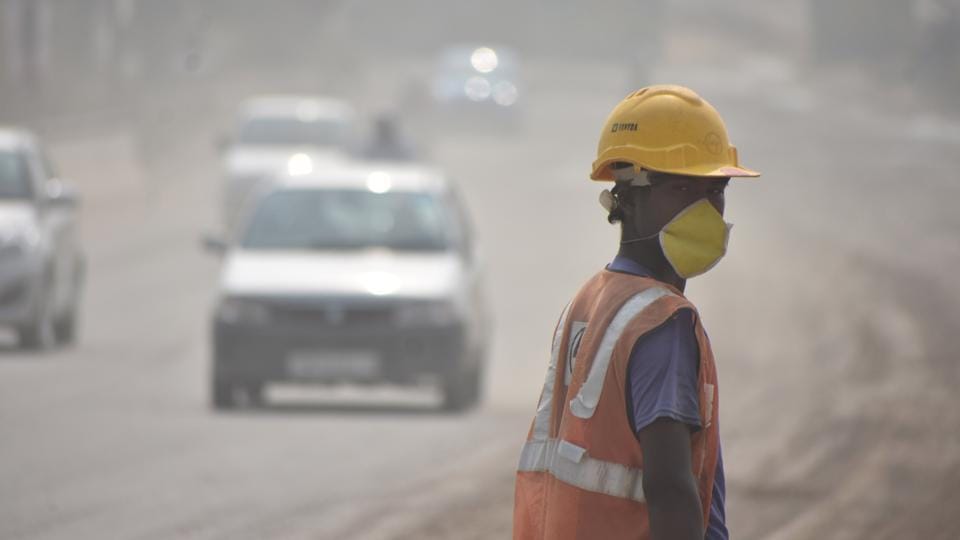
The drop in pollution again demonstrated how Delhi is largely defenceless against adverse meteorological conditions in the absence of an effective response from authorities. While the city wore a desolate look on Sunday, when low wind speed led to abysmal visibility caused by smog, an improvement in weather provided much-needed relief to residents complaining of itchy throats, burning eyes and shortness of breath.
HT reported on Monday that a combination of scanty rainfall and weak wind created a “smog blanket” up to the height of 50 metres over the national capital, with experts saying ad hoc measures had again failed the city.
The India Meteorological Department (IMD) said a fresh western disturbance – a weather pattern that brings rainfall – is approaching north India, and scattered rainfall and change in wind direction could further improve the air quality in Delhi by November 8.
The Central Pollution Control Board’s (CPCB) 4pm bulletin on the Air Quality Index (AQI) on Monday showed the pollution was “severe” at 407, which was a considerable improvement over the previous day’s recording of 494, the worst in three years. The gusts of wind ensured that the reading went down to 360 in the “very poor” category by 11pm.
The AQI reading at a given time is an average of the readings from the previous 24 hours. Air quality is considered good when the AQI is below 50 and satisfactory under 100.
The Supreme Court, which stepped in on Monday amid increasing voices for an effective solution to arrest the annual air crisis, said people in Delhi-NCR are losing “precious years of their lives” and cannot be “left to die” due to the “atrocious” pollution situation, which reflects a “shocking state of affairs”.
“Can we survive in this atmosphere? This is not the way we can survive,” the bench of justices Arun Mishra and Deepak Gupta said, adding that the authorities have left the people to die.
The apex court has taken a stern view of the deteriorating air quality over the past few years and an SC-mandated body, the Environment Pollution Control Authority (EPCA), has taken several steps to control the menace.
The national weather department said Cyclone Maha and a western disturbance will cause rainfall in parts of the northern plains, covering Rajasthan, Punjab, Haryana, western Uttar Pradesh and Delhi-NCR, on Wednesday and Thursday, which will improve the situation further.
Experts said a significant increase in the wind speed, up to about 20km per hour, dispersed the pollutants.
“It was after long, may be after Diwali day, that the sky was clear, with sunlight being able to penetrate to the ground. Also, the winds picked up pace, helping pollution levels to improve. Though in ‘severe’ zone, the toxicity in the air reduced by noon. It is expected to get better on November 5. Air quality may dip again due to cloud formation and rainfall is likely on November 6, but pollution levels will most likely dissipate by the evening,” said Kuldeep Shrivastava, head, regional weather forecasting centre, IMD.
The Union environment ministry’s System of Air Quality and Weather Forecasting And Research (Safar) said: “High surface and boundary layer winds are expected on Tuesday also. A fresh western disturbance, scattered rainfall and change in wind direction are likely to positively influence the AQI in the region.”
Sun rays appeared from the fading smog for the first time in six days. The duration of sunlight the city witnessed through the day was longer than all previous days combined since Diwali, when the national capital rang with thousands of illegal firecrackers, which release noxious fumes and particulate matter.
The Aam Aadmi Party-led Delhi’s government’s road rationing measures began on Monday, with data showing that the traffic compliance this year was better than that compared to the first two editions of the scheme, popularly referred to as “odd-even”.
About 271 challans were issued to violators, who are required to pay a penalty of ~4,000. Under the scheme, private vehicles with odd-numbered registration plates are allowed to run on odd dates, while those with even numbers are permitted on even dates. Studies conducted in the past have raised concerns about effectiveness of the move as many vehicles, including two-wheelers, are exempted.
The SC asked the Delhi government within hours of the scheme’s launch as to why the authorities stopped plying cars that are less polluting compared to two- and three-wheelers, and cabs.
Stopping all construction and demolition activities as well as garbage and waste burning till further orders, the SC directed neighbouring Punjab, Haryana and western Uttar Pradesh to prevent stubble burning.
The court’s remarks came on a day farm fires saw a sharp spike in Punjab. As the cloud cover that militated against an effective mapping of stubbing burning cases in the region cleared, Punjab on Monday reported highest number of farm fires this season — 5,953 in a single day, according to data from the Punjab Agriculture University (PAU). Before Monday, the highest number of stubble burning incidents was 3,135.
Experts have said that the detection of farm fires with the help of satellites could be erroneous as clouds were obscuring the fire incidents. “Satellite fire detection capability is strongly doubtful under dense cloud cover which is prevailing. The unusually low fire counts detected on 2nd November (57) may be partly due to this,” said a statement issued by Safar on Monday.
The period till November 15 is vulnerable to pollution spikes since this is the time when farm fires in Punjab and Haryana peak, and the resulting smoke settles over NCR and adjoining regions. Stubble left behind after the harvest is often burnt by farmers as a quick and cheap way of clearing the field for the next round of sowing.
Farm fires and emissions from firecrackers result in heavy concentrations of PM2.5 ultrafine particles in the air, which can lead to major health problems since they can enter the bloodstream after penetrating deep into the lungs.
The Delhi government declared a public health emergency on Friday and closed schools and all construction activity.
Pollution levels in Ghaziabad (440), Noida (430) and Greater Noida (428) remained at alarming levels. Gurugram and Faridabad’s AQI stood at 370 and 403 respectively, as per the 4pm bulletin.
Principal secretary to Prime Minister Narendra Modi, PK Mishra, reviewed the measures taken by the states of Punjab, Haryana and Delhi to tackle the air pollution. He sought to know the details of additional measures taken to check fresh cases of fire and stubble burning in these states during the last 24 hours.


