E-Paper



Supreme Court halts ASI survey at Gyanvapi for two days
The directive came at a time when a 30-member team of ASI was inside the mosque complex to carry out the survey — as directed by the Varanasi district court.

 Prefer HTon Google


The Supreme Court on Monday stayed till 5pm on July 26 the Varanasi district court’s order of an extensive survey of the Gyanvapi Masjid by the Archaeological Survey of India (ASI) to ascertain whether the mosque was built over a pre-existing Hindu temple, holding that the mosque management committee must get “some breathing time” to challenge the impugned directive.
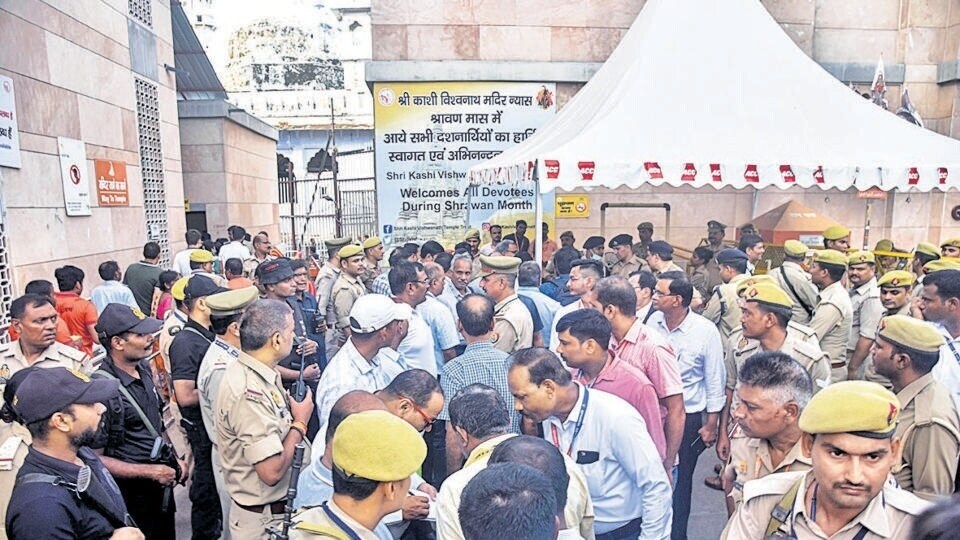
Also Read | Hours before SC order, ASI clicks photos, collects soil samples at Gyanvapi
A bench, headed by Chief Justice of India (CJI) Dhananjaya Y Chandrachud, also directed the registrar (judicial) of the Allahabad high court to ensure that the committee’s petition is placed before an appropriate bench in the high court “so that it can be heard before the order of status quo, which has been granted by this court today, comes to an end”.
“Having regard to the fact that the order of the district court was pronounced at 4.30pm on July 21, 2023, and the survey is in the process of being carried out today, we are of the view that some ‘breathing time’ must be granted to the petitioners to move the high court for pursuing their remedies. We direct that the impugned order of the district court shall not be enforced until 5pm on July 26, 2023,” stated the bench, also comprising justices JB Pardiwala and Manoj Misra.
The directive came at a time when a 30-member team of ASI was inside the mosque complex to carry out the survey — as directed by the Varanasi district court, while the mosque management committee had rushed to the Supreme Court, pressing for an immediate stay of the contentious order. The ASI team was accompanied by the four Hindu women plaintiffs and their counsel, Uttar Pradesh government’s special counsel Advocate Rajesh for Shringar Gauri-Gyanvapi case, and senior administrative officials.
The bench asked solicitor general (SG) Tushar Mehta, who appeared for the UP government in the case, to communicate the court’s restraining order to ASI without delay. It also recorded the SG’s statement that ASI contemplates no excavation at the site until July 31, 2023, and that only measurements, photography and radar imaging were being carried out.
The top court order came on an urgent plea moved by the mosque management committee, complaining that they were “ambushed” by the district court’s order which came on Friday evening and ASI quickly moved in action, reaching the site on Monday morning .
“What’s the tearing hurry? The property has been a mosque and has been used as one since the 16th century and since the Independence. They are going to excavate too, and the district court order says so. We were given no time to pursue the legal remedies available to us while the ASI team is already there...Let there be an order of status quo,” argued senior counsel Huzefa Ahmadi, representing the committee. He added that an omnibus order of a survey cannot be implemented when the district court has not even framed the issues in the suits pending before it.
On Friday, Varanasi district judge Ajaya Krishna Vishvesha directed ASI to conduct a comprehensive survey, using dating, excavation and ground penetrating radar (GPR) techniques, of the plot where the mosque stands, next to the Kashi Vishwanath temple. The judge held that the scientific investigation is “necessary” for the “true facts” to come out, as it allowed an application by the four Hindu women plaintiffs. The district court, however, ordered excluding the section which has remained sealed since the Supreme Court order in May 2022. The area under seal is where the Hindu side insists a Shivling has been found, while the Muslims says it is part of a fountain.
After Ahmadi sought the top court’s intervention, the bench, at first, asked the SG to speak to ASI officials and apprise the court of the nature of survey being conducted at the site. Mehta returned in 10 minutes and told the bench, “Not even a brick has been removed nor will it be done for at least a week.” He added that there would be no effort to carry out any excavation at the site for at least a week and hence, the mosque committee can be remitted to the high court to pursue their appeal against the district court’s order in the meantime.
Taking Mehta’s statements on record that the structure faces no imminent danger of excavation, the bench was inclined to wrap up the proceedings while asking the committee to argue its appeal before the high court, but Ahmadi insisted on a restraining order. He pointed out that letting ASI carry out any activity at the site would be prejudicial to them, especially when the committee is yet to get an opportunity to argue before the high court for a complete stay of the Friday order.
Senior counsel Shyam Divan, who appeared for the four Hindi plaintiffs, opposed Ahmadi’s request, contending that a status quo order by the apex court continues indefinitely and that the issue should be left to the Allahabad high court to decide.
The bench then turned to the SG, asking if he was willing to make a statement that ASI can maintain a status quo till Friday to enable the committee to secure a hearing in the high court. The SG, however, expressed his inability to make such a statement, emphasising that ASI is not carrying out excavation or any other invasive method at the disputed site. Mehta added that the mosque committee should rather be asked to make all such submissions before the high court.
Responding, the bench said that it is of the view that the matter can be set down before the high court by Wednesday, but an order of status quo should be in force until a hearing takes place there. It then proceeded to stay the enforcement of the district court order till 5pm on July 26.
In its Friday order, the district court directed ASI to conduct a detailed scientific investigation using GPR survey, excavation, dating methods, and other modern techniques to find out whether the mosque was constructed over a pre-existing Hindu temple.
Dating is a method of calculating the age of very old objects while a GPR survey is a method of gathering data about what’s below the ground using ground-penetrating radar technology that sends electromagnetic energy signals into the subsurface.
The district court order further directed ASI to carry out GPR survey under the three domes of the mosque (where the plaintiffs claim there are remains of the pinnacle of a temple) and beneath the western wall (where the Hindu shrine of Shringar Gauri exists). The court also permitted ASI to carry out scientific investigation of all the artefacts found in the mosque to find out their age and nature, and directed it to study all objects of historical and religious importance in different parts of the building, and also beneath the structure which may be found during excavation.
“The director of ASI is also directed to conduct GPR survey, excavation wherever required,” said the court, adding that ASI must ensure that there should be no damage to the structure.
The order came on two applications moved by four of the five Hindu plaintiffs who filed a suit in August 2021, demanding the right of unhindered worship at the Maa Shringar Gauri Sthal, located inside the complex that houses idols of Hindu gods. Rekha Pathak, Manju Vyas, Sita Sahu, and Lakshmi Devi filed the application for the survey. Their pleas were argued by advocates Hari Shankar Jain, Vishnu Jain, Sudhir Tripathi and Subhash Nandan Chaturvedi.
The mosque management committee, in its reply, refuted that the mosque was built over a temple, maintaining the structure at the spot was always a mosque. Represented through advocates Ansari and Ekhlaq Ahmad, the management committee opposed the survey, saying such an exercise cannot be ordered to collect evidence. It was also argued that a survey by an advocate commissioner was previously conducted in April 2022 and until the validity of that survey is not decided, no new survey can be ordered.
But the district judge shot down the mosque management committee’s objections, noting the spot inspection conducted in April 2022 is entirely different from a scientific survey by ASI, which has all the modern techniques and wherewithal to ascertain the age and nature of construction at the disputed site.
The mosque management committee earlier sought to get the case thrown out under Order VII Rule 11 of the Civil Procedure Code (CPC), arguing the suit by the Hindu plaintiffs was barred by the 1991 Places of Worship Act. The Act locks the position or “religious identity” of any place of worship as it existed on August 15, 1947.
But last September, the Varanasi district judge dismissed the committee’s application. This judgment was upheld by the Allahabad high court in May, and the committee’s appeal is now pending before the Supreme Court.
The district judge is currently trying eight suits claiming the existence of idols of Hindu deities inside the Gyanvapi mosque located next to the Kashi Vishwanath Temple. While the first one to be filed by the five HIndu women asked for a right to worship Hindu deities inside the mosque complex, six others have pressed for a claim over title of the land where the Gyanvapi Masjid stands.
Anjuman Intezamia Masjid Committee joint secretary SM Yasin said, “We have got temporary relief.” He claimed that he didn’t get the copy of the Varanasi court’s order for the survey till Monday morning but the ASI received it and started the survey in a hurry.
One of the counsels for the Anjuman Intezamia Masajid Committee, Advocate Eklaq Ahmad said, “The Supreme Court’s order has given a relief to the committee.” He said that they were preparing and would argue the matter in the Allahabad high court.
Counsel for four Hindu Women plaintiffs Vishnu Shankar Jain said, “We will argue the matter before high court.”
The Gyanvapi case is one of several such petitions filed by Hindu groups and individuals in lower courts in Varanasi, Agra and Mathura, seeking redressal on centuries-old disputes involving religious places. The Places of Worship Act 1991 was designed to prevent such disputes but it appears to be ineffective. Proceedings around the law are already before the top court, so the government must clarify its stand on the law, and the SC should consider taking a call.