
 E-Paper



Tamil eternal, says PM after Stalin’s Hindi jibe
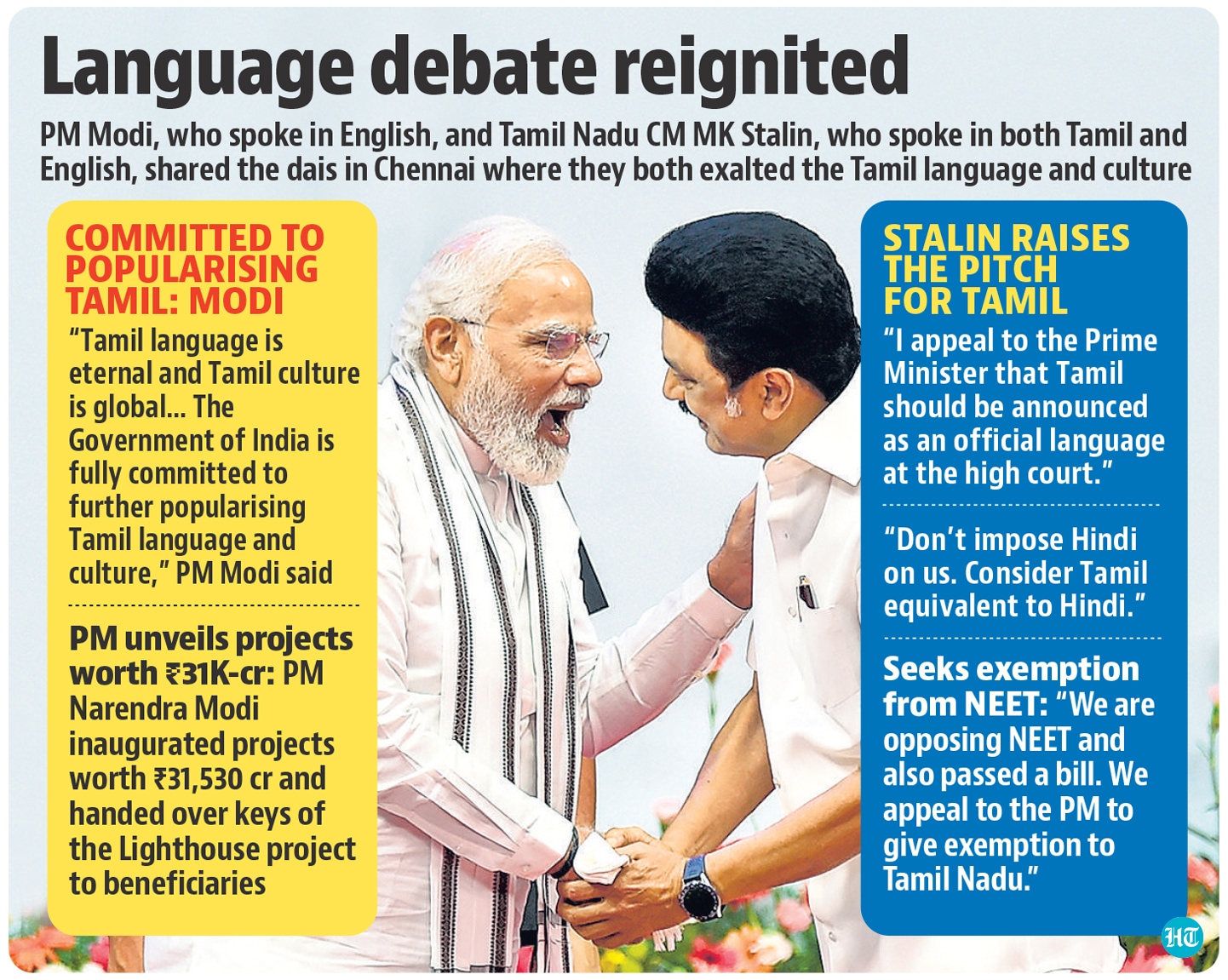
PM Narendra Modi praised Tamil language and culture and said his government is committed to popularising it. He said: “Tamil language is eternal and Tamil culture is global... The government of India is fully committed to further popularising Tamil language and culture.”


Prime Minister Narendra Modi, speaking in English, and Tamil Nadu chief minister MK Stalin, speaking in Tamil and English, took forward the debate on language when they shared the dais during the former’s visit to the city for the launch of a clutch of infrastructure projects.
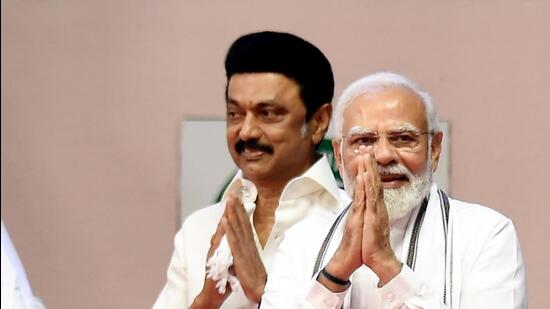
The PM, in his speech, avoided the politically combative tone he sometimes adopts when touring states ruled by parties other than his Bharatiya Janata Party (BJP) — he was very combative in Hyderabad earlier in the day — and the visit was characterised by cordiality and warmth, but both leaders did make the points they wanted to.
Speaking first, Stalin spoke of the state’s NEET (National Eligibility cum Entrance Test) scrapping bill pending before the President, Goods and Services Tax (GST) dues, and sought more funds for developmental projects in the state, highlighting Tamil Nadu’s contribution to the country’s economy. “Tamil language is both ancient and modern among the classical languages of the world,” Stalin said, pitching Tamil to be made an official language on par with Hindi. “It thrives with its eternal youthfulness and should be made the official language of the Union on par with Hindi and recognised as the court language in the high court.”
“Don`t impose Hindi on us. Consider Tamil equivalent to Hindi,” he said.
Also Read | PM raises Telangana poll pitch, calls for end of ‘family rule’
Modi, when he spoke, praised Tamil language and culture and said his government is committed to popularising it. The PM, who was in Chennai for the first time since the DMK came to power, said: “Tamil language is eternal and Tamil culture is global... The government of India is fully committed to further popularising Tamil language and culture.”
Modi cited the setting up of the new campus of the Central Institute of Classical Tamil in Chennai and the decision to have a Subramania Bharati chair on Tamil studies at Banaras Hindu University (BHU) as efforts by his government to promote the language. “Since BHU is located in my constituency, the joy was extra special,” Modi said.
Ramu Manivannan, professor of political science at University of Madras, said India can have more than one official language. “All languages in the 7th schedule can be integrated as official languages, which will set a precedent across the world because India is pluralistic,” he said.
The Union government and the ruling BJP has been criticised by several parties in Tamil Nadu and Karnataka over what has been regarded as attempts to impose Hindi. It stems from comments from BJP leaders, including Union home minister Amit Shah, that Hindi should be considered a nationwide alternative to English, and a now-abandoned recommendation in the National Education Policy (NEP) that called for mandatory teaching of Hindi in schools.
Manivannan said the BJP’s thrust on Hindi may be a conscious attempt to rally Hindi votes. “My view is that the BJP is fairly convinced that if they secure the Hindi belt, they can secure 2024 elections. They have already successfully played the religion formula and next is language.”
Stalin, who spoke predominantly in Tamil, often switched to English to translate to Modi a gist of what he wanted to convey. “I would request you to allot more funds and projects to our state Tamil Nadu, in the true spirit of co-operative federalism...We will extend a hand of friendship at the same time we will raise our voice for our rights,” he said.
Though Stalin didn’t touch on NEP, Modi said that policy allows for technical and medical courses that can be done in local languages. “Youngsters from Tamil Nadu will benefit from this,” the PM said.
The Tamil Nadu CM also pressed for the demand that the Katchatheevu Island be retrieved from Sri Lanka, urged the NEET exemption bill be assented to, and called on the Union government to clear GST dues of ₹14,006 crore and extend the GST compensation cess by another two years — all of which Stalin had done so previously when he had met Modi in Delhi.
The PM, who was in Chennai to inaugurate development projects, said the central government is focusing on road connectivity since “it is directly linked to economic prosperity.”
“We aim to achieve Garib Kalyan. Our emphasis on social infrastructure indicates our emphasis on the principle of ‘Sarv Jan Hitaya and Sarv Jan Sukhaya,’” he said, adding that the focus of the Union government was saturation-level coverage in key schemes.
“Take any sector — toilets, housing, financial inclusion... we are working towards complete coverage. When this is done, there is no scope for exclusion,” he added.
Stalin advocated for more development projects and funds to be allotted to Tamil Nadu as the state contributed to India’s development and the Union government’s fiscal resources. The chief minister said that Tamil Nadu’s share in India’s GDP was 9.22%, and 6% in the overall tax income at the central level.
“Therefore, Union government must increase its contribution to schemes and fund allocation, to do justice to the contribution lent by developed states like Tamil Nadu in the country’s development and economy. Only then will the true spirit of cooperative federalism be upheld,” he said.
The CM said in schemes jointly implemented by the Union and state governments, the latter contribute more. “Therefore, I demand that the contribution ratio mentioned in the beginning of such schemes shall continue till the end and when beneficiaries are not able to pay their share, the Union government must also step in along with the state government,” he added.
The Prime Minister spoke of the government’s assistance to Sri Lanka. “I am sure you are concerned with the developments there. As a close friend and neighbour, India is providing all possible support to Sri Lanka,” he said.
Political analyst Raveendran Duraisamy said both Stalin and Modi played their roles on stage. “As a regional leader, Stalin keeps sticking to the language issue. Modi wants to outdo the Congress on the Hindi issued and by bringing in sentiments of mother tongue, he is trying to also get a share of the political mileage with regional leaders like Stalin, Mamata and Naveen Patnaik,” said Duraisamy.


