E-Paper



Twisha Sharma cremated after second post-mortem in Bhopal ‘dowry death’ case
The cremation was conducted after a team of doctors from AIIMS Delhi conducted a second post-mortem examination at AIIMS Bhopal for nearly four hours.

 Prefer HTon Google


The last rites of former actor-model Twisha Sharma, who was allegedly harassed for dowry, were conducted on Sunday evening, soon after an AIIMS Delhi team completed her second post-mortem examination.
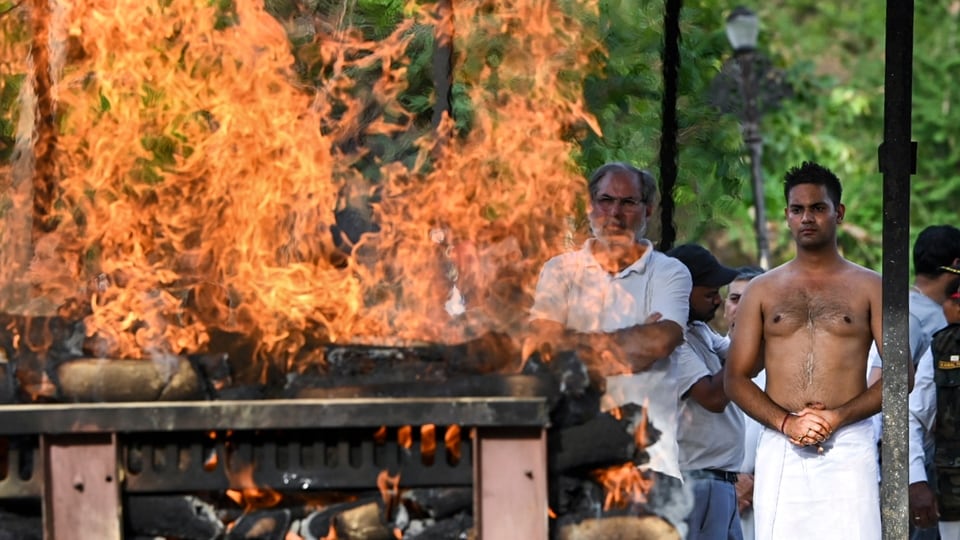
The 32-year-old actor-model was found dead at her home in Bhopal’s Katara Hills area on May 12, with her family alleging harassment and abuse over dowry. Her lawyer-husband, Samarth Singh, who absconded for 10 days since an FIR was registered against him and his mother following Twisha’s death, surrendered to the Bhopal police on May 22 and is currently in police custody.
The victim was cremated at Bhopal’s Bhadbhada Vishram Ghat, with her brother, Harshit, lighting the funeral pyre. Her mother-in-law, retired judge Giribala Singh, did not attend the cremation, while Samarth Singh was denied police permission to be present at the ceremony.
The cremation was conducted after a team of doctors from AIIMS Delhi conducted a second post-mortem examination at AIIMS Bhopal for nearly four hours. The second post mortem was ordered by the Madhya Pradesh high court following concerns raised by Twisha’s parents regarding procedural lapses by local authorities.
The chief of forensic medicine at AIIMS Delhi, Dr Sudhir Gupta, meanwhile, said compiling the report will take some time as certain laboratory tests, including histopathology and viscera examination, are required.
Relations soured after pregnancy: Samarth
According to officials familiar with the matter, Samarth told police during questioning that their relationship soured after April 17, when Twisha learned of her pregnancy. “Twisha’s pregnancy was confirmed on April 17, 2026, after which she said she didn’t want a domesticated life... Upon returning from the hospital, Twisha expressed a desire to go to her home in Delhi. That evening, she took a flight to Delhi and reached her home in Noida,” said an investigating officer, who spoke on the condition of anonymity.
Samarth further claimed that the couple had planned a trip to Bengaluru on April 24, but Twisha said she wanted to go Ajmer, sparking a conflict. “Both families intervened, and the couple returned to Bhopal on April 30. Later, they argued after Samarth learned Twisha had spent only one day in Ajmer and the rest in Delhi. He said they fought over her remark that she belonged to the world of glamour and never wanted a confined domestic life,” the officer said, quoting Samarth.
As per Samarth, on May 12, Twisha visited a beauty parlour, returned at 6 pm, went for a walk with him, and they had dinner. He claimed she went downstairs to talk on the phone while he slept. His mother later alerted him that Twisha was nowhere to be found. Giribala found her hanging on the rooftop with a nylon exercise belt.
“Samarth said he rushed to support her, while his mother tried to loosen the noose, and he attempted CPR... took her to AIIMS, where doctors declared her dead,” the officer added.
Twisha’s father, Navnidhi Sharma, rejected Samarth’s account and said, “When Twisha was talking on the phone, Samarth shouted from the background and she disconnected the phone...”
SIT head Rajneesh Kaul said, “Giribala Singh has been asked to stay at home as police will go to their home with Samarth for the reconstruction of the crime scene...”