
 E-Paper



‘No let-up in preparedness against Covid-19’: Satyendar Jain
On oxygen support until last Thursday, Delhi health minister Satyendar Jain credited his recovery to plasma therapy and pranayam, a breathing exercise in yoga.


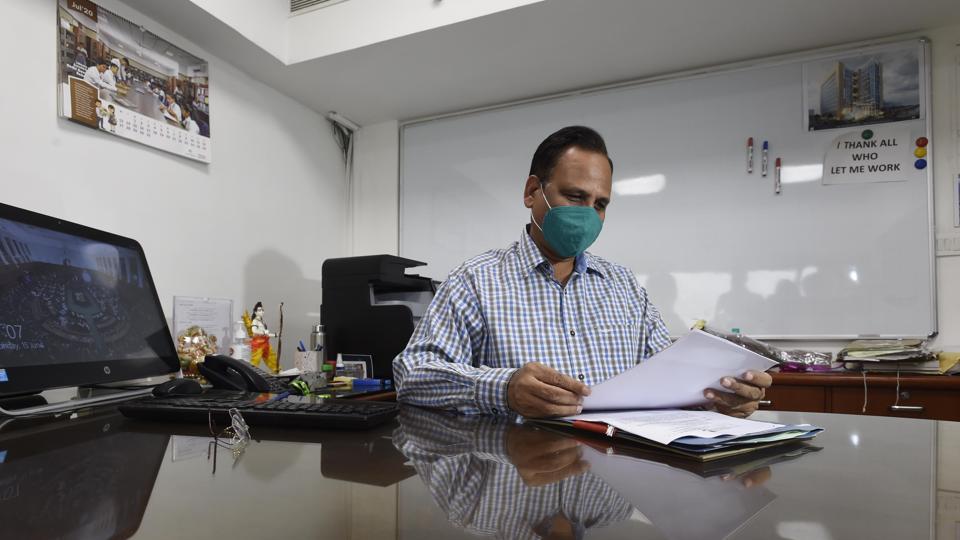
On the first day back at his office after recovering from the coronavirus disease (Covid-19), Delhi health minister Satyendar Jain said on Monday that the state government has no plan to lower its guard in the fight against the pandemic and there would be no let-up in preparations to deal with it. Jain was hospitalised with fever on June 15 and diagnosed with Covid-19 on June 17. On oxygen support until last Thursday, Jain credited his recovery to plasma therapy and pranayam, a breathing exercise in yoga. Edited excerpts:
How was your experience with the coronavirus disease?
Whenever doctors asked me how I was feeling, I said I was absolutely fine. The doctors used to laugh that I never said I wasn’t fine. Two days after I was moved out of the ICU (intensive care unit), I came home. The doctors had said that I should stay at the hospital, but I said when I am not in the ICU, staying in the hospital or at home was the same. Even after coming back home, I needed oxygen daily. It has just been three days since I haven’t needed it.
Oxygen is very important when it comes to this disease. And, I think pranayam helps. My oxygen saturation was dipping even after I came home; when I spoke to the doctors they asked me to try pranayam. I started doing it around 12 days back and there has been an impact. So, all the people – those who have the infection and even those who don’t – should do pranayam.
Also read: Daily new Covid-19 cases drop in Delhi, CM Kejriwal says ‘don’t be complacent’
What helped you get through it?
First of all, people should not be scared, they should be strong mentally. When I got the infection, everyone in my family other than me was worried. I was never scared. People are not scared of the disease, they are scared of dying. I never even thought that there was a possibility that I could die. That might be the reason I recovered from the disease easily. The biggest immunity buster or booster is the mindset of the person.
The cases are going down now. Is it time for de-escalating Covid-19 preparedness?
We cannot decide what to do based on a seven or 10 days’ trend. Today, we are getting just over a 1,000 cases a day, but we do not know whether the numbers would remain there. We are comfortable at the moment; if we scale down and then the cases start rising again, what will we do? Scaling back up is easier said than done. So, we need to wait and watch.
We are reviewing the situation daily. There was a time when some hospitals were at 100% occupancy; now it is just 50%. Beds are available at every big hospital in the city. This is a comfortable situation.
Getting the 16,000 beds was not an easy task and we had planned ahead. Had there been a need for 80,000 beds, we would have arranged that too. The CM (Arvind Kejriwal) had said, keep three times as many beds ready as the number of cases in the city – for 1,000 patients in the hospitals we wanted 3,000 beds ready and for 5,000 patients 15,000.
At present, our occupancy is less than a third of the hospital beds available, so we do not need to scale up the beds further. We will maintain this for some time.
Also read | In its fight against coronavirus, Capital has turned a corner: CM Kejriwal
Has Delhi crossed its Covid-19 peak?
The numbers are definitely going down, but I think it is too early to say whether the cases have peaked. Even if you see the trends in the US, a month ago it had started declining but now look at the situation there – the highest number of cases are being reported from there. It is very difficult to predict anything about this virus. If today, I say that it’s over, the cases might start going up from tomorrow. And, when we had predicted a sharp increase, it went down.
So, we need to be prepared for the worst-case scenario.
There are two plasma banks in Delhi government hospitals and preparations to set up a third one have begun. Are enough people donating plasma?
We have received some donations, but I would like to appeal to all those who have recovered from the infection to come forward and donate plasma. They can save someone’s life. I will donate my plasma once I get the doctors’ nod.
A sero-surveillance study had been conducted in Delhi to gauge the population-level presence of Covid-19 antibodies. What have we learnt from the study?
The sero-surveillance tells us how many people in the population have already had the infection. What we have learnt is a huge number of people have had it. But the results of the survey will be declared by the central government’s NCDC (National Centre for Disease Control).
How will this help us in planning ahead?
First, let us find out the number. Then, we will see what to do. However, I think treatment is the most important. At this time, we should leave the other things and focus on treating Covid-19 just like any other ailment.
In your capacity as the public works department (PWD) minister, could you tell us what went wrong with monsoon preparedness that led to water-logging at Minto Bridge after the first heavy shower of the monsoon season?
I think the water-logging at Minto Bridge was because the BJP {Bharatiya Janata Party} people deliberately closed the drain in front of the BJP headquarters. They had done it last year as well and we had to get it opened up. Why else would the water not drain out despite having four pumps working there?
Apart from that, about 1,500 pumps – including mobile pumps – have been deployed across the city.
Yesterday, Delhi received about 80-90mm rainfall within two hours – that is about 15% of the total annual rainfall of the city. This means Delhi got two months’ worth of rain in two hours. This is the reason there was water-logging in some places. But all the water across Delhi was drained out – even from Minto Bridge – within two hours. Five years ago, this would have taken two days.


