
 E-Paper



50 facts to rule them all: A look at Tolkien’s way with worlds

 Prefer HTon Google


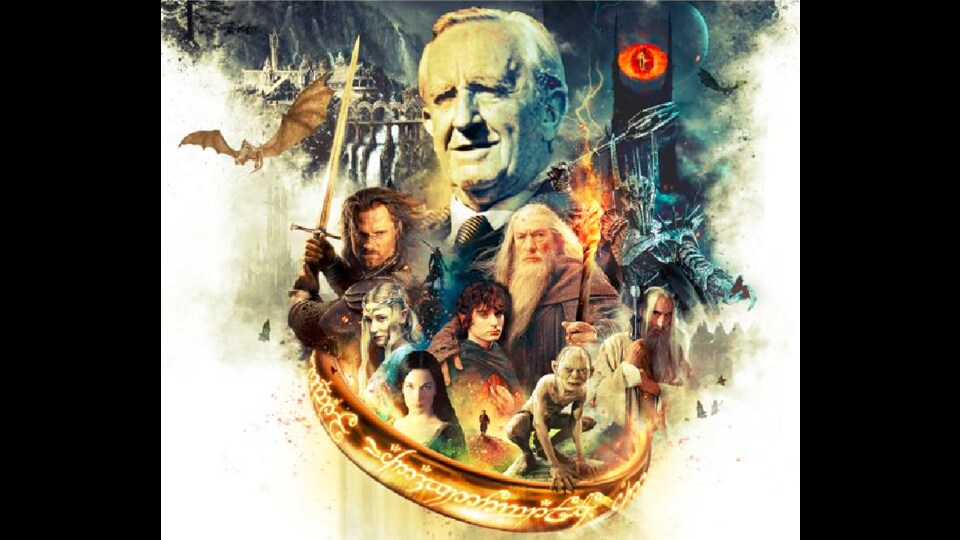
September marks half a century since the death of JRR Tolkien, yet signs of him are everywhere – in videogames, software programs, Star Wars and Game of Thrones
Fantasy fiction had existed before JRR Tolkien, but he essentially made it what it is today. From George Lucas’s Star Wars films to The Wheel of Time novels by Robert Jordan and Brandon Sanderson and the Dragon Age and Witcher games, Tolkien’s presence is felt in almost every attempt at fantasy worldbuilding. The languages of Dothraki and Valyrian in Game of Thrones owe as much to Quenya and Sindarin as to George RR Martin’s imagination.
The author Terry Pratchett once wrote: “J.R.R. Tolkien has become a sort of mountain, appearing in all subsequent fantasy in the way that Mt. Fuji appears so often in Japanese prints. Sometimes it’s big and up close. Sometimes it’s a shape on the horizon. Sometimes it’s not there at all, which means that the artist either has made a deliberate decision against the mountain, which is interesting in itself, or is in fact standing on Mt. Fuji.”.
Tolkien died in September 1973, aged 81. Fifty years on, take a tour of his legacy.
THE ORIGINS
1. Where did Middle-Earth come from? JRR Tolkien’s answer is: A song.
The origin story of the imagined world of The Lord of the Rings (LoTR) is the Ainulindalë or Music of the Ainur (the Ainur being the godly beings that existed before this world).
Music creates the world, in Tolkien’s imagined universe; as well as the creatures in it.
2. Tolkien studied languages through their literature, and was a scholar in this field of philology at Oxford. For his books, he drew from the Finnish epic poem Kalevala, notably The Story of Kullervo, particularly when shaping Middle-Earth.
An early Middle-Earth man, for instance, is Turin Turambar, and his story echoes Kullervo’s. Both are tragic heroes who accidentally commit incest with a sister, who discovers what they have done and kills herself by leaping into water. Both heroes later kill themselves after asking their sword if it will slay them (which it does).
3. Tolkien also plundered Norse mythology for names — Bifur, Bombur, Dain, Durin, Dwalin, Fili, Fundin, Gandalf, Gloin, Kili, Ori, Oin, Thorin are all named in the Poetic Edda, a collection of Old Norse narrative poems.
4. There’s a bit of Tolkien’s real life in LoTR too. Bilbo and Frodo Baggins live at Bag End, for instance, which was the real name of the Tudor home, dated to 1413, of Tolkien’s aunt Jane Neave, in the village of Dormston in Worcestershire, England.
THE BOOKS
5. After The Hobbit, the tale centered on Bilbo Baggins published in 1937, Tolkien had initially planned a sequel with a giant, not a dragon, as the foe.
Early outlines had a giant named Tree Beard capturing Gandalf (as Saruman later would). Bilbo’s new treasure quest was comical but turned darker, becoming The Lord of the Rings (published in 1954). In which Bilbo was sidelined in favour of his nephew Frodo.

6. A tree-like giant named Treebeard the Ent (above) would eventually feature in LoTR. He is described by the wizard Gandalf as “the oldest living thing… upon this Middle-Earth”. He — especially his booming voice — was based in part on Tolkien’s friend and rival, CS Lewis, the author of The Chronicles of Narnia series.
7. There were five colour-coded wizards in Tolkien’s legendarium, only three of which appear in his books: Saruman the White, Gandalf the Grey and Radagast the Brown. The missing two are blue wizards named Alatar and Pallando, who in his notes also go to Middle-Earth to help those fighting Sauron. They are referenced in the Peter Jackson films too.
8. Sauron started out as a mighty cat called Tevildo aka Tiberth (from the cat Tibert in the medieval tales of Reynard the Fox). Tolkien then reworked the character into Sauron, the foremost of the evil Valar (godlike beings).
9. Most people know that Sauron was defeated by the combined forces of Elves and Men in the War of the Last Alliance, with Elendil, the legendary leader of the Numenorean men, and Gil Galad, the High King of Noldor, fighting Sauron — who was not at his full power, despite having the One Ring — and defeating him at the cost of their own lives. Elendil’s son Isildur then cut the ring from Sauron’s hand. But Sauron, a Sauron at the peak of his powers, had been defeated before. In the First Age. By a dog.
Huan, the hound of Valinor (home of the Valar), faced Sauron at his stronghold in the Isle of Werewolves. Sauron took the form of a great werewolf to fight Huan, but lost:
“There befell the battle of Huan and Wolf-Sauron, and howls and baying echoed in the hills, and the watchers on the walls of Ered Wethrin across the valley heard it afar and were dismayed. But no wizardry nor spell, neither fang nor venom, nor devil’s art nor beast-strength, could overthrow Huan of Valinor; and he took his foe by the throat and pinned him down. Then Sauron shifted shape, from wolf to serpent, and from monster to his own accustomed form; but he could not elude the grip of Huan without forsaking his body utterly.”

10. Tolkien began work on a sequel to the LoTR trilogy (above) called The New Shadow, but abandoned it after 13 pages. He had this to say.
“I did begin a story placed about 100 years after the Downfall, but it proved both sinister and depressing. Since we are dealing with Men it is inevitable that we should be concerned with the most regrettable feature of their nature: their quick satiety with good. So that the people of Gondor in times of peace, justice and prosperity, would become discontented and restless — while the dynasts descended from Aragorn would become just kings and governors... I could have written a ‘thriller’ about the plot and its discovery and overthrow — but it would have been just that. Not worth doing.”
11. Tolkien, incidentally, hated paperbacks. When the American publisher Donald Wollheim contacted him in 1964 to ask if he could publish LoTR in this format, the author replied that he would never allow his work to appear in “so degenerate a form”. Which is rather ironic, given that most books today are paperback by default, including the many new editions of his own work.
12. The Tolkien estate sued TSR, the original publisher of the Dungeons & Dragons game, in 1977, for trademark infringement. The game was inspired by fantasy literature, including the works of Tolkien. But it used specific names and terms, such as Hobbit, Balrog and Ent, without permission. TSR eventually changed those names to Halfling, Balor and Treant.
13. In 1978, the British science-fiction author Michael Moorcock wrote an essay titled Epic Pooh where he harshly criticised Tolkien (and CS Lewis and Watership Down author Richard Adams) for being anti-technology, anti-urban-living and ultimately misanthropic.
14. Feminist scholars have severely criticised Tolkien’s women as insignificant, or important only in relation to male characters. His stories have been described as tales about men for boys. The few women with significant roles — such as the Elf-queen Galadriel, the Eowyn of the Rohirrim and Arwen — give up their immortality for love of a man. He has been criticised for a lack of racial and LGBTQ representation too.
THE FILMS
15. In 1968, Denis O’Dell, a film producer at Apple (the Beatles company, not the Jobs / Cook one) had an idea of doing a Lord of the Rings film. He sent the Fab Four, who were in Rishikesh at the time, copies of the book. The Beatles loved it and approached Tolkien, who immediately turned them down.
If he had agreed, it would have starred Paul McCartney as Frodo, Ringo Starr as Sam Gamgee, George Harrison as Gandalf. And John Lennon as Gollum. The Beatles’ choice of director was Stanley Kubrick.
16. In the 1990s, Peter Jackson and New Line Cinema acquired the rights to direct a film trilogy based on the LoTR books. Jackson would choose, as his setting, his native New Zealand. The films — the project was later acquired by Warner Bros — would go on to make upwards of $3 billion.
Jackson added a few touches of his own. Among the most notorious, after a disagreement with the producer (and, later, convicted sex-offender) Harvey Weinstein of Miramax (which had the project for a while), Jackson modelled an orc on him.
17. Sean Connery was originally chosen for the role of Gandalf, but said he found the script far too complicated.
18. Of the cast of Peter Jackson’s films, only Christopher Lee (who plays Saruman) had met Tolkien. Lee was a huge Tolkien fan who said he re-read The Lord of the Rings every year.
19. Incidentally, Ian Holm, who played Bilbo Baggins in Peter Jackson’s films, had, 20 years earlier, played Frodo Baggins in a BBC radio adaptation.
THE FANDOM
20. The first person to officially review LoTR was its publisher Stanley Unwin’s then-10-year-old son, Rayner.
Unwin routinely passed children’s book manuscripts to his son, believing that children were the best judges of children’s literature. He paid the boy a shilling for each book he read and reviewed.
When Unwin gave Rayner the manuscript for The Hobbit, the boy loved the story, and wrote this review: “Bilbo Baggins was a Hobbit who lived in his Hobbit hole and never went for adventures, at last Gandalf the wizard and his Dwarves persuaded him to go. He had a very ex[c]iting time fighting goblins and wargs. At last they got to the lonely mountain; Smaug, the dragon who guards it is killed and after a terrific battle with the goblins he returned home – rich! This book, with the help of maps, does not need any illustrations it is good and should appeal to all children between the ages of 5 and 9.”
Needless to say, Unwin published The Hobbit.
21. In 1961, CS Lewis nominated Tolkien for the Nobel Prize in Literature. (The Nobel jury responded that “the result has not in any way measured up to storytelling of the highest quality”.)

22. In 1969, author and fan Vera Chapman started the Tolkien Society. The next year, she met Tolkien at a party and he agreed to become the society’s honorary president. When Tolkien died in 1973, Chapman offered the presidency to the youngest of his four children, Christopher (who had been the most heavily involved in his work). Christopher Tolkien (above) wrote back suggesting that his father remain president in perpetuity. JRR continues as the president of the Tolkien Society.
23. In 1972, Peter Jordan, Fred Thiessen and Eric White became the first to summit three unnamed peaks in the Cadwallader mountain range in Canada. One night, the party was caught in a snowstorm, and they passed the time reading The Hobbit and LoTR. These mountains were then officially named after Tolkien’s characters: Mt Gandalf, Mt Shadowfax, and Mt Aragorn. There are also mountains named Caradhras, Orthanc and Mindolluin Crag in Washington State in the US.
24. Almost every source-code file for the Perl programming language (devised in 1987) begins with a quote from Tolkien. A sample, from the file mathoms.c
./mathoms.c- * Anything that Hobbits had no immediate use for, but were unwilling to
./mathoms.c- * throw away, they called a mathom. Their dwellings were apt to become
./mathoms.c- * rather crowded with mathoms, and many of the presents that passed from
./mathoms.c- * hand to hand were of that sort.
./mathoms.c- *
./mathoms.c: * [Drawn from The Lord of the Rings prologue]
25. A Danish group named The Tolkien Ensemble created “the world’s first complete musical interpretation of the poems and songs from The Lord of the Rings”, published as four CDs released between 1997 and 2005. The project was approved by the Tolkien estate.
26. Pope Francis, 86, has described himself as a fan of Tolkien’s work. In 2008, he delivered a sermon in which he used the stories of Bilbo and Frodo as examples of lives lived in “a continuous pilgrimage of hope”.
27. Musicians who have paid homage to Tolkien in their work include Led Zeppelin, Joni Mitchell and Enya. Even AR Rahman has been on the Tolkien bandwagon, composing the music for The Lord of the Rings musical, with the Finnish folk band Värttinä and Christopher Nightingale.
28. Tolkein said repeatedly that he had no interest in those who had become obsessed with LoTR, its world, its languages and its myth.
29. Sam Gamgee was his favourite character from the books. In a letter, he wrote “My ‘Samwise’ is indeed largely a reflexion of the English soldier—grafted on the village-boys of early days, the memory of the privates and my batmen that I knew in the 1914 War, and recognized as so far superior to myself.”
THE WRITER
30. Well before Game of Thrones writer George RR Martin, Tolkien worked on a story involving incestuous siblings. Turin Turambar, a legendary hero from the First Age, falls in love with a strange woman he calls Niniel, and marries her. The evil dragon Glaurung reveals to Niniel that she is in fact Turin’s sister. The horrified Niniel kills herself. Later, so does Turin. Not exactly the kind of relationship Jaime and Cersei Lannister enjoyed.
31. In 1938, the Nazis said they would create a German version of The Hobbit if Tolkien proved his Aryan heritage. He wrote back that he disavowed any sort of “race doctrine”. He responded to a question from a German publisher with: “I am not of Aryan extraction: that is Indo-Iranian; as far as I am aware none of my ancestors spoke Hindustani, Persian, Gypsy, or any related dialects. But if I am to understand that you are enquiring whether I am of Jewish origin, I can only reply that I regret that I appear to have no ancestors of that gifted people.”
32. Tolkien’s last published work was the novella Smith of Wootton Major (1967). It was originally titled The Great Cake, but Tolkien changed its name in a nod to PG Wodehouse.
33. Tolkien bought his first car in 1932, and wasn’t very lucky as a driver. He converted his misadventures with his car into a children’s story called Mr Bliss, one of the rare stories not set in a medieval or fantasy setting.
34. Over a span of two decades, Tolkien also sent his children illustrated letters from Santa Claus, featuring Santa’s encounters with goblins riding bats, fireworks, a mischievous polar bear, and various newly devised languages.
35. Tolkien published two novels (The Hobbit and LoTR), two volumes of poetry and seven short works during his life. Everything else — including The Silmarillion (1977), a vast collection of myths and stories — was the result of his son Christopher Tolkien’s painstaking work on his notes.
36. The Canadian fantasy author Guy Gavriel Kay worked as Christopher’s assistant in editing The Silmarillion.
37. Incidentally, Tolkien loathed Disney. He once wrote to a fan saying “I recognize (Walt Disney’s) talent, but it has always seemed to me hopelessly corrupted. Though in most of the ‘pictures’ proceeding from his studios there are admirable or charming passages, the effect of all of them to me is disgusting. Some have given me nausea.”
He also forbade the studio from being involved in any adaptation of his books for “as long as it was possible to veto anything from or influenced by the Disney studios, for all whose works I have a heartfelt loathing”.
THE FAMILY
38. John Ronald Reuel Tolkien was born in 1892 to an English bank manager named Arthur and a homemaker named Mabel. Two years later, they would have their second child, another son, whom they would name Hilary.
39. By the time JRR Tolkien was 12, he had lost both parents. His father died when he was three.
40. Mabel then died, at 34, from acute diabetes. Before her death, she entrusted the care of her children to a friend, a priest named Fr Francis Xavier Morgan.
41. Tolkien’s cousins, Mary and Marjorie Incledon, would introduce him to his first constructed language, when he was in his early teens. Animalic was invented by the two girls. Mary and Tolkien would later create a language together called Nevbosh.
42. Tolkien met Edith Bratt, also an orphan, when he was 16 and she was 19. According to his biographer Humphrey Carpenter, they “took to frequenting Birmingham teashops, especially one which had a balcony overlooking the pavement. There they would sit and throw sugarlumps into the hats of passers-by, moving to the next table when the sugar bowl was empty. ...With two people of their personalities and in their position, romance was bound to flourish.”
Fr Morgan did not approve of this relationship, and forbade him from any contact with Edith until he was 21. Tolkien obeyed. In the meanwhile, Edith became engaged.
On the eve of his 21st birthday, she received a letter from Tolkien, declaring his love and asking her to marry him. That week, Tolkien travelled to Cheltenham to meet her. Edith met him at the station, returned her engagement ring to her fiancée, and announced that she was marrying Tolkien.
43. The story of their love shows up over and over in his books, and is believed to have inspired his characters Arwen, descended from the Elf-queen Galadriel; and Luthien, daughter of the Elf-king Thingol.
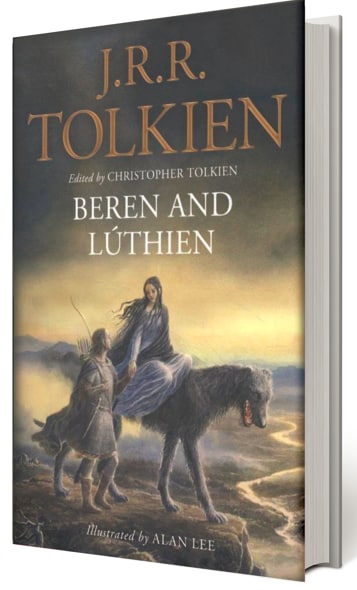
Some of their stories are inspired by the author’s real life too. Take the tale of how Beren, a mortal man, falls in love with Luthien (above). The idea for this story came to Tolkien in 1918, when he was a lieutenant in the British army during World War 1.
He was stationed at Kingston Upon Hull, where he and Edith went for a walk in the woods. There, she danced for him in a clearing full of flowers, and this was the inspiration for the scene in which the mortal Beren sees Luthien (the word means “daughter of flowers” in Tolkien’s Sindarin, the language of the Elves) dancing in the forest and falls in love with her.
44. When Beren asks Luthien’s father Thingol for her hand, Thingol, who isn’t particularly keen on the marriage, sets him a seemingly impossible task: he asks Beren for one of the fabled Silmarils, priceless, magical gems of light, set in the crown of Middle-Earth’s equivalent of Satan, Morgoth. Beren is captured, and it is Luthien who rescues him. Together, they manage to steal a Silmaril from Morgoth’s crown.
45. Tolkien was deeply affected by his wife’s becoming a member of the Catholic Church in order to marry him, against a lot of resistance from family. (She had been a member of the Protestant Church of England). And so, in a monumental sacrifice, Luthien gives up her Elven immortality to be with Beren.
46. Tolkien and his wife Edith are buried side-by-side in Wolvercote Cemetery, Oxford. The tombstone reads
“Edith Mary Tolkien
Luthien
1889-1971
John Ronald Reuel Tolkien
Beren
1892-1973
47. JRR’s brother Hilary Tolkien, meanwhile, lived out his life as a farmer. The brothers remained close all their lives. In 2009, a grandson found an exercise book full of fantasy stories by Hilary, notes on his wartime experiences, and writings about the English countryside, which he had loved. These were published posthumously as Black and White Ogre Country: The Lost Tales of Hilary Tolkien.
48. JRR and Edith, meanwhile, would have four children: John, Michael, Priscilla and Christopher. When Michael joined the army, he listed his father’s occupation as “Wizard”.
49. While Tolkien was a gifted artist, and drew both illustrations and maps for The Hobbit and The Lord of the Rings, it was his son Christopher who did the final maps for the trilogy.
50. British historian Dominic Sandbrook points out: “An amateur psychologist could have a field day with the fact that both JRR Tolkien and Agatha Christie lost parents in their childhood and nursed a sense of loss for the rest of their careers. (Perhaps even more remarkable is the fact that the only writers of their generation to rival them in terms of sales – Enid Blyton, who was born in 1897; Barbara Cartland, who was born in 1901; and of course Catherine Cookson, born in 1906 – all had similar memories of loss and upheaval. Cookson hated her mother and never knew her father, Blyton’s father walked out when she was 13, and Cartland’s father was killed in Flanders when she was a teenager.)”


