
 E-Paper



A for anxious, B for Blue?: How children are coping in our polycrisis world

 Prefer HTon Google


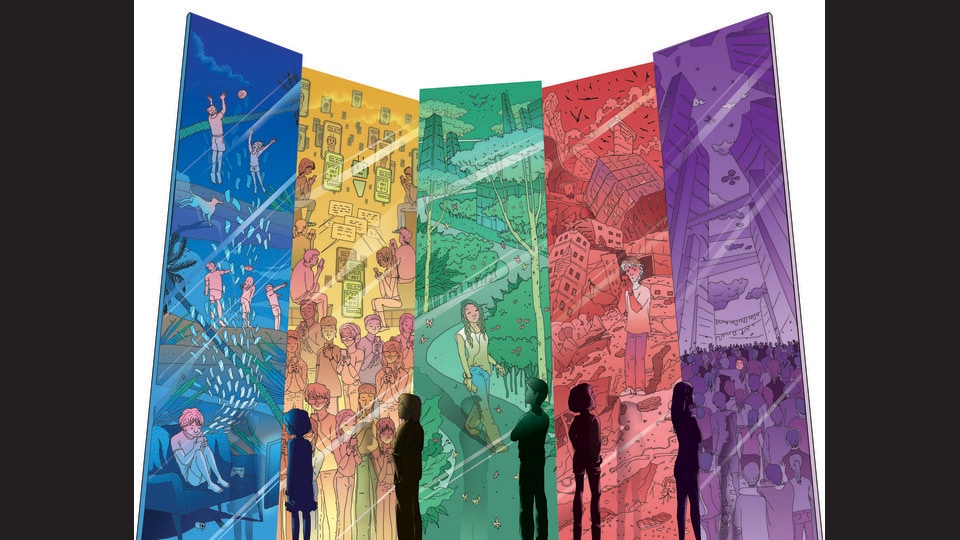
Studies show loneliness is up; the future is seen as uncertain (but still a place of hope). What else? Kashyap Kompella, an analyst and father, takes a look.
At 13, Akbar became the Mughal emperor (though a regent initially governed on his behalf).
At 18, the young Macedonian Alexander was leading soldiers into battle.
Today, children around the world still work in fields, workshops and homes; or as models, entertainers and performers on reality shows.
There has never been a universal experience of childhood.
Many care for siblings or do a substantial share of household work. Pure chance — in the form of class, gender, geography etc — determines how much freedom, protection and choice a child will have.
This essay is chiefly about a narrow group: urban middle-class Indian children, whose families have the means to plan and invest heavily in their future.
For them, childhood has become one long phase of intense preparation. This is progress, in many ways. But it comes with the burden of growing expectation.
It is not enough to graduate and earn a living; one must justify years of investment by earning well, chasing excellence and following a never-ending breadcrumb trail of goals and targets.
Meanwhile, as the rate of change accelerates, each target shifts around the scoreboard like one of those captcha puzzles that simply won’t let you be human.
It’s no wonder the children are anxious, we say. But must they be so sensitive, so distracted, so attached to their phones? It wasn’t this hard raising us, we say.
So, have children changed as much as we think?
THE CURSE OF ETERNAL LIFE
In some ways, yes, they have. How could they not, given the world we have made for them?
This is the first generation to know what it feels like to have cameras potentially watching them since birth: as infants and through their awkward years, during moments of embarrassment and heartbreak, while dancing, driving, swimming or crying.
The consequences can be swift and merciless. The evidence doesn’t go away.
A child growing up in the 1990s might have been hurt to discover, a day later, that classmates attended a party without them. Today, they can watch the party unfold in real time.
Earlier generations competed with classmates, cousins or the neighbours’ children. Now, they can compare themselves with teen influencers and strangers around the world, nudged by powerful algorithms to do just that, and feel inadequate.
Every foolish remark and impulsive text can survive in clips, boomerangs, group chats and screenshots.
On the plus side, the language of feeling and community has changed. The internet lets children maintain friendships across distances and find people who share interests few others understand. (Though this comes with risks of its own.)
As the vocabulary around mental health expands, and biases are challenged, today’s young people talk more readily about anxiety, trauma, boundaries and distress.
Sadly, they have plenty of reasons to feel anxious and distressed. Their world is more complex and fast-changing than the one their parents or grandparents grew up in.
They live amid a climate crisis, faltering institutions and economies that can be shaken by events on another continent. They are old enough to understand that they will inherit these troubles, but still too young to do much about them.
(Click here for an overview of recent findings on the anxiety and loneliness this can cause.)
THE INDIA STORY
A key factor at play in urban India is the shrinking size of the average family.
Households with four or five children, common in previous generations, are rare today.
Fewer offspring can mean more time, money and attention for each one. The gains are substantial: better care, education and individual support. Yet, so much hope can rest on these offspring that attention can turn to scrutiny, leaving little room for individuality.
As investments mount and checklists start to loom, childhood can become less an experience and more a project to be managed. The line between wanting the best for a child and wanting each child to be the best begins to blur.
By their pre-teen years, many are expected to start building a “profile”: advanced courses, books or coding projects, internships, community work, competitions, leadership positions, sports, essays and recommendations. This is what we once expected of postgraduate applicants in their 20s.
Call it the Headstart Paradox: when every child gets a head start, the starting line moves, and it can become harder to stand out. Yesterday’s advantage becomes today’s expectation.
As entire industries promise to make your child exceptional, the obvious questions rear their heads: Where does the average fit in? And “exceptional” compared with whom?
QUESTIONS, AND ANSWERS?
It is tempting to point the finger at parents, but they did not create the world — defined by late-stage capitalism and the rise of AI — that their children inhabit.
They too, in fact, struggle to keep up.
“How much screen time?” has acquired a newer companion: “How much access to AI?” For an older child, a total ban may be neither realistic nor useful.
How much privacy? Here too, none is a bad answer.
Smartphones, videogames and social media are convenient villains. But how else is a child to spend their time, in cities with few parks, open spaces or other safe spaces?
Parents must somehow navigate these, regulate technology, preserve privacy, encourage independence, prevent harm; and keep watch without appearing to watch.
Meanwhile, the big questions loom too: How ambitious should a child be? When does encouragement become pressure?
How is one to manage all this while juggling work, homemaking, loans, caring for parents and caring for oneself, without falling apart? The answer here is that there isn’t one.
Parenting was always hard. It wasn’t always this draining.
We must now run as fast as we can, just to stay in place.
NOW LISTEN...
Back to the kids, how are they faring, amid it all?
A 2022 survey of nearly 380,000 students in Classes 6 through 12, conducted by the National Council of Educational Research and Training (NCERT), found that studies and exams were major sources of anxiety.
In another key finding, about 27% reported feeling lonely two or three times a week. Yet nearly three-quarters reported being satisfied with their school life.
These are children who admit to feeling ambitious and afraid, well-supported and lonely, hopeful and anxious about the future. There is a tendency to respond to this complexity by oversimplifying the present: just focus on the next exam; try not to overanalyse everything; toughen up.
A more honest way forward might be to admit that we simply don’t know what this version of childhood feels like.
Perhaps, as we measure their achievements, monitor their habits and worry about their future, we could explore what matters to them: friendships, freedom, hopes for tomorrow, and fears about a future none of us can predict.
Without that honest discourse, what we have is an elaborate system designed to maximise their potential, and a growing concern that they might not live up to it. If that’s what we call the best possible childhood, one wonders what a bad one would look like.
(Kashyap Kompella is a tech-industry analyst, author and father)


