
 E-Paper



An app shows how ancient Greek sites looked thousands of years ago. It's a glimpse of future tech

 Prefer HTon Google


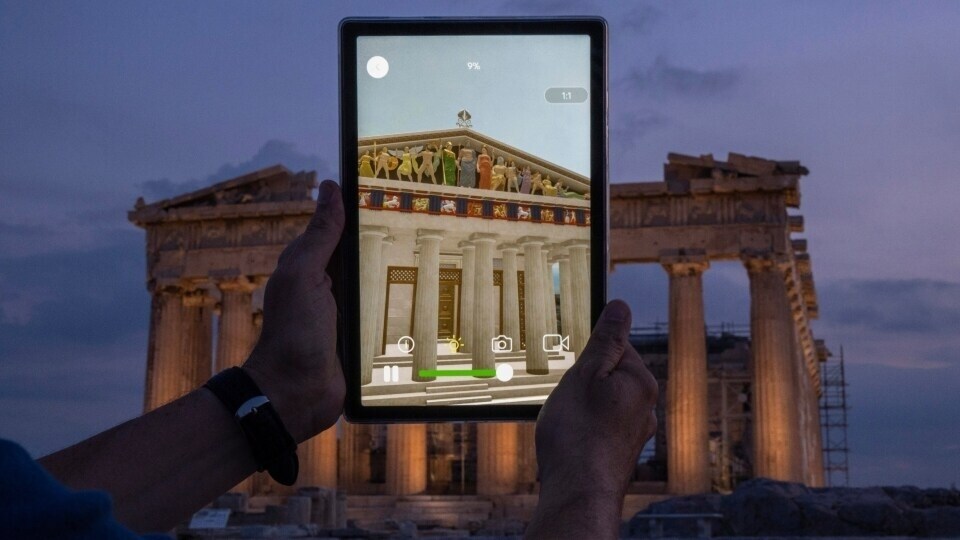
The app, called Chronos, uses augmented reality to place the ancient impression of the site onto the screen, matching the real-world view as you walk around.
Tourists at the Acropolis this holiday season can witness the resolution of one of the world’s most heated debates on cultural heritage. All they need is a smartphone. (Also Read | India biennale: British-era barracks at Red Fort to host exhibitions; launch of graphic novel on architecture)
Visitors can now pinch and zoom their way around the ancient Greek site, with a digital overlay showing how it once looked. That includes a collection of marble sculptures removed from the Parthenon more than 200 years ago that are now on display at the British Museum in London. Greece has demanded they be returned.
For now, an app supported by Greece’s Culture Ministry allows visitors to point their phones at the Parthenon temple, and the sculptures housed in London appear back on the monument as archaeologists believe they looked 2,500 years ago.
Other, less widely known features also appear: Many of the sculptures on the Acropolis were painted in striking colors. A statue of goddess Athena in the main chamber of the Parthenon also stood over a shallow pool of water.
“That's really impressive ... the only time I've seen that kind of technology before is at the dentist,” Shriya Parsotam Chitnavis, a tourist from London, said after checking out the app on a hot afternoon at the hilltop Acropolis, Greece's most popular archaeological site.
“I didn't know much about the (Acropolis), and I had to be convinced to come up here. Seeing this has made it more interesting — seeing it in color,” she said. “I'm more of a visual person, so this being interactive really helped me appreciate it.”
The virtual restoration works anywhere and could spare some visitors the crowded uphill walk and long wait to see the iconic monuments up close. It might also help the country's campaign to make Greek cities year-round destinations.
Tourism, vital for the Greek economy, has roared back since the COVID-19 pandemic, even as wildfires chased visitors from the island of Rhodes and affected other areas this summer. The number of inbound visitors from January through July was up 21.9% to 16.2 million compared with a year ago, according to the Bank of Greece. Revenue was up just over 20%, to 10.3 billion euros ($10.8 billion).
The app, called “Chronos” after the mythological king of the Titans and Greek word for “time,” uses augmented reality to place the ancient impression of the site onto the screen, matching the real-world view as you walk around.
AR is reaching consumers after a long wait and is set to affect a huge range of professional and leisure activities.
Medical surgery, military training and specialized machine repair as well as retail and live event experiences are all in the sights of big tech companies betting on a lucrative future in immersive services. Tech giant like Meta and Apple are pushing into VR headsets that can cost thousands of dollars.
The high price tag will keep the cellphone as the main AR delivery platform to consumers for some time, said Maria Engberg, co-author of the book “Reality Media” on augmented and virtual reality.
She says services for travelers will soon offer a better integrated experience, allowing for more sharing options on tours and overlaying archive photos and videos.
“AR and VR have been lagging behind other kinds of things like games and movies that we’re consuming digitally,” said Engberg, an associate professor of computer science and media technology at Malmo University in Sweden.
“I think we will see really interesting customer experiences in the next few years as more content from museums and archives becomes digitized,” she said.
Greece’s Culture Ministry and national tourism authority are late but enthusiastic converts to technology. The popular video game Assassin’s Creed Odyssey, which allows players to roam ancient Athens, was used to attract young travelers from China to Greece with a state-organized photo contest.
Microsoft partnered with the Culture Ministry two years ago to launch an immersive digital tour at ancient Olympia, birthplace of the Olympic Games in southern Greece.
Culture Minister Lina Mendoni said the innovations would boost accessibility to Greece’s ancient monuments, supplementing the recent installation of ramps and anti-slip pathways.
“Accessibility is extending to the digital space,” Mendoni said at a preview launch event for the Chronos app in May. “Real visitors and virtual visitors anywhere around the world can share historical knowledge.”
Developed by Greek telecoms provider Cosmote, the free app's designers say they hope to build on existing features that include an artificial intelligence-powered virtual guide, Clio.
“As technologies and networks advance, with better bandwidth and lower latencies, mobile devices will be able to download even higher-quality content,” said Panayiotis Gabrielides, a senior official at the telecom company involved in the project.
Virtual reconstructions using Chronos also cover three other monuments at the Acropolis, an adjacent Roman theater and parts of the Acropolis Museum built at the foot of the rock.


