
 E-Paper



Chalk and awe: A Teachers' Day tribute by Poonam Saxena

 Prefer HTon Google


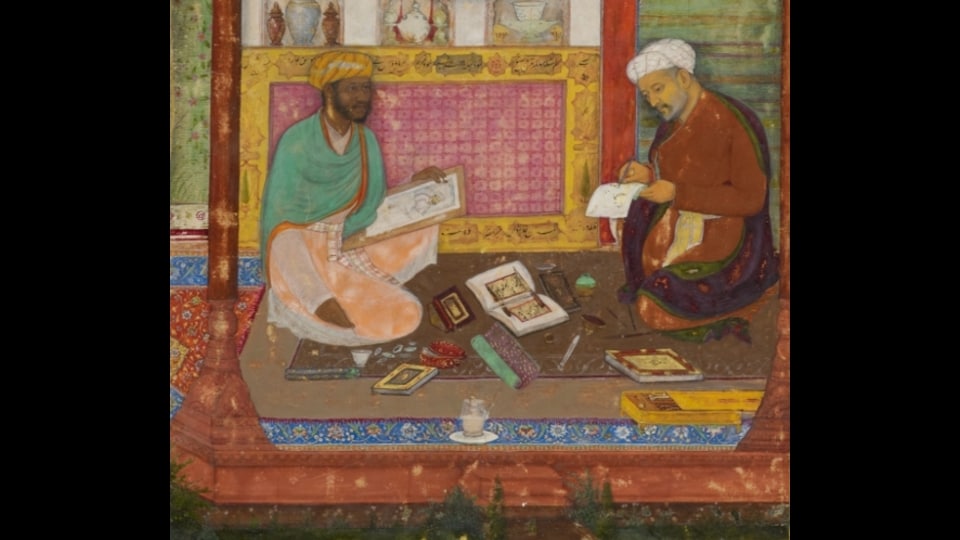
It’s easy to forget the debt we owe our teachers. So I’ve been re-reading a gentle Hindi tale, Rin, which traces loops of gratitude, regard, memory, affection.
In these days of doomscrolling, I often crave a short story or novel that will warm the heart.
If I can’t find one from recent times, fiction often being as gloomy as the times it’s written in, I go back to old favourites, to feel at least momentarily uplifted.
Rin (Debt) is one such short story, particularly apt for Teachers’ Day (September 5). The writer, Badiuzzaman (1928 - 1986), was introduced to me by his son, Shazi Zaman, a journalist and accomplished Hindi writer himself. He gave me a volume of short stories by his father, and that’s how I read Rin.
The story is in the first person and begins with an unnamed narrator remembering how his Abbajan, a teacher, once taught English and arithmetic to a small group of students at home in his spare time. He took a fee from those who could afford it, but taught the poor students free.
Seventeen-year-old Ramkishan, preparing for his matriculation exam, is in the latter category. The narrator, then a mischievous five-year-old, is fond of playing pranks on his father’s students, and Ramkishan becomes a favourite target.
Then, one day, the serious young man arrives with a box of sweets. He has passed his exam with excellent marks. He wants to study further in Patna, but doesn’t have the admission fees. Abbajan gives him fifty rupees, and he manages to enrol.
Whenever Ramkishan returns for a visit, he never forgets to visit his erstwhile teacher.
Time passes. The narrator grows up. Ramkishan marries. He returns from Patna and begins to teach at a local school. He would have liked to do a BA but, once again, money problems hold him back.
One day, Abbajan tells him, “My son’s schoolwork is not going well. Can you take some time out for him?” And so Ramkishan becomes the narrator’s teacher. He is strict and exacting. The narrator, who had once teased and troubled him, now regards him with some fear.
At the end of the first month, when Abbajan tries to give him ten rupees as a fee (quite a lot of money at the time), Ramkishan is distraught and refuses to take it. After a great deal of persuasion, he reluctantly accepts the money.
Whenever Abbajan looks at this young man, his chest swells with pride and happiness. It is as if a sapling he planted himself has grown big and strong.
Ramkishan has been teaching for four years when Abbajan suddenly dies. The young man is inconsolable, and cries as the body of his teacher is lowered into the ground. He continues to teach the narrator, but refuses to take the monthly fee from the boy’s mother.
The narrator finishes school, leaves home to study further. He graduates and wants to take the civil services exam, but money is tight. So he begins to teach too. He stays in touch with Ramkishan, and hears one day that Master Saab is very ill. He rushes to see him. It’s pneumonia. His teacher is gone within a week.
The narrator accompanies the body to the cremation ground. He seems to see Master Saab’s face aglow with a soft radiance, the goodness of his soul shining through. It is the same kind of radiance he saw on his Abbajan’s face, he says.
He had hoped that he would teach Master Saab’s children someday. Now the opportunity will never come. His wife and children have left to live with her brother in another city.
Shazi tells me that this gentle, evocative story was autobiographical. Badiuzzaman once read it out on All India Radio on Teachers’ Day, with the title Hamare Master Saab.
Badiuzzaman was born in Gaya and did a double MA, in Hindi and Urdu. He taught Urdu at a college in Odisha in the 1950s, then moved to Delhi to work with the Government of India’s department of languages for over three decades. He was fluent in Hindi, Urdu, English and Odia. He was closely associated with the Progressive Writers’ Movement, but never bound by any dogma.
He was a dispassionate yet empathetic observer of religion and history. Part of a generation that saw the breakup of the country and the breakdown of extended families. As Shazi put it, “He gave this sorrow a voice.” A deeply human voice.
His Chhako ki Vapsi is one of the great Hindi Partition novels.
Shazi remembers his father writing amid the chaos of a small, two-room flat in Kidwai Nagar. When the family moved to a spacious bungalow on Rouse Avenue, his writing ironically dwindled. Shazi would nag him about this, but he would just smile and light a cigarette. His belief was: If you can think freely, and if you have freedom of thought, isn’t that the most important thing?
If there was one flaw in his personality, Shazi says, it’s that he never publicised his work. “He didn’t get the recognition he deserved.”
Perhaps it’s time to rectify that.
(Email poonamsaxena3555@ gmail.com. The views expressed are personal)


