With the force of inevitability, we can expect the new year to bring new sporting records.
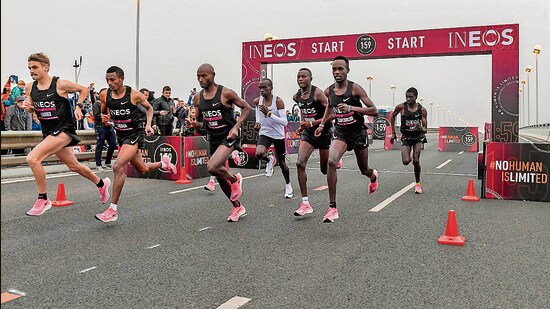
Kipchoge (in white) runs in his Nike Vaporfly shoes, shielded from wind resistance by other runners. (Photo via Ineos)
Who would bet against Armand Duplantis bettering his own world record for the 11th time in the pole vault? Or Sydney Mclaughlin-Levrone breaking her 400m hurdles record for the seventh time, and pushing her run time closer to the improbable 50 seconds?
Running defines the limits of the human body in ways that few other sporting disciplines do, and so it is in the world of running that we get our clearest view of how sports science is pushing the edges of what is possible too.
Just think of the Dutch Sifan Hassan winning bronze in the 5,000m and 10,000m races at the Paris Olympics and topping that off with gold in the marathon, with a time (2:22:55) that set a new Olympic record.
Of the three great limits that have defined running in the modern era, in fact, only one still stands. Two were broken a long time ago. England’s Roger Bannister became the first athlete to run the mile in under four minutes, in 1954. And Jim Hines became the first to break the 10-second barrier in a 100m dash, in 1968. (Scores have replicated the two feats since.)
The one barrier still standing is the sub-two-hour marathon.
For as long as the marathon has existed, running it under two hours has been seen as an impossibility. The human body, it was thought, simply could not sustain the speeds this required, over the distance of more than 42 km.
Yet, over the past decade, that iron barrier has appeared more and more as if it were made of glass. In 2023, the Kenyan Kelvin Kiptum set a new world record with a blazing, hard-to-comprehend 2 hours and 35 seconds, in Chicago. His death in a car accident last year has left the sport without the man who would most likely have breached the two-hour barrier in competition. But there is every indication that it will crash soon, as sports science zooms in closer on what it can do to help.
The top 20 marathon times of all time, after all, have been set over the past decade. In that period, the record for a men’s marathon has dropped below 2 hours and 3 minutes, then below 2 hours and 2 minutes, and finally to Kiptum’s whisper-short-of-the-impossible.
A big boost has come from innovations in running-shoe design.
Scientists and engineers have worked furiously, backed by large corporations, to offer every advantage that could possibly help an athlete run faster. Shoes are far more aerodynamic; certain soles can absorb some of the force dissipated by contact with the ground, and direct it back to the runner.
This helped the Kenyan Eliud Kipchoge run a marathon distance in 1 hour and 59 minutes, in 2019.
Already the holder of the marathon world record at the time (2:01:39), Kipchoge ran a race optimised entirely to try and achieve the sub-two-hour mark. It was held on a flat track, at almost-sea-level (which helps with oxygen availability), on a day that met all the precalculated markers for “just right” (not too hot, cold, dry or humid).
Other athletes were used to block off wind resistance. Kipchoge’s diet and hydration was monitored minutely before and during. And he was given specially designed shoes. (Nike’s Vaporfly, which absorb and redirect energy from ground contact, but are not allowed in races because they aren’t available to the general public.)
None of this takes anything away from the fact that he did it; achieved a feat thought to be physiologically impossible under any conditions.
The marathon, of all races, is not really designed for setting records. It isn’t even run on a standardised track. So results have a lot to do with the interplay of runner, route (elevations, surfaces, twists and turns) and weather.
I, for one, can’t wait for the two-hour barrier to be officially breached, so we can all go back to simply enjoying the spectator experience, as each runner pits body and mind against the path.
(To reach Rudraneil Sengupta with feedback, email rudraneil@gmail.com)

 E-Paper