
 E-Paper



World's largest hand-tufted carpet: How the artisans of India's ‘carpet city’ Bhadohi built a Guinness World Record
Bhadohi, India’s Carpet City, blends centuries-old craftsmanship with global luxury, showcasing skill, world records, and carpets as modern design statements.

 Prefer HTon Google


The story of Indian carpets has always been fascinating. It began with the Mughals, especially during Akbar’s reign, when Persian artisans arrived with their knotting techniques, designs, and philosophy of carpet-making. Over time, these methods transformed into a unique Indo-Persian style that became the foundation of India’s handmade carpet tradition.

Experiencing Bhadohi firsthand and witnessing the celebration of the Guinness World Record brought this history to life. Seeing artisans at work and the scale of their achievement make one realise how centuries of skill continue to thrive today.
Bhadohi: From a quiet town to the carpet capital of the world
Bhadohi might seem like a quiet, tucked-away town in Uttar Pradesh, but its influence in the world of carpets is enormous. Known as the Carpet City of India, it has shaped design conversations across the globe for generations. Families have been weaving for decades, passing down skills from one generation to the next. In the workshops, every knot, tuft, and design carries years of devotion and precision. Witnessing a community so committed to keeping a centuries-old craft alive while making a global name for itself was humbling.
The Guinness carpet: Achieving the impossible
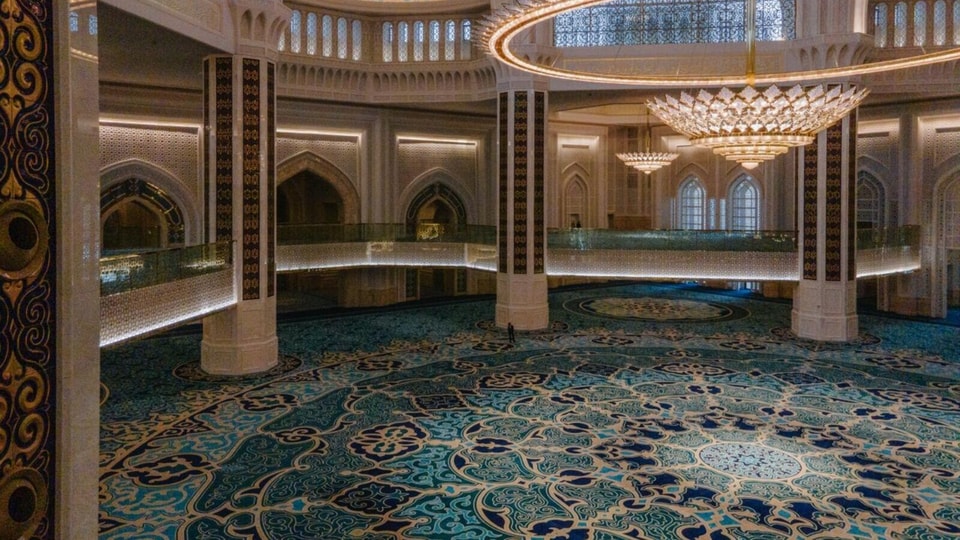
Watching Bhadohi claim a Guinness World Record for the world’s largest hand-tufted carpet was unforgettable. The award went to Patodia Contract, the team behind this extraordinary achievement. The carpet covers over 12,400 square meters, with a medallion 70 meters across, created for the Astana Grand Mosque in Kazakhstan. Hundreds of artisans worked for months, hand-tufting, clipping, washing, stretching, and installing each section. The project was a testament to patience, skill, and human effort.
Ravi Patodia told HT Lifestyle in an interview, “We are a third-generation company. What my father started in 1970 with me is now run alongside my sons, and soon my grandson will join. We call carpets the fifth wall of the house. They are not just decor but add comfort and a new dimension to any space. Today, a carpet is about design, colour, and matching your decor. We have adapted with time and now create new designs and varieties to meet global tastes.”
This achievement showed how tradition and modern capability can come together on a global scale.

The craft, the artisan, and global platforms
What truly struck me as poetic in Bhadohi was the people behind the carpets. Watching artisans at work, you realise how much skill, patience, and years of practice go into every piece.
Ganesh Maurya, who has been working as a weaver for the past 20 years in the carpet industry, told HT Lifestyle, “It took me a month to really learn. You have to plan the size, the pattern, everything carefully. Even a small section takes around ten days to complete.”
Golu, another weaver with 14 years' experience, shared, “I learned the craft from a travelling carpet maker in my village and then moved to Bhadohi for better opportunities. I have been weaving for this brand for over ten years.”

These carpets are living traditions. I watched artisans hand-tuft, clip, and stretch each section with a focus that made even the smallest detail matter. The patterns slowly emerged under their hands, precise and alive, showing the skill and care passed down through generations.
The Kazakhstan commission: A monumental feat
One of the most impressive projects in Bhadohi was the commission for the Astana Grand Mosque in Kazakhstan. Patodia Contract created the world’s largest hand-tufted carpet, covering 12,464 square meters with a 70-meter medallion. From spinning yarn to hand-tufting, clipping, washing, stretching, and installing, every step demanded precision and teamwork. The design, inspired by the mosque gardens and central courtyard, had to fit seamlessly within the architecture. Watching artisans translate such immense, intricate designs into a flawless carpet was a testament to centuries of skill and innovation.

From cottage to corporate luxury
Seeing the scale of the carpet industry highlighted the beauty of India’s handicraft sector. We often celebrate grassroots artisans, but witnessing this craft reach global platforms was eye-opening. Here, artisans are trained, employment is generated, and art forms are preserved. Centuries-old skills now thrive in luxury markets, reaching high-end residences, hotels, and palaces.
Ravisha Merchant, an Interior designer who sources from multiple brands in Bhadohi, told HT Lifestyle, “Carpets now are a medium to tell a story. They are not just for the floor—they can reflect your personality and transform a space with concept and thought.”
Aditi Taran, who is redefining spaces through decor and smart sourcing, added, “While I prefer connecting with showrooms directly, it is always a treat to feel the fabric and know it comes from clusters and towns. It shows what our country is building.”

This scale ensures livelihoods for artisans and their families while contributing to economic growth. It’s inspiring to see local art dominate international platforms, preserving tradition while adapting to a rapidly changing global world.
(The writer travelled to Bhadohi on an invitation from Hands Carpets.)
Similar articles for you
How rugs can transform your home into a cosy and stylish space
10 popular Indian art forms you can use in your home decor
Why vintage decor is making a comeback: Textile museum designer Ravisha Merchant weighs in
8 easy ways to use mirrors to make a small space look bigger
Colour theory for your home: How to set the mood with the right palette
The author of this article holds a Master's Degree in Interior Design and has spent over a decade in research, teaching, and designing homes from scratch.


