
 E-Paper



For first time in 8 years, Maharashtra pollution board calls off annual pre-Diwali firecracker noise, smoke testing exercise
Even as there has been no reduction in availability of firecrackers in markets this year, the Maharashtra Pollution Control Board (MPCB) has decided not to go ahead


Even as there has been no reduction in availability of firecrackers in markets this year, the Maharashtra Pollution Control Board (MPCB) has decided not to go ahead with its annual pre-Diwali exercise to monitor noise and amount of smoke in firecrackers in 2020.
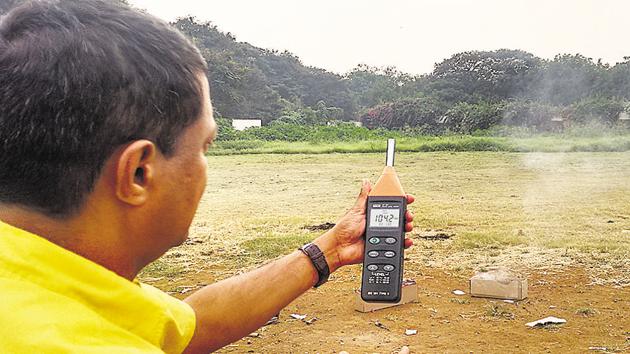
The pollution control body, cited the National Green Tribunal (NGT) order published on Monday, that allowed cities like Mumbai with ‘moderate’ air quality (during November 2019) to allow the use of green crackers during major festivals this year and within a specific time-frame during each festival when fireworks could be used by citizens.
MPCB with anti-noise campaigners Awaaz Foundation have been jointly conducting the firecracker testing study that calculates noise levels and for the past few years have also been detecting the quantity of smoke emitted by firecrackers sold in markets. Those fireworks violating noise norms or emitting large amounts of smoke are recommended to be banned by MPCB to the controller of explosives, Nagpur, Petroleum and Explosives Safety Organisation.
The monitoring study has been undertaken since 2005 on a biannual basis, but from 2012 onwards it was being done annually. The testing was annually done in an open ground in Rashtriya Chemical and Fertiliser (RCF) colony, Chembur.
“It will not be possible to conduct the exercise this close to Diwali as by the time we send the recommendations, it would be time for the festival,” said SC Kollur, chief scientist, MPCB, adding that the firecracker testing this year was originally scheduled on November 5, but had to be cancelled in light of orders anticipated from NGT. “Also, the NGT order clearly indicates the availability of voluminous data for noise and smoke levels with the Central Pollution Control Board,” said Kollur.
Awaaz Foundation said the exercise had been successful resulting in a reduction in noise levels of firecrackers from over 140dB to 126dB (close to the noise norms) and better enforcement of noise rules over the years. “It is disappointing that the testing will not be conducted this year for the first time in eight years. It has created public awareness and policy change,” said Sumaira Abdulali, convener, Awaaz Foundation adding, that since firecrackers, which are still permitted for manufacture are used at other times of the year and all over the country, the results of the test extend beyond Diwali. “I hope the test will be held immediately after Diwali and will help inform how future celebrations are conducted until such time as manufacture of all crackers except green crackers are completely banned,” she said.
Last year, three firecrackers were recommended to be banned by MPCB, including a pack of 16 sky shots (crackling delight from Ajanta Fireworks) which recorded 126 decibels (dB) (as loud as a thunderclap). A series of crackers (5,000 series) called Celebration Akira 5000 recorded 121.3dB, while a 1,000 series from Guru Fireworks recorded 113.6 dB. The testing last year also recorded noise levels from a green cracker (108.3 dB against the safe limit of 125 dB). Green crackers have 30% less emissions than traditional ones with no barium nitrate, a metal oxide that increases both air and noise pollution.
The permissible limit for single crackers is 125dB, a series of crackers (ladi), has limits between 90 dB and 110dB depending upon the number of crackers put together.
A PESO official said they would have to check whether the recommendations had been incorporated in their annual report. “However, such exercises create awareness and deterrence against the use of such noisy crackers. We are also able to differentiate between those banned crackers that used to be manufactured in China versus those made in Sivakasi, Tamil Nadu,” the official said.
Meanwhile, Kollur added that MPCB will however monitor noise across all 27 municipal corporations at 158 locations in Maharashtra before and after Diwali, including 10 locations in Mumbai, during the Diwali period. “Guidelines based on the NGT order and air quality classification of cities and towns in Maharashtra will be shared with urban local bodies and state departments. They can decide on a restricted time frame for bursting crackers within their jurisdiction during Diwali and other festivals this year,” he said.
FIRECRACKER TESTING RESULTS OVER THE YEARS
In 2019: Three firecrackers were recommended to be banned by MPCB including a sky-shot (rocket), two series crackers (5000 series and 1000 series) all of which violated noise norms.
In 2018: Two firecrackers, both series crackers (1000 series) were recommended to be banned for violating noise norms.
In 2017: Two crackers - a single cracker (dyno bomb) and a series of crackers (10000 series) - violated noise norms and the state pollution control recommended banning both. There was also a rise in air pollution levels with dust and smoke from various rockets, bombs and new firecrackers being sold in the market.
In 2016: The noisiest firecrackers was the 1000 series at 116.2dB and noise levels from single crackers (thread bombs, atom bomb, double knotted bomb) was highest for ‘thriller bomb’ (atom bomb) at a maximum decibel of 99.9 dB.
In 2015: The noisiest series crackers were measured at 117 dB and single crackers were as loud as 113 dB (thunderbolt atom bomb).
In 2012: 25 firecrackers were tested and all of them breached permissible noise limits.
(Source: MPCB and Awaaz Foundation)
Stay updated with all the Breaking News and Latest News from Mumbai. Click here for comprehensive coverage of top Cities including Bengaluru, Delhi, Hyderabad, and more across India along with Stay informed on the latest happenings in World News.


